

40
C T can be measured accurately using an instrument known as a Single Operator
Multiparameter Metabolic Analyzer (SOMMA). In the world, ocean C T averages
around 2 mmolC.kg
−1
.
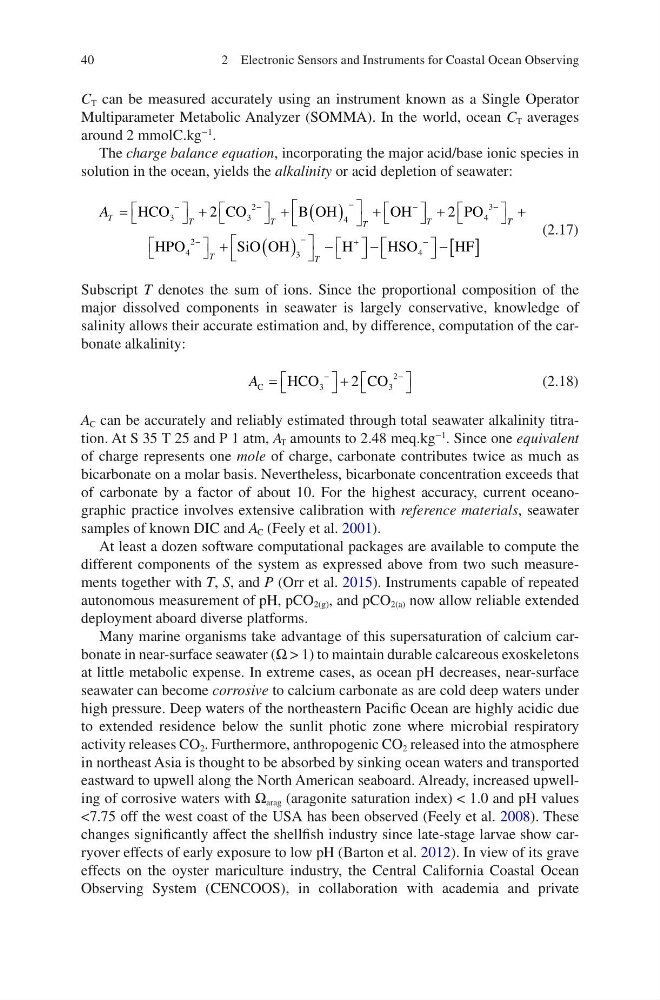
The charge balance equation, incorporating the major acid/base ionic species in
solution in the ocean, yields the alkalinity or acid depletion of seawater:
A T
T
T
T
T
=
+
+ ( )
+
+
−
−
−
−
−
HCO
C O
B OH
OH
PO
3
3
2
4
4
3
2
2
T T
T
T
+
+
( )
− −
− [ ]
−
−
+
−
HPO
S iO OH
H
HSO
HF
4
2
3
4
(2.17)
Subscript T denotes the sum of ions. Since the proportional composition of the
major dissolved components in seawater is largely conservative, knowledge of
salinity allows their accurate estimation and, by difference, computation of the carbonate alkalinity:
A C
HCO
C O
=
+
−
−
3
3
2
2
(2.18)
A C can be accurately and reliably estimated through total seawater alkalinity titration. At S 35 T 25 and P 1 atm, A T amounts to 2.48 meq.kg
−1
. Since one equivalent
of charge represents one mole of charge, carbonate contributes twice as much as
bicarbonate on a molar basis. Nevertheless, bicarbonate concentration exceeds that
of carbonate by a factor of about 10. For the highest accuracy, current oceanographic practice involves extensive calibration with reference materials, seawater
samples of known DIC and A C (Feely et al. 2001).
At least a dozen software computational packages are available to compute the
different components of the system as expressed above from two such measurements together with T, S, and P (Orr et al. 2015). Instruments capable of repeated
autonomous measurement of pH, pCO 2(g) , and pCO 2(a) now allow reliable extended
deployment aboard diverse platforms.
Many marine organisms take advantage of this supersaturation of calcium carbonate in near-surface seawater (Ω > 1) to maintain durable calcareous exoskeletons
at little metabolic expense. In extreme cases, as ocean pH decreases, near-surface
seawater can become corrosive to calcium carbonate as are cold deep waters under
high pressure. Deep waters of the northeastern Pacific Ocean are highly acidic due
to extended residence below the sunlit photic zone where microbial respiratory
activity releases CO 2 . Furthermore, anthropogenic CO 2 released into the atmosphere
in northeast Asia is thought to be absorbed by sinking ocean waters and transported
eastward to upwell along the North American seaboard. Already, increased upwelling of corrosive waters with Ω arag (aragonite saturation index) < 1.0 and pH values
<7.75 off the west coast of the USA has been observed (Feely et al. 2008). These
changes significantly affect the shellfish industry since late-stage larvae show carryover effects of early exposure to low pH (Barton et al. 2012). In view of its grave
effects on the oyster mariculture industry, the Central California Coastal Ocean
Observing System (CENCOOS), in collaboration with academia and private
2 Electronic Sensors and Instruments for Coastal Ocean Observing
C T can be measured accurately using an instrument known as a Single Operator
Multiparameter Metabolic Analyzer (SOMMA). In the world, ocean C T averages
around 2 mmolC.kg
−1
.
The charge balance equation, incorporating the major acid/base ionic species in
solution in the ocean, yields the alkalinity or acid depletion of seawater:
A T
T
T
T
T
=
+
+ ( )
+
+
−
−
−
−
−
HCO
C O
B OH
OH
PO
3
3
2
4
4
3
2
2
T T
T
T
+
+
( )
− −
− [ ]
−
−
+
−
HPO
S iO OH
H
HSO
HF
4
2
3
4
(2.17)
Subscript T denotes the sum of ions. Since the proportional composition of the
major dissolved components in seawater is largely conservative, knowledge of
salinity allows their accurate estimation and, by difference, computation of the carbonate alkalinity:
A C
HCO
C O
=
+
−
−
3
3
2
2
(2.18)
A C can be accurately and reliably estimated through total seawater alkalinity titration. At S 35 T 25 and P 1 atm, A T amounts to 2.48 meq.kg
−1
. Since one equivalent
of charge represents one mole of charge, carbonate contributes twice as much as
bicarbonate on a molar basis. Nevertheless, bicarbonate concentration exceeds that
of carbonate by a factor of about 10. For the highest accuracy, current oceanographic practice involves extensive calibration with reference materials, seawater
samples of known DIC and A C (Feely et al. 2001).
At least a dozen software computational packages are available to compute the
different components of the system as expressed above from two such measurements together with T, S, and P (Orr et al. 2015). Instruments capable of repeated
autonomous measurement of pH, pCO 2(g) , and pCO 2(a) now allow reliable extended
deployment aboard diverse platforms.
Many marine organisms take advantage of this supersaturation of calcium carbonate in near-surface seawater (Ω > 1) to maintain durable calcareous exoskeletons
at little metabolic expense. In extreme cases, as ocean pH decreases, near-surface
seawater can become corrosive to calcium carbonate as are cold deep waters under
high pressure. Deep waters of the northeastern Pacific Ocean are highly acidic due
to extended residence below the sunlit photic zone where microbial respiratory
activity releases CO 2 . Furthermore, anthropogenic CO 2 released into the atmosphere
in northeast Asia is thought to be absorbed by sinking ocean waters and transported
eastward to upwell along the North American seaboard. Already, increased upwelling of corrosive waters with Ω arag (aragonite saturation index) < 1.0 and pH values
<7.75 off the west coast of the USA has been observed (Feely et al. 2008). These
changes significantly affect the shellfish industry since late-stage larvae show carryover effects of early exposure to low pH (Barton et al. 2012). In view of its grave
effects on the oyster mariculture industry, the Central California Coastal Ocean
Observing System (CENCOOS), in collaboration with academia and private
2 Electronic Sensors and Instruments for Coastal Ocean Observing