

39
Despite the buffering properties of the carbonate system, increased CO 2 injection
results in reduced pH and depletion of the carbonate ion at the expense of newly
formed bicarbonate ion. Simple calculations with the above expressions show that,
at the current ocean carbon content and at an assumed pH 8, the ion ratio HCO 3
−
:
CO3 2
=
: CO 2(a) is about 100:10:1 whereas the ratio changes to 100:1:10 upon acidification to pH 7. That is to say that upon acidification bicarbonate concentration is
proportionally affected little since it is the most abundant species but carbonate
decreases dramatically, by a factor of 10 over 1 unit pH change, as carbon dioxide
increases.
In the ocean, acidification threatens one of the most fundamental pillars of plant
and animal life: the calcareous skeleton composed of the mineral salt calcium carbonate (CaCO 3 ). Calcium carbonate in surface seawater is normally supersaturated
(see below), but the degree of saturation varies greatly in the ocean. Thus, under
certain circumstances discussed below, this calcareous skeleton can be subject to
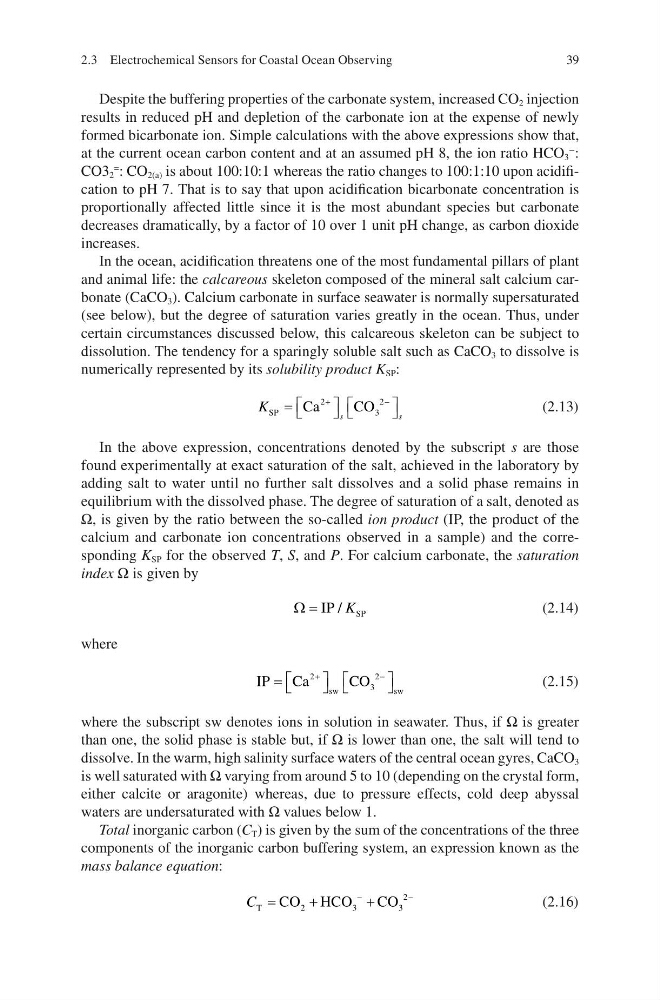
dissolution. The tendency for a sparingly soluble salt such as CaCO 3 to dissolve is
numerically represented by its solubility product K SP :
K
s
s
SP
Ca
CO
=
+
−
2
3
2
(2.13)
In the above expression, concentrations denoted by the subscript s are those
found experimentally at exact saturation of the salt, achieved in the laboratory by
adding salt to water until no further salt dissolves and a solid phase remains in
equilibrium with the dissolved phase. The degree of saturation of a salt, denoted as
Ω, is given by the ratio between the so-called ion product (IP, the product of the
calcium and carbonate ion concentrations observed in a sample) and the corresponding K SP for the observed T, S, and P. For calcium carbonate, the saturation
index Ω is given by
Ω = IP SP
/ K
(2.14)
where
IP
Ca
CO
sw
sw
=
+
−
2
3
2
(2.15)
where the subscript sw denotes ions in solution in seawater. Thus, if Ω is greater
than one, the solid phase is stable but, if Ω is lower than one, the salt will tend to
dissolve. In the warm, high salinity surface waters of the central ocean gyres, CaCO 3
is well saturated with Ω varying from around 5 to 10 (depending on the crystal form,
either calcite or aragonite) whereas, due to pressure effects, cold deep abyssal
waters are undersaturated with Ω values below 1.
Total inorganic carbon (C T ) is given by the sum of the concentrations of the three
components of the inorganic carbon buffering system, an expression known as the
mass balance equation:
C T CO HCO
CO
=
+
+
−
−
2
3
3
2
(2.16)
2.3 Electrochemical Sensors for Coastal Ocean Observing
Despite the buffering properties of the carbonate system, increased CO 2 injection
results in reduced pH and depletion of the carbonate ion at the expense of newly
formed bicarbonate ion. Simple calculations with the above expressions show that,
at the current ocean carbon content and at an assumed pH 8, the ion ratio HCO 3
−
:
CO3 2
=
: CO 2(a) is about 100:10:1 whereas the ratio changes to 100:1:10 upon acidification to pH 7. That is to say that upon acidification bicarbonate concentration is
proportionally affected little since it is the most abundant species but carbonate
decreases dramatically, by a factor of 10 over 1 unit pH change, as carbon dioxide
increases.
In the ocean, acidification threatens one of the most fundamental pillars of plant
and animal life: the calcareous skeleton composed of the mineral salt calcium carbonate (CaCO 3 ). Calcium carbonate in surface seawater is normally supersaturated
(see below), but the degree of saturation varies greatly in the ocean. Thus, under
certain circumstances discussed below, this calcareous skeleton can be subject to
dissolution. The tendency for a sparingly soluble salt such as CaCO 3 to dissolve is
numerically represented by its solubility product K SP :
K
s
s
SP
Ca
CO
=
+
−
2
3
2
(2.13)
In the above expression, concentrations denoted by the subscript s are those
found experimentally at exact saturation of the salt, achieved in the laboratory by
adding salt to water until no further salt dissolves and a solid phase remains in
equilibrium with the dissolved phase. The degree of saturation of a salt, denoted as
Ω, is given by the ratio between the so-called ion product (IP, the product of the
calcium and carbonate ion concentrations observed in a sample) and the corresponding K SP for the observed T, S, and P. For calcium carbonate, the saturation
index Ω is given by
Ω = IP SP
/ K
(2.14)
where
IP
Ca
CO
sw
sw
=
+
−
2
3
2
(2.15)
where the subscript sw denotes ions in solution in seawater. Thus, if Ω is greater
than one, the solid phase is stable but, if Ω is lower than one, the salt will tend to
dissolve. In the warm, high salinity surface waters of the central ocean gyres, CaCO 3
is well saturated with Ω varying from around 5 to 10 (depending on the crystal form,
either calcite or aragonite) whereas, due to pressure effects, cold deep abyssal
waters are undersaturated with Ω values below 1.
Total inorganic carbon (C T ) is given by the sum of the concentrations of the three
components of the inorganic carbon buffering system, an expression known as the
mass balance equation:
C T CO HCO
CO
=
+
+
−
−
2
3
3
2
(2.16)
2.3 Electrochemical Sensors for Coastal Ocean Observing