

95
Alloy formulations are available for a range of applications from freshwater to
seawater progressing from more friable magnesium alloys through mid-range aluminum, to zinc, specified for practical seawater salinity above 30. Sacrificial anode
endurance depends largely on current speed. Care must be taken to protect the junction between anode and subject material with a nonconductive coating such as an
epoxy sealant.
Cathodic protection relying on sacrificial anodes is known as passive protection.
Active or impressed current cathodic protection may prove advantageous for larger
structures such as towers. A direct current electrical (DC) potential is applied to
inert metal cathodes connected to the surface to be protected. Anodes may be graphite or high silicon iron or may consist of platinized copper or copper core titanium
usually shaped as 12 mm diameter rods (Bahador 2014). Reduction of molecular
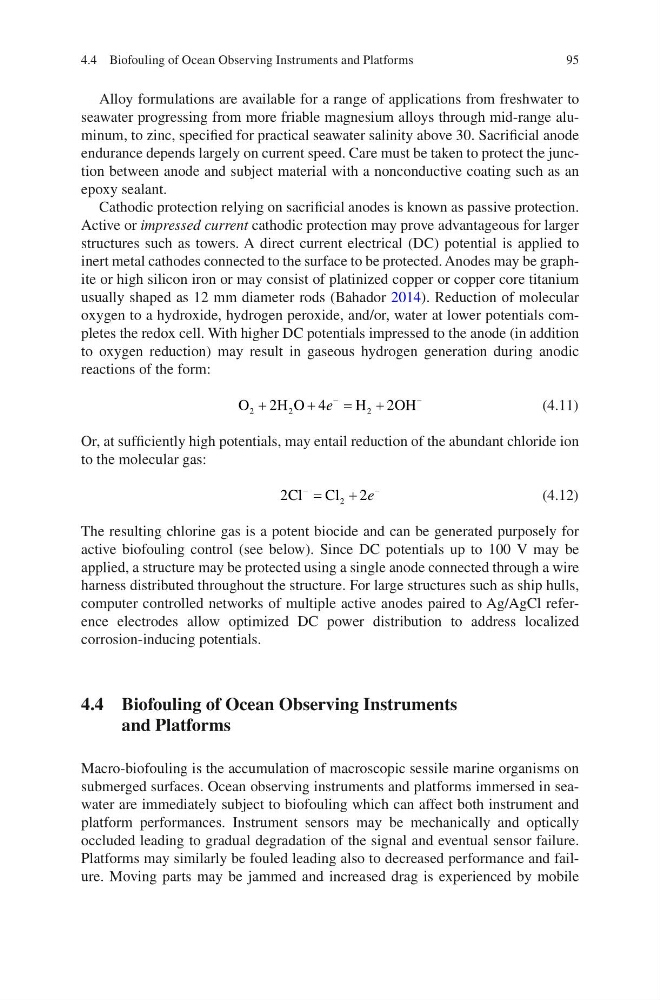
oxygen to a hydroxide, hydrogen peroxide, and/or, water at lower potentials completes the redox cell. With higher DC potentials impressed to the anode (in addition
to oxygen reduction) may result in gaseous hydrogen generation during anodic
reactions of the form:
O
H O
H
OH
2
2
2
2
4
2
+
+
=
+
−
−
e
(4.11)
Or, at sufficiently high potentials, may entail reduction of the abundant chloride ion
to the molecular gas:
2
2
2
Cl
Cl
−
−
=
+ e
(4.12)
The resulting chlorine gas is a potent biocide and can be generated purposely for
active biofouling control (see below). Since DC potentials up to 100 V may be
applied, a structure may be protected using a single anode connected through a wire
harness distributed throughout the structure. For large structures such as ship hulls,
computer controlled networks of multiple active anodes paired to Ag/AgCl reference electrodes allow optimized DC power distribution to address localized
corrosion- inducing potentials.
4.4 Biofouling of Ocean Observing Instruments
and Platforms
Macro-biofouling is the accumulation of macroscopic sessile marine organisms on
submerged surfaces. Ocean observing instruments and platforms immersed in seawater are immediately subject to biofouling which can affect both instrument and
platform performances. Instrument sensors may be mechanically and optically
occluded leading to gradual degradation of the signal and eventual sensor failure.
Platforms may similarly be fouled leading also to decreased performance and failure. Moving parts may be jammed and increased drag is experienced by mobile
4.4 Biofouling of Ocean Observing Instruments and Platforms
Alloy formulations are available for a range of applications from freshwater to
seawater progressing from more friable magnesium alloys through mid-range aluminum, to zinc, specified for practical seawater salinity above 30. Sacrificial anode
endurance depends largely on current speed. Care must be taken to protect the junction between anode and subject material with a nonconductive coating such as an
epoxy sealant.
Cathodic protection relying on sacrificial anodes is known as passive protection.
Active or impressed current cathodic protection may prove advantageous for larger
structures such as towers. A direct current electrical (DC) potential is applied to
inert metal cathodes connected to the surface to be protected. Anodes may be graphite or high silicon iron or may consist of platinized copper or copper core titanium
usually shaped as 12 mm diameter rods (Bahador 2014). Reduction of molecular
oxygen to a hydroxide, hydrogen peroxide, and/or, water at lower potentials completes the redox cell. With higher DC potentials impressed to the anode (in addition
to oxygen reduction) may result in gaseous hydrogen generation during anodic
reactions of the form:
O
H O
H
OH
2
2
2
2
4
2
+
+
=
+
−
−
e
(4.11)
Or, at sufficiently high potentials, may entail reduction of the abundant chloride ion
to the molecular gas:
2
2
2
Cl
Cl
−
−
=
+ e
(4.12)
The resulting chlorine gas is a potent biocide and can be generated purposely for
active biofouling control (see below). Since DC potentials up to 100 V may be
applied, a structure may be protected using a single anode connected through a wire
harness distributed throughout the structure. For large structures such as ship hulls,
computer controlled networks of multiple active anodes paired to Ag/AgCl reference electrodes allow optimized DC power distribution to address localized
corrosion- inducing potentials.
4.4 Biofouling of Ocean Observing Instruments
and Platforms
Macro-biofouling is the accumulation of macroscopic sessile marine organisms on
submerged surfaces. Ocean observing instruments and platforms immersed in seawater are immediately subject to biofouling which can affect both instrument and
platform performances. Instrument sensors may be mechanically and optically
occluded leading to gradual degradation of the signal and eventual sensor failure.
Platforms may similarly be fouled leading also to decreased performance and failure. Moving parts may be jammed and increased drag is experienced by mobile
4.4 Biofouling of Ocean Observing Instruments and Platforms