

94
Cathodic Protection
Cathodic protection is a technology designed to render metal-containing structures
impervious to electrolytic corrosion by providing an alternate electron source for
oxygen reduction (Brown 1969; Horne 1969). Since corrosivity increases as the
redox potential of the individual metal/seawater half cells diverges, it is also standard
practice to affix an easily corroded metal, usually zinc, to the structure to be protected. The zinc here constitutes a sacrificial anode designed to be lost in place of the
protected cathodic structure through which the electrons from the corroded anode
flow to satisfy the electron demand of dissolved oxygen as per reactions 4.2 and 4.3.
Larger structures such as ocean towers may be provided with active cathodic
protection using DC powered cathodes. For smaller scale applications such as
instruments and vehicles, sacrificial anodes provide an economical solution. Alloy
formulations for use as sacrificial anodes are designed to purposely corrode when
affixed to the structure of interest by creating a galvanic pair thus protecting instruments and platforms containing metal parts. In practice, various solid metal alloy
shapes are fitted to the application. Solid cylinders or flat ingots may be bolted to
carousels or buoy infrastructure; toroidal shapes may be clamped to instrument
cages; finger anodes inserted in the cooling manifolds are common to raw seawater
cooled diesel engines. Smaller units distributed throughout the structure prove to be
more effective than massive single units since current flow is dispersed avoiding
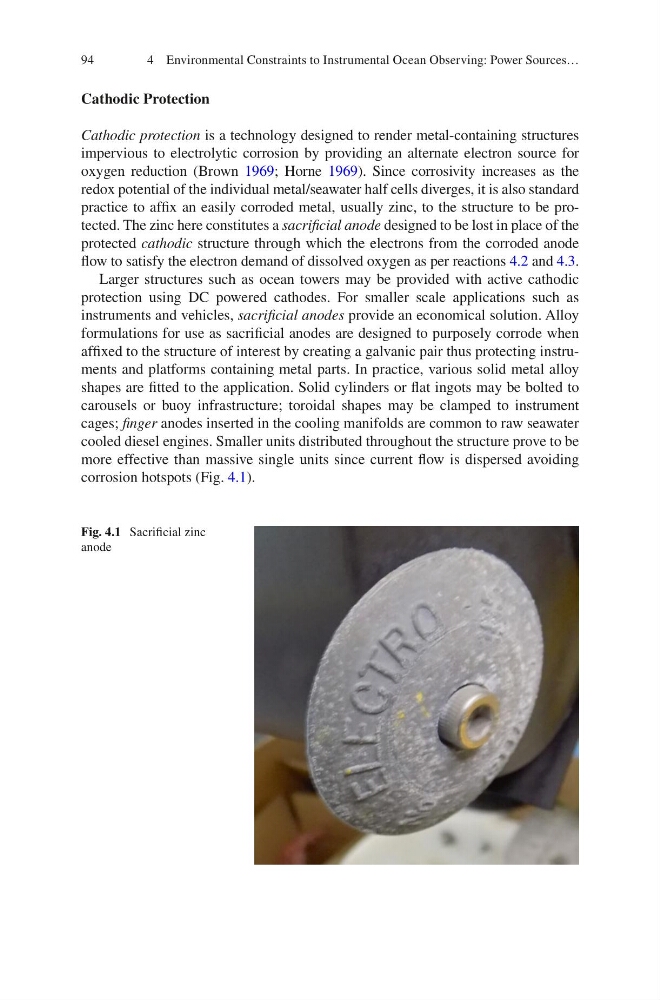
corrosion hotspots (Fig. 4.1).
Fig. 4.1 Sacrificial zinc
anode
4 Environmental Constraints to Instrumental Ocean Observing: Power Sources…
Cathodic Protection
Cathodic protection is a technology designed to render metal-containing structures
impervious to electrolytic corrosion by providing an alternate electron source for
oxygen reduction (Brown 1969; Horne 1969). Since corrosivity increases as the
redox potential of the individual metal/seawater half cells diverges, it is also standard
practice to affix an easily corroded metal, usually zinc, to the structure to be protected. The zinc here constitutes a sacrificial anode designed to be lost in place of the
protected cathodic structure through which the electrons from the corroded anode
flow to satisfy the electron demand of dissolved oxygen as per reactions 4.2 and 4.3.
Larger structures such as ocean towers may be provided with active cathodic
protection using DC powered cathodes. For smaller scale applications such as
instruments and vehicles, sacrificial anodes provide an economical solution. Alloy
formulations for use as sacrificial anodes are designed to purposely corrode when
affixed to the structure of interest by creating a galvanic pair thus protecting instruments and platforms containing metal parts. In practice, various solid metal alloy
shapes are fitted to the application. Solid cylinders or flat ingots may be bolted to
carousels or buoy infrastructure; toroidal shapes may be clamped to instrument
cages; finger anodes inserted in the cooling manifolds are common to raw seawater
cooled diesel engines. Smaller units distributed throughout the structure prove to be
more effective than massive single units since current flow is dispersed avoiding
corrosion hotspots (Fig. 4.1).
Fig. 4.1 Sacrificial zinc
anode
4 Environmental Constraints to Instrumental Ocean Observing: Power Sources…