

486
Multiscale Hydrologic Remote Sensing: Perspectives and Applications
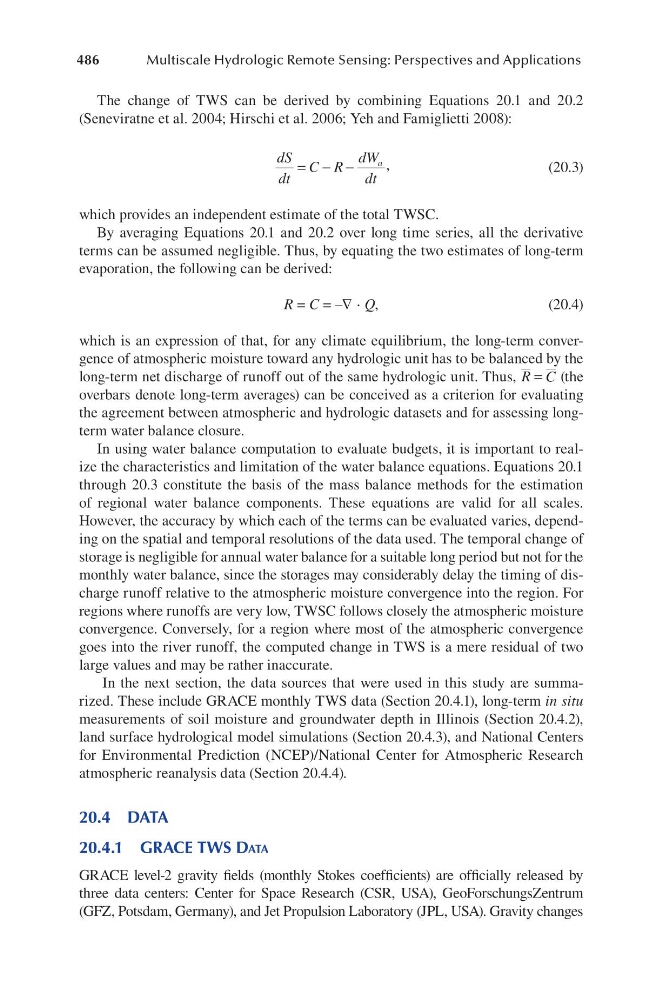
The change of TWS can be derived by combining Equations 20.1 and 20.2
(Seneviratne et al. 2004; Hirschi et al. 2006; Yeh and Famiglietti 2008):
dS
dt
C R
dW
dt
a
= − −
,
(20.3)
which provides an independent estimate of the total TWSC.
By averaging Equations 20.1 and 20.2 over long time series, all the derivative
terms can be assumed negligible. Thus, by equating the two estimates of long-term
evaporation, the following can be derived:
R = C = –∇ ⋅ Q,
(20.4)
which is an expression of that, for any climate equilibrium, the long-term convergence of atmospheric moisture toward any hydrologic unit has to be balanced by the
long-term net discharge of runoff out of the same hydrologic unit. Thus, R C
= (the
overbars denote long-term averages) can be conceived as a criterion for evaluating
the agreement between atmospheric and hydrologic datasets and for assessing longterm water balance closure.
In using water balance computation to evaluate budgets, it is important to realize the characteristics and limitation of the water balance equations. Equations 20.1
through 20.3 constitute the basis of the mass balance methods for the estimation
of regional water balance components. These equations are valid for all scales.
However, the accuracy by which each of the terms can be evaluated varies, depending on the spatial and temporal resolutions of the data used. The temporal change of
storage is negligible for annual water balance for a suitable long period but not for the
monthly water balance, since the storages may considerably delay the timing of discharge runoff relative to the atmospheric moisture convergence into the region. For
regions where runoffs are very low, TWSC follows closely the atmospheric moisture
convergence. Conversely, for a region where most of the atmospheric convergence
goes into the river runoff, the computed change in TWS is a mere residual of two
large values and may be rather inaccurate.
In the next section, the data sources that were used in this study are summarized. These include GRACE monthly TWS data (Section 20.4.1), long-term in situ
measurements of soil moisture and groundwater depth in Illinois (Section 20.4.2),
land surface hydrological model simulations (Section 20.4.3), and National Centers
for Environmental Prediction (NCEP)/National Center for Atmospheric Research
atmospheric reanalysis data (Section 20.4.4).
20.4 DATA
20.4.1 gRace twS data
GRACE level-2 gravity fields (monthly Stokes coefficients) are officially released by
three data centers: Center for Space Research (CSR, USA), GeoForschungsZentrum
(GFZ, Potsdam, Germany), and Jet Propulsion Laboratory (JPL, USA). Gravity changes
Multiscale Hydrologic Remote Sensing: Perspectives and Applications
The change of TWS can be derived by combining Equations 20.1 and 20.2
(Seneviratne et al. 2004; Hirschi et al. 2006; Yeh and Famiglietti 2008):
dS
dt
C R
dW
dt
a
= − −
,
(20.3)
which provides an independent estimate of the total TWSC.
By averaging Equations 20.1 and 20.2 over long time series, all the derivative
terms can be assumed negligible. Thus, by equating the two estimates of long-term
evaporation, the following can be derived:
R = C = –∇ ⋅ Q,
(20.4)
which is an expression of that, for any climate equilibrium, the long-term convergence of atmospheric moisture toward any hydrologic unit has to be balanced by the
long-term net discharge of runoff out of the same hydrologic unit. Thus, R C
= (the
overbars denote long-term averages) can be conceived as a criterion for evaluating
the agreement between atmospheric and hydrologic datasets and for assessing longterm water balance closure.
In using water balance computation to evaluate budgets, it is important to realize the characteristics and limitation of the water balance equations. Equations 20.1
through 20.3 constitute the basis of the mass balance methods for the estimation
of regional water balance components. These equations are valid for all scales.
However, the accuracy by which each of the terms can be evaluated varies, depending on the spatial and temporal resolutions of the data used. The temporal change of
storage is negligible for annual water balance for a suitable long period but not for the
monthly water balance, since the storages may considerably delay the timing of discharge runoff relative to the atmospheric moisture convergence into the region. For
regions where runoffs are very low, TWSC follows closely the atmospheric moisture
convergence. Conversely, for a region where most of the atmospheric convergence
goes into the river runoff, the computed change in TWS is a mere residual of two
large values and may be rather inaccurate.
In the next section, the data sources that were used in this study are summarized. These include GRACE monthly TWS data (Section 20.4.1), long-term in situ
measurements of soil moisture and groundwater depth in Illinois (Section 20.4.2),
land surface hydrological model simulations (Section 20.4.3), and National Centers
for Environmental Prediction (NCEP)/National Center for Atmospheric Research
atmospheric reanalysis data (Section 20.4.4).
20.4 DATA
20.4.1 gRace twS data
GRACE level-2 gravity fields (monthly Stokes coefficients) are officially released by
three data centers: Center for Space Research (CSR, USA), GeoForschungsZentrum
(GFZ, Potsdam, Germany), and Jet Propulsion Laboratory (JPL, USA). Gravity changes