

460
Multiscale Hydrologic Remote Sensing: Perspectives and Applications
(1) Algorithm input data. Biases exist for all input datasets, and they can introduce uncertainties in estimated MODIS ET. MOD12Q1 accuracies are
in the range of 70% to 80%, with most mistakes between similar classes
(Gao et al. 2005). Misclassification of the land cover will result in using
the wrong parameters for VPD and minimum air temperature for stomatal conductance constraints, resulting in less accurate ET estimates. While
approximately 62% of MODIS LAI estimates were within the estimates
based on field optical measurements, the remaining values overestimated
site values (Heinsch et al. 2006). Overestimates of LAI may result in overestimates of ET, even if other input data such as the meteorological data and
MODIS EVI data are relatively accurate. The inaccuracy in MODIS EVI
will lead to miscalculation of F C and, hence, ET. An extreme experiment
conducted by setting Fc as 1.0 for all 19 towers shows that the tower-driven
RMSE increases from 27.3 to 40.1 W ∙ m –2 , and from 29.5 to 49.6 W ∙ m –2
when driven by GMAO data. Although the temporal filling of unreliable
MODIS data, including LAI, EVI, and albedo, greatly improves the accuracy of inputs, the filled values are artificial and contain uncertainties. The
global daily GMAO is a reanalysis dataset with coarse spatial resolution; its
quality can have large influences on MODIS ET estimates.
(2) Algorithm limitations. Issues remaining in the ET algorithm might contribute to the differences between the tower ET observations and the MODIS
60
80
70
50
40
30
–120 –110 –100 –90
–80
–70
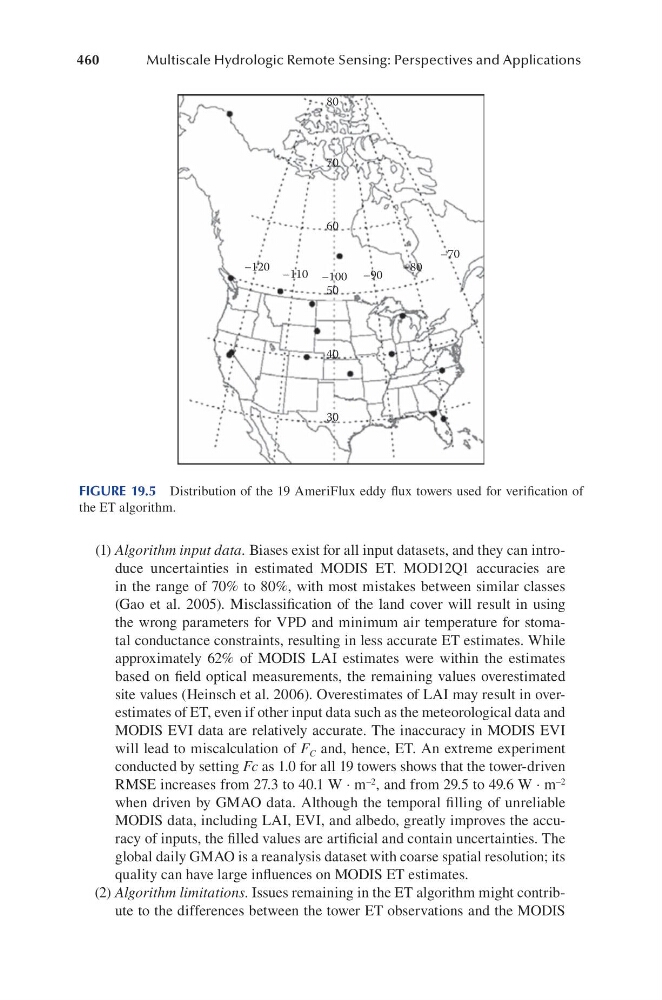
FIGURE 19.5 Distribution of the 19 AmeriFlux eddy flux towers used for verification of
the ET algorithm.
Multiscale Hydrologic Remote Sensing: Perspectives and Applications
(1) Algorithm input data. Biases exist for all input datasets, and they can introduce uncertainties in estimated MODIS ET. MOD12Q1 accuracies are
in the range of 70% to 80%, with most mistakes between similar classes
(Gao et al. 2005). Misclassification of the land cover will result in using
the wrong parameters for VPD and minimum air temperature for stomatal conductance constraints, resulting in less accurate ET estimates. While
approximately 62% of MODIS LAI estimates were within the estimates
based on field optical measurements, the remaining values overestimated
site values (Heinsch et al. 2006). Overestimates of LAI may result in overestimates of ET, even if other input data such as the meteorological data and
MODIS EVI data are relatively accurate. The inaccuracy in MODIS EVI
will lead to miscalculation of F C and, hence, ET. An extreme experiment
conducted by setting Fc as 1.0 for all 19 towers shows that the tower-driven
RMSE increases from 27.3 to 40.1 W ∙ m –2 , and from 29.5 to 49.6 W ∙ m –2
when driven by GMAO data. Although the temporal filling of unreliable
MODIS data, including LAI, EVI, and albedo, greatly improves the accuracy of inputs, the filled values are artificial and contain uncertainties. The
global daily GMAO is a reanalysis dataset with coarse spatial resolution; its
quality can have large influences on MODIS ET estimates.
(2) Algorithm limitations. Issues remaining in the ET algorithm might contribute to the differences between the tower ET observations and the MODIS
60
80
70
50
40
30
–120 –110 –100 –90
–80
–70
FIGURE 19.5 Distribution of the 19 AmeriFlux eddy flux towers used for verification of
the ET algorithm.