

392
Multiscale Hydrologic Remote Sensing: Perspectives and Applications
surface emissivity may represent one of the largest sources of uncertainties in the
interpretation of radiometer observations over land. Although models for simulating
the surface emissivity as a function of various parameters such as soil moisture, soil
type, vegetation type, snow depth, soil temperature, and frequency exist, they are
still under development and likely to undergo improvements through extensive validation. The strategy in this study is not to mitigate uncertainties in retrieval through
improved surface emissivity modeling but through retrieval formulations that are
least sensitive to uncertainties in surface emissivity.
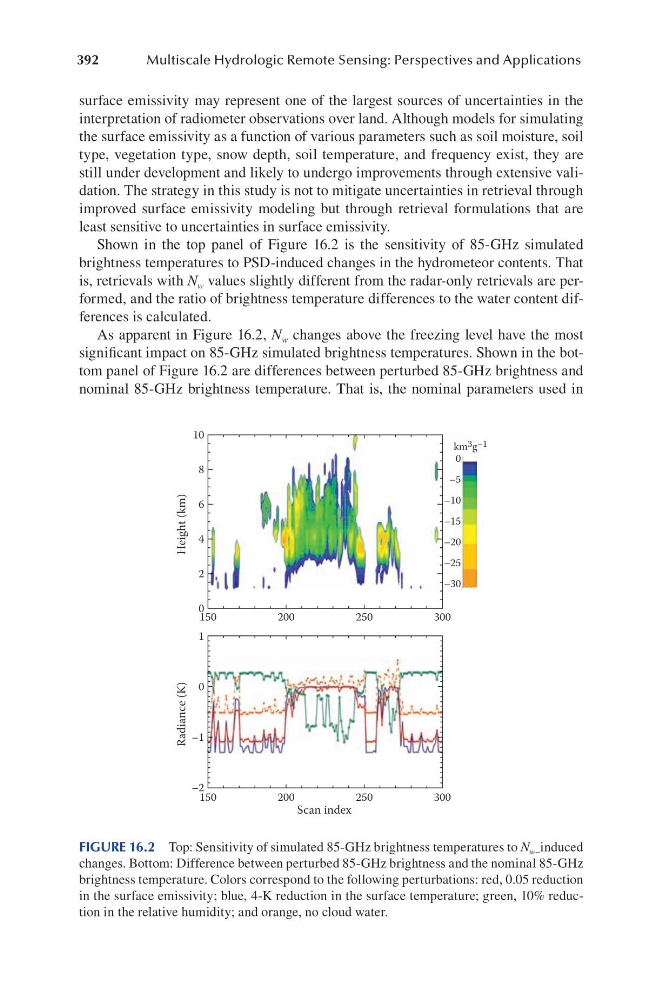
Shown in the top panel of Figure 16.2 is the sensitivity of 85-GHz simulated
brightness temperatures to PSD-induced changes in the hydrometeor contents. That
is, retrievals with N w values slightly different from the radar-only retrievals are performed, and the ratio of brightness temperature differences to the water content differences is calculated.
As apparent in Figure 16.2, N w changes above the freezing level have the most
significant impact on 85-GHz simulated brightness temperatures. Shown in the bottom panel of Figure 16.2 are differences between perturbed 85-GHz brightness and
nominal 85-GHz brightness temperature. That is, the nominal parameters used in
10
8
6
4
2
1
0
–1
–2
0
Height (km)
Radiance (K)
150
200
250
Scan index
300
150
200
250
300
0
km 3 g –1
–5
–10
–15
–20
–25
–30
FIGURE 16.2 Top: Sensitivity of simulated 85-GHz brightness temperatures to N w– induced
changes. Bottom: Difference between perturbed 85-GHz brightness and the nominal 85-GHz
brightness temperature. Colors correspond to the following perturbations: red, 0.05 reduction
in the surface emissivity; blue, 4-K reduction in the surface temperature; green, 10% reduction in the relative humidity; and orange, no cloud water.
Multiscale Hydrologic Remote Sensing: Perspectives and Applications
surface emissivity may represent one of the largest sources of uncertainties in the
interpretation of radiometer observations over land. Although models for simulating
the surface emissivity as a function of various parameters such as soil moisture, soil
type, vegetation type, snow depth, soil temperature, and frequency exist, they are
still under development and likely to undergo improvements through extensive validation. The strategy in this study is not to mitigate uncertainties in retrieval through
improved surface emissivity modeling but through retrieval formulations that are
least sensitive to uncertainties in surface emissivity.
Shown in the top panel of Figure 16.2 is the sensitivity of 85-GHz simulated
brightness temperatures to PSD-induced changes in the hydrometeor contents. That
is, retrievals with N w values slightly different from the radar-only retrievals are performed, and the ratio of brightness temperature differences to the water content differences is calculated.
As apparent in Figure 16.2, N w changes above the freezing level have the most
significant impact on 85-GHz simulated brightness temperatures. Shown in the bottom panel of Figure 16.2 are differences between perturbed 85-GHz brightness and
nominal 85-GHz brightness temperature. That is, the nominal parameters used in
10
8
6
4
2
1
0
–1
–2
0
Height (km)
Radiance (K)
150
200
250
Scan index
300
150
200
250
300
0
km 3 g –1
–5
–10
–15
–20
–25
–30
FIGURE 16.2 Top: Sensitivity of simulated 85-GHz brightness temperatures to N w– induced
changes. Bottom: Difference between perturbed 85-GHz brightness and the nominal 85-GHz
brightness temperature. Colors correspond to the following perturbations: red, 0.05 reduction
in the surface emissivity; blue, 4-K reduction in the surface temperature; green, 10% reduction in the relative humidity; and orange, no cloud water.