

391
Instantaneous Precipitation and Latent Heating Estimation over Land
(1954). The PIA derived from the Hitschfeld and Bordan procedure is compared with
the SRT PIA (which is a standard TRMM product), and if they do not match Nw is
adjusted. The default values of N w are set to 2.2 × 10 4 cm –1 m –3 for stratiform rain and
2 × 10 5 cm –1 m –3 for convective rain according to Testud et al. (2000). The adjusted
values are truncated not to exceed 10 times the default values or be more than 10
times smaller than the default values. This is because the SRT PIA may be subject
to quite-large random errors that can affect the retrievals through unrealistic N w
values. As explained by Grecu and Anagnostou (2002), TRMM TMI-like brightness
temperatures can be simulated from the PR-only retrievals. The brightband height
(which can be readily determined from reflectivity profiles) and a constant lapse rate
of 6 K km –1 are used to derive the temperature profiles used in the radiative transfer
calculations.
Whenever the brightband signature is missing, the freezing level is determined by
interpolation from neighboring profiles. The relative humidity, and cloud water and
cloud ice profiles are set to fixed predefined values determined from cloud resolving
simulations of the actual storm sampled by TRMM. Although customized cloudresolving simulations for every single storm observed by TRMM are not possible,
the relative humidity, and cloud and ice profiles can be set on the basis of simulations of similar events. The surface emissivity is set to 0.9. As mentioned before, the
10
8
6
4
2
0
10
8
6
4
2
0
150
200
250
Scan index
Height (km)
Height (km)
300
150
200
250
Scan index
300
45
1.0
gm –3
dBZ
0.8
0.6
0.4
0.2
0.0
40
35
30
25
20
15
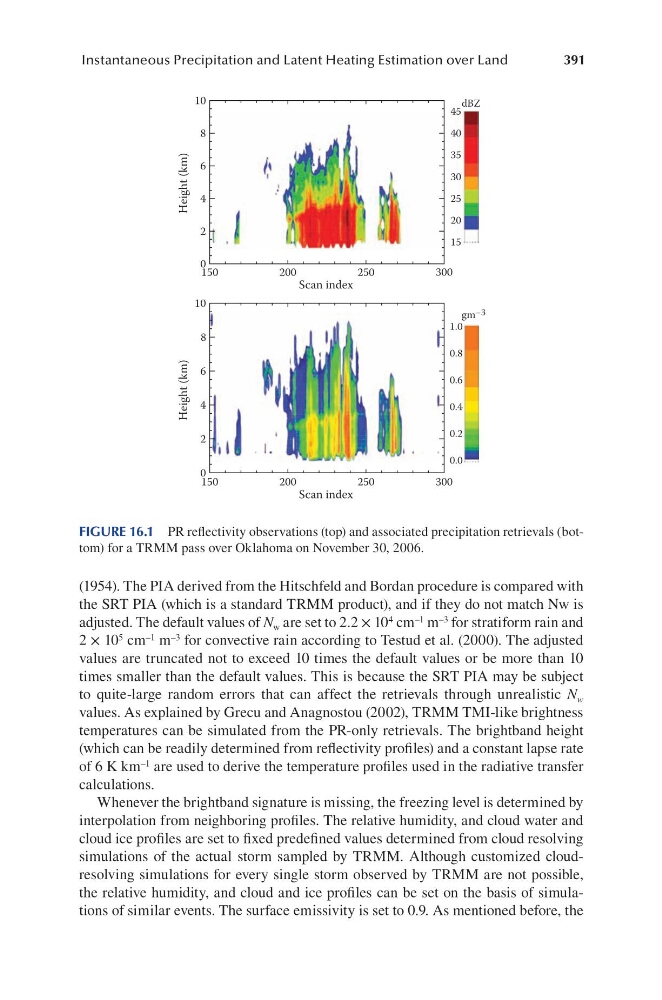
FIGURE 16.1 PR reflectivity observations (top) and associated precipitation retrievals (bottom) for a TRMM pass over Oklahoma on November 30, 2006.
Instantaneous Precipitation and Latent Heating Estimation over Land
(1954). The PIA derived from the Hitschfeld and Bordan procedure is compared with
the SRT PIA (which is a standard TRMM product), and if they do not match Nw is
adjusted. The default values of N w are set to 2.2 × 10 4 cm –1 m –3 for stratiform rain and
2 × 10 5 cm –1 m –3 for convective rain according to Testud et al. (2000). The adjusted
values are truncated not to exceed 10 times the default values or be more than 10
times smaller than the default values. This is because the SRT PIA may be subject
to quite-large random errors that can affect the retrievals through unrealistic N w
values. As explained by Grecu and Anagnostou (2002), TRMM TMI-like brightness
temperatures can be simulated from the PR-only retrievals. The brightband height
(which can be readily determined from reflectivity profiles) and a constant lapse rate
of 6 K km –1 are used to derive the temperature profiles used in the radiative transfer
calculations.
Whenever the brightband signature is missing, the freezing level is determined by
interpolation from neighboring profiles. The relative humidity, and cloud water and
cloud ice profiles are set to fixed predefined values determined from cloud resolving
simulations of the actual storm sampled by TRMM. Although customized cloudresolving simulations for every single storm observed by TRMM are not possible,
the relative humidity, and cloud and ice profiles can be set on the basis of simulations of similar events. The surface emissivity is set to 0.9. As mentioned before, the
10
8
6
4
2
0
10
8
6
4
2
0
150
200
250
Scan index
Height (km)
Height (km)
300
150
200
250
Scan index
300
45
1.0
gm –3
dBZ
0.8
0.6
0.4
0.2
0.0
40
35
30
25
20
15
FIGURE 16.1 PR reflectivity observations (top) and associated precipitation retrievals (bottom) for a TRMM pass over Oklahoma on November 30, 2006.