

352
Multiscale Hydrologic Remote Sensing: Perspectives and Applications
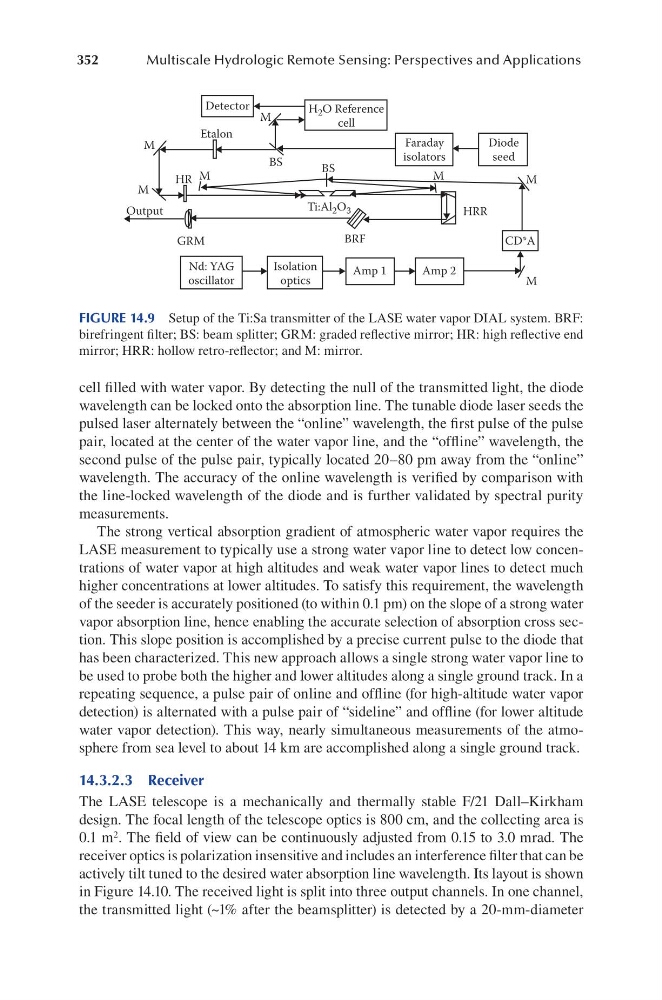
cell filled with water vapor. By detecting the null of the transmitted light, the diode
wavelength can be locked onto the absorption line. The tunable diode laser seeds the
pulsed laser alternately between the “online” wavelength, the first pulse of the pulse
pair, located at the center of the water vapor line, and the “offline” wavelength, the
second pulse of the pulse pair, typically located 20–80 pm away from the “online”
wavelength. The accuracy of the online wavelength is verified by comparison with
the line-locked wavelength of the diode and is further validated by spectral purity
measurements.
The strong vertical absorption gradient of atmospheric water vapor requires the
LASE measurement to typically use a strong water vapor line to detect low concentrations of water vapor at high altitudes and weak water vapor lines to detect much
higher concentrations at lower altitudes. To satisfy this requirement, the wavelength
of the seeder is accurately positioned (to within 0.1 pm) on the slope of a strong water
vapor absorption line, hence enabling the accurate selection of absorption cross section. This slope position is accomplished by a precise current pulse to the diode that
has been characterized. This new approach allows a single strong water vapor line to
be used to probe both the higher and lower altitudes along a single ground track. In a
repeating sequence, a pulse pair of online and offline (for high-altitude water vapor
detection) is alternated with a pulse pair of “sideline” and offline (for lower altitude
water vapor detection). This way, nearly simultaneous measurements of the atmosphere from sea level to about 14 km are accomplished along a single ground track.
14.3.2.3 Receiver
The LASE telescope is a mechanically and thermally stable F/21 Dall–Kirkham
design. The focal length of the telescope optics is 800 cm, and the collecting area is
0.1 m 2 . The field of view can be continuously adjusted from 0.15 to 3.0 mrad. The
receiver optics is polarization insensitive and includes an interference filter that can be
actively tilt tuned to the desired water absorption line wavelength. Its layout is shown
in Figure 14.10. The received light is split into three output channels. In one channel,
the transmitted light (~1% after the beamsplitter) is detected by a 20-mm-diameter
Detector
H 2 O Reference
cell
Faraday
isolators
Diode
seed
M
M
M
M
M
M
BS
BS
Ti:Al 2 O 3
Etalon
HR
M
HRR
BRF
GRM
Output
CD*A
Amp 2
Amp 1
Isolation
optics
Nd: YAG
oscillator
FIGURE 14.9 Setup of the Ti:Sa transmitter of the LASE water vapor DIAL system. BRF:
birefringent filter; BS: beam splitter; GRM: graded reflective mirror; HR: high reflective end
mirror; HRR: hollow retro-reflector; and M: mirror.
Multiscale Hydrologic Remote Sensing: Perspectives and Applications
cell filled with water vapor. By detecting the null of the transmitted light, the diode
wavelength can be locked onto the absorption line. The tunable diode laser seeds the
pulsed laser alternately between the “online” wavelength, the first pulse of the pulse
pair, located at the center of the water vapor line, and the “offline” wavelength, the
second pulse of the pulse pair, typically located 20–80 pm away from the “online”
wavelength. The accuracy of the online wavelength is verified by comparison with
the line-locked wavelength of the diode and is further validated by spectral purity
measurements.
The strong vertical absorption gradient of atmospheric water vapor requires the
LASE measurement to typically use a strong water vapor line to detect low concentrations of water vapor at high altitudes and weak water vapor lines to detect much
higher concentrations at lower altitudes. To satisfy this requirement, the wavelength
of the seeder is accurately positioned (to within 0.1 pm) on the slope of a strong water
vapor absorption line, hence enabling the accurate selection of absorption cross section. This slope position is accomplished by a precise current pulse to the diode that
has been characterized. This new approach allows a single strong water vapor line to
be used to probe both the higher and lower altitudes along a single ground track. In a
repeating sequence, a pulse pair of online and offline (for high-altitude water vapor
detection) is alternated with a pulse pair of “sideline” and offline (for lower altitude
water vapor detection). This way, nearly simultaneous measurements of the atmosphere from sea level to about 14 km are accomplished along a single ground track.
14.3.2.3 Receiver
The LASE telescope is a mechanically and thermally stable F/21 Dall–Kirkham
design. The focal length of the telescope optics is 800 cm, and the collecting area is
0.1 m 2 . The field of view can be continuously adjusted from 0.15 to 3.0 mrad. The
receiver optics is polarization insensitive and includes an interference filter that can be
actively tilt tuned to the desired water absorption line wavelength. Its layout is shown
in Figure 14.10. The received light is split into three output channels. In one channel,
the transmitted light (~1% after the beamsplitter) is detected by a 20-mm-diameter
Detector
H 2 O Reference
cell
Faraday
isolators
Diode
seed
M
M
M
M
M
M
BS
BS
Ti:Al 2 O 3
Etalon
HR
M
HRR
BRF
GRM
Output
CD*A
Amp 2
Amp 1
Isolation
optics
Nd: YAG
oscillator
FIGURE 14.9 Setup of the Ti:Sa transmitter of the LASE water vapor DIAL system. BRF:
birefringent filter; BS: beam splitter; GRM: graded reflective mirror; HR: high reflective end
mirror; HRR: hollow retro-reflector; and M: mirror.