

344
Multiscale Hydrologic Remote Sensing: Perspectives and Applications
wavelengths with a linewidth of 1.3 pm and typically larger than 99.99% spectral
purity are emitted at a 50-μs time interval, with a repetition rate of 10 Hz. The
central wavelength is controlled in real time on a shot-to-shot basis by a wavemeter
with an absolute accuracy of 140 MHz. The required narrow spectral linewidth is
achieved by using filter and intracavity etalons. This technique results in a bandwidth
of 560 MHz, so corrections are applied if measurements are performed in the upper
troposphere, where the linewidths of water vapor absorption lines become smaller.
After the first reflection, the laser beam passes through a five-beam expander and
is directed along the telescope’s line of sight by a mirror placed in front of the teleline of sight by a mirror placed in front of the teleline of sight by a mirror placed in front of the telescope’s secondary mirror (coaxial configuration). The output divergence of the laser
can be adjusted from 0.5 to 3 mrad to yield eye safety on the ground. A large steering
mirror whose size covers the telescope aperture (300 mm) enables measurements to
be made at various angles (zenith, nadir, or ±15° scanning from nadir). The receiver
is a 30-cm aperture telescope with a 3.5-mrad fi eld of view and a 1-nm fi lter band-cm aperture telescope with a 3.5-mrad fi eld of view and a 1-nm fi lter bandcm aperture telescope with a 3.5-mrad fi eld of view and a 1-nm fi lter banda 3.5-mrad fi eld of view and a 1-nm fi lter banda 3.5-mrad fi eld of view and a 1-nm fi lter band-mrad fi eld of view and a 1-nm fi lter bandmrad field of view and a 1-nm fi lter band-nm fi lter bandnm filter bandwidth. The emitter with the wavemeter, the telescope, the reception optics, and the
detector are placed in an optical container with a dimension of 1.50 × 0.90 × 0.45
m 3 . The power supplies for the detector and various mechanisms (mask, diaphragm,
filter holder) are placed in an auxiliary electronic unit near the optical bench. The
two main electronic units have a dimension of 0.60 × 0.60 × 1.60 m 3 and contain
standard 6-m racks. The power supply and cooling unit of the laser, the laser itself
and wavemeter control electronics, the steering mirror control electronics, and the
signal digitizers are located in the first unit. The second unit contains two computers:
the first for real-time control of the instrument and data recording and the second for
calculation and display of the scientific results.
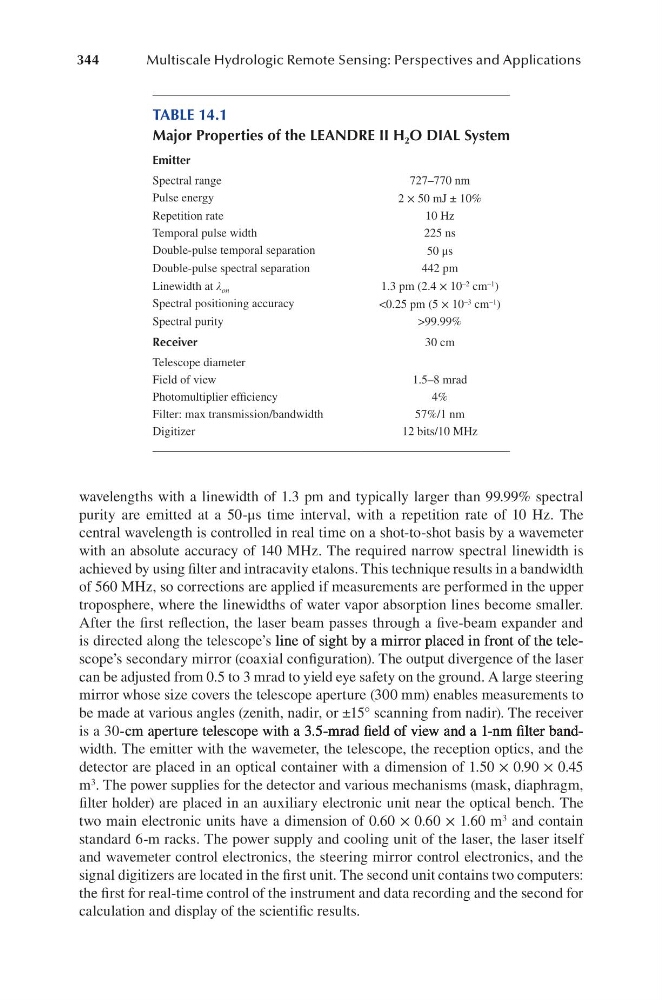
TABLE 14.1
Major Properties of the LEANDRE II H 2 O DIAL System
Emitter
Spectral range
727–770 nm
Pulse energy
2 × 50 mJ ± 10%
Repetition rate
10 Hz
Temporal pulse width
225 ns
Double-pulse temporal separation
50 μs
Double-pulse spectral separation
442 pm
Linewidth at λ on
1.3 pm (2.4 × 10 –2 cm –1 )
Spectral positioning accuracy
<0.25 pm (5 × 10 –3 cm –1 )
Spectral purity
>99.99%
Receiver
30 cm
Telescope diameter
Field of view
1.5–8 mrad
Photomultiplier efficiency
4%
Filter: max transmission/bandwidth
57%/1 nm
Digitizer
12 bits/10 MHz
Multiscale Hydrologic Remote Sensing: Perspectives and Applications
wavelengths with a linewidth of 1.3 pm and typically larger than 99.99% spectral
purity are emitted at a 50-μs time interval, with a repetition rate of 10 Hz. The
central wavelength is controlled in real time on a shot-to-shot basis by a wavemeter
with an absolute accuracy of 140 MHz. The required narrow spectral linewidth is
achieved by using filter and intracavity etalons. This technique results in a bandwidth
of 560 MHz, so corrections are applied if measurements are performed in the upper
troposphere, where the linewidths of water vapor absorption lines become smaller.
After the first reflection, the laser beam passes through a five-beam expander and
is directed along the telescope’s line of sight by a mirror placed in front of the teleline of sight by a mirror placed in front of the teleline of sight by a mirror placed in front of the telescope’s secondary mirror (coaxial configuration). The output divergence of the laser
can be adjusted from 0.5 to 3 mrad to yield eye safety on the ground. A large steering
mirror whose size covers the telescope aperture (300 mm) enables measurements to
be made at various angles (zenith, nadir, or ±15° scanning from nadir). The receiver
is a 30-cm aperture telescope with a 3.5-mrad fi eld of view and a 1-nm fi lter band-cm aperture telescope with a 3.5-mrad fi eld of view and a 1-nm fi lter bandcm aperture telescope with a 3.5-mrad fi eld of view and a 1-nm fi lter banda 3.5-mrad fi eld of view and a 1-nm fi lter banda 3.5-mrad fi eld of view and a 1-nm fi lter band-mrad fi eld of view and a 1-nm fi lter bandmrad field of view and a 1-nm fi lter band-nm fi lter bandnm filter bandwidth. The emitter with the wavemeter, the telescope, the reception optics, and the
detector are placed in an optical container with a dimension of 1.50 × 0.90 × 0.45
m 3 . The power supplies for the detector and various mechanisms (mask, diaphragm,
filter holder) are placed in an auxiliary electronic unit near the optical bench. The
two main electronic units have a dimension of 0.60 × 0.60 × 1.60 m 3 and contain
standard 6-m racks. The power supply and cooling unit of the laser, the laser itself
and wavemeter control electronics, the steering mirror control electronics, and the
signal digitizers are located in the first unit. The second unit contains two computers:
the first for real-time control of the instrument and data recording and the second for
calculation and display of the scientific results.
TABLE 14.1
Major Properties of the LEANDRE II H 2 O DIAL System
Emitter
Spectral range
727–770 nm
Pulse energy
2 × 50 mJ ± 10%
Repetition rate
10 Hz
Temporal pulse width
225 ns
Double-pulse temporal separation
50 μs
Double-pulse spectral separation
442 pm
Linewidth at λ on
1.3 pm (2.4 × 10 –2 cm –1 )
Spectral positioning accuracy
<0.25 pm (5 × 10 –3 cm –1 )
Spectral purity
>99.99%
Receiver
30 cm
Telescope diameter
Field of view
1.5–8 mrad
Photomultiplier efficiency
4%
Filter: max transmission/bandwidth
57%/1 nm
Digitizer
12 bits/10 MHz