

338
Multiscale Hydrologic Remote Sensing: Perspectives and Applications
14.2.1 geneRal lidaR equation
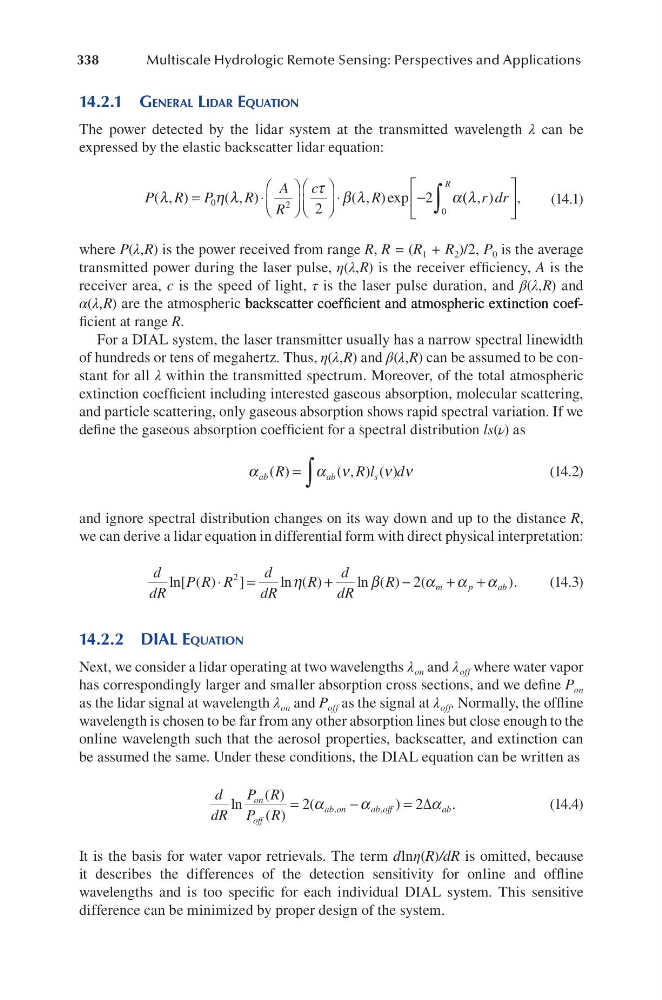
The power detected by the lidar system at the transmitted wavelength λ can be
expressed by the elastic backscatter lidar equation:
P R P
R
A
R
c
R
( , )
( , )
( , ) exp
λ
η λ
τ β λ
α
=
⋅
⋅
−
0
2
2
2
( ( , )
λ r dr
R
0
∫
,
(14.1)
where P(λ,R) is the power received from range R, R = (R 1 + R 2 )/2, P 0 is the average
transmitted power during the laser pulse, η(λ,R) is the receiver efficiency, A is the
receiver area, c is the speed of light, τ is the laser pulse duration, and β(λ,R) and
α(λ,R) are the atmospheric backscatter coeffi cient and atmospheric extinction coefbackscatter coeffi cient and atmospheric extinction coefbackscatter coefficient and atmospheric extinction coefficient at range R.
For a DIAL system, the laser transmitter usually has a narrow spectral linewidth
of hundreds or tens of megahertz. Thus, η(λ,R) and β(λ,R) can be assumed to be constant for all λ within the transmitted spectrum. Moreover, of the total atmospheric
extinction coefficient including interested gaseous absorption, molecular scattering,
and particle scattering, only gaseous absorption shows rapid spectral variation. If we
define the gaseous absorption coefficient for a spectral distribution ls(ν) as
α
α ν
ν ν
ab
ab
s
R
R l d
( )
( , ) ( )
=
∫
(14.2)
and ignore spectral distribution changes on its way down and up to the distance R,
we can derive a lidar equation in differential form with direct physical interpretation:
d
dR
P R R
d
dR
R
d
dR
R
m
p
ab
ln[ ( )
]
ln ( )
ln ( ) (
)
⋅
=
+
−
+ +
2
2
η
β
α α α .
(14.3)
14.2.2 dial equation
Next, we consider a lidar operating at two wavelengths λ on and λ off where water vapor
has correspondingly larger and smaller absorption cross sections, and we define P on
as the lidar signal at wavelength λ on and P off as the signal at λ off . Normally, the offline
wavelength is chosen to be far from any other absorption lines but close enough to the
online wavelength such that the aerosol properties, backscatter, and extinction can
be assumed the same. Under these conditions, the DIAL equation can be written as
d
dR
P R
P R
on
off
ab on
ab off
ab
ln
( )
( )
(
)
,
,
=
−
=
2
2
α
α
α
∆ .
(14.4)
It is the basis for water vapor retrievals. The term dlnη(R)/dR is omitted, because
it describes the differences of the detection sensitivity for online and offline
wavelengths and is too specific for each individual DIAL system. This sensitive
difference can be minimized by proper design of the system.
Multiscale Hydrologic Remote Sensing: Perspectives and Applications
14.2.1 geneRal lidaR equation
The power detected by the lidar system at the transmitted wavelength λ can be
expressed by the elastic backscatter lidar equation:
P R P
R
A
R
c
R
( , )
( , )
( , ) exp
λ
η λ
τ β λ
α
=
⋅
⋅
−
0
2
2
2
( ( , )
λ r dr
R
0
∫
,
(14.1)
where P(λ,R) is the power received from range R, R = (R 1 + R 2 )/2, P 0 is the average
transmitted power during the laser pulse, η(λ,R) is the receiver efficiency, A is the
receiver area, c is the speed of light, τ is the laser pulse duration, and β(λ,R) and
α(λ,R) are the atmospheric backscatter coeffi cient and atmospheric extinction coefbackscatter coeffi cient and atmospheric extinction coefbackscatter coefficient and atmospheric extinction coefficient at range R.
For a DIAL system, the laser transmitter usually has a narrow spectral linewidth
of hundreds or tens of megahertz. Thus, η(λ,R) and β(λ,R) can be assumed to be constant for all λ within the transmitted spectrum. Moreover, of the total atmospheric
extinction coefficient including interested gaseous absorption, molecular scattering,
and particle scattering, only gaseous absorption shows rapid spectral variation. If we
define the gaseous absorption coefficient for a spectral distribution ls(ν) as
α
α ν
ν ν
ab
ab
s
R
R l d
( )
( , ) ( )
=
∫
(14.2)
and ignore spectral distribution changes on its way down and up to the distance R,
we can derive a lidar equation in differential form with direct physical interpretation:
d
dR
P R R
d
dR
R
d
dR
R
m
p
ab
ln[ ( )
]
ln ( )
ln ( ) (
)
⋅
=
+
−
+ +
2
2
η
β
α α α .
(14.3)
14.2.2 dial equation
Next, we consider a lidar operating at two wavelengths λ on and λ off where water vapor
has correspondingly larger and smaller absorption cross sections, and we define P on
as the lidar signal at wavelength λ on and P off as the signal at λ off . Normally, the offline
wavelength is chosen to be far from any other absorption lines but close enough to the
online wavelength such that the aerosol properties, backscatter, and extinction can
be assumed the same. Under these conditions, the DIAL equation can be written as
d
dR
P R
P R
on
off
ab on
ab off
ab
ln
( )
( )
(
)
,
,
=
−
=
2
2
α
α
α
∆ .
(14.4)
It is the basis for water vapor retrievals. The term dlnη(R)/dR is omitted, because
it describes the differences of the detection sensitivity for online and offline
wavelengths and is too specific for each individual DIAL system. This sensitive
difference can be minimized by proper design of the system.