

337
Airborne Water Vapor Differential Absorption Lidar
applications of DIAL systems. During the past two decades, progress have been
made in all of the areas, including laser technique, detection technique, mechanics
design, and software development, which bring DIAL systems into broad and
practical applications.
In this chapter, the theory of the DIAL technique is reviewed, and the systemand the system- systematic and random errors are discussed first. Progress in the development of DIAL
techniques for water vapor profiling is described in three wavelength regions: 720,
820, and 940 nm. Recent advances in multiwavelength DIAL are summarized, and
finally, some conjectures are offered on technology areas that will most likely be in
rapid progress in the near future.
14.2 METHODOLOGY
Range-dependent differential absorption of laser radiation by water vapor represents
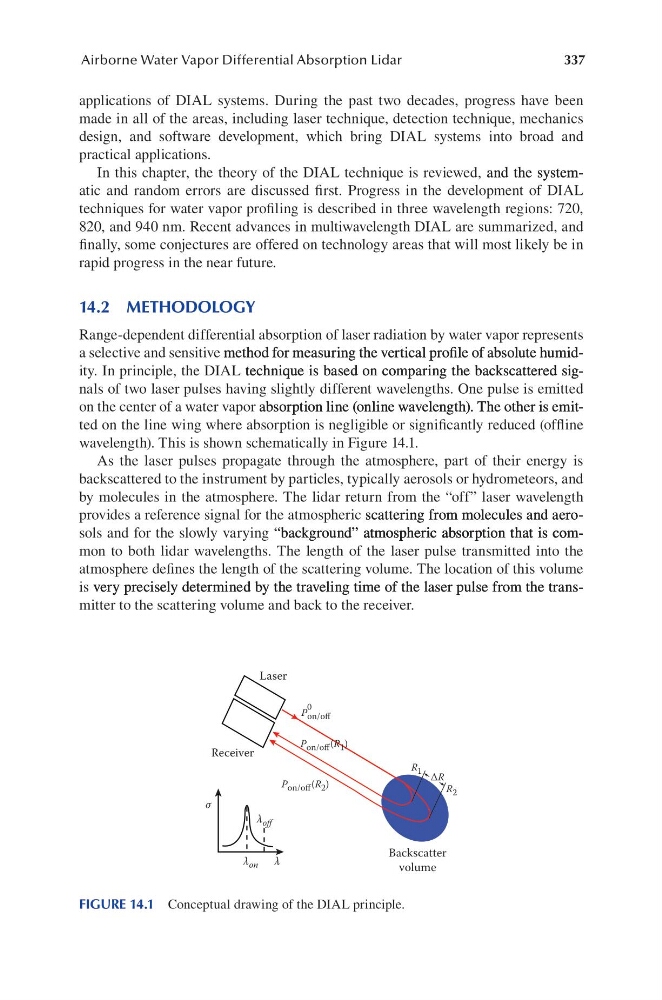
a selective and sensitive method for measuring the vertical profi le of absolute humidmethod for measuring the vertical profi le of absolute humidmethod for measuring the vertical profile of absolute humidity. In principle, the DIAL technique is based on comparing the backscattered sigtechnique is based on comparing the backscattered sigtechnique is based on comparing the backscattered signals of two laser pulses having slightly different wavelengths. One pulse is emitted
on the center of a water vapor absorption line (online wavelength). The other is emitabsorption line (online wavelength). The other is emitabsorption line (online wavelength). The other is emitted on the line wing where absorption is negligible or significantly reduced (offline
wavelength). This is shown schematically in Figure 14.1.
As the laser pulses propagate through the atmosphere, part of their energy is
backscattered to the instrument by particles, typically aerosols or hydrometeors, and
by molecules in the atmosphere. The lidar return from the “off” laser wavelength
provides a reference signal for the atmospheric scattering from molecules and aeroscattering from molecules and aeroscattering from molecules and aerosols and for the slowly varying “background” atmospheric absorption that is com“background” atmospheric absorption that is com“background” atmospheric absorption that is comatmospheric absorption that is comatmospheric absorption that is common to both lidar wavelengths. The length of the laser pulse transmitted into the
atmosphere defines the length of the scattering volume. The location of this volume
is very precisely determined by the traveling time of the laser pulse from the transvery precisely determined by the traveling time of the laser pulse from the transvery precisely determined by the traveling time of the laser pulse from the transmitter to the scattering volume and back to the receiver.
Backscatter
volume
Receiver
Laser
P
0
on/off
P on/off (R 1 )
P on/off (R 2 )
R 1
R 2
∆R
λ off
λ on λ
σ
FIGURE 14.1 Conceptual drawing of the DIAL principle.
Airborne Water Vapor Differential Absorption Lidar
applications of DIAL systems. During the past two decades, progress have been
made in all of the areas, including laser technique, detection technique, mechanics
design, and software development, which bring DIAL systems into broad and
practical applications.
In this chapter, the theory of the DIAL technique is reviewed, and the systemand the system- systematic and random errors are discussed first. Progress in the development of DIAL
techniques for water vapor profiling is described in three wavelength regions: 720,
820, and 940 nm. Recent advances in multiwavelength DIAL are summarized, and
finally, some conjectures are offered on technology areas that will most likely be in
rapid progress in the near future.
14.2 METHODOLOGY
Range-dependent differential absorption of laser radiation by water vapor represents
a selective and sensitive method for measuring the vertical profi le of absolute humidmethod for measuring the vertical profi le of absolute humidmethod for measuring the vertical profile of absolute humidity. In principle, the DIAL technique is based on comparing the backscattered sigtechnique is based on comparing the backscattered sigtechnique is based on comparing the backscattered signals of two laser pulses having slightly different wavelengths. One pulse is emitted
on the center of a water vapor absorption line (online wavelength). The other is emitabsorption line (online wavelength). The other is emitabsorption line (online wavelength). The other is emitted on the line wing where absorption is negligible or significantly reduced (offline
wavelength). This is shown schematically in Figure 14.1.
As the laser pulses propagate through the atmosphere, part of their energy is
backscattered to the instrument by particles, typically aerosols or hydrometeors, and
by molecules in the atmosphere. The lidar return from the “off” laser wavelength
provides a reference signal for the atmospheric scattering from molecules and aeroscattering from molecules and aeroscattering from molecules and aerosols and for the slowly varying “background” atmospheric absorption that is com“background” atmospheric absorption that is com“background” atmospheric absorption that is comatmospheric absorption that is comatmospheric absorption that is common to both lidar wavelengths. The length of the laser pulse transmitted into the
atmosphere defines the length of the scattering volume. The location of this volume
is very precisely determined by the traveling time of the laser pulse from the transvery precisely determined by the traveling time of the laser pulse from the transvery precisely determined by the traveling time of the laser pulse from the transmitter to the scattering volume and back to the receiver.
Backscatter
volume
Receiver
Laser
P
0
on/off
P on/off (R 1 )
P on/off (R 2 )
R 1
R 2
∆R
λ off
λ on λ
σ
FIGURE 14.1 Conceptual drawing of the DIAL principle.