

325
Radar Polarimetry for Rain Estimation
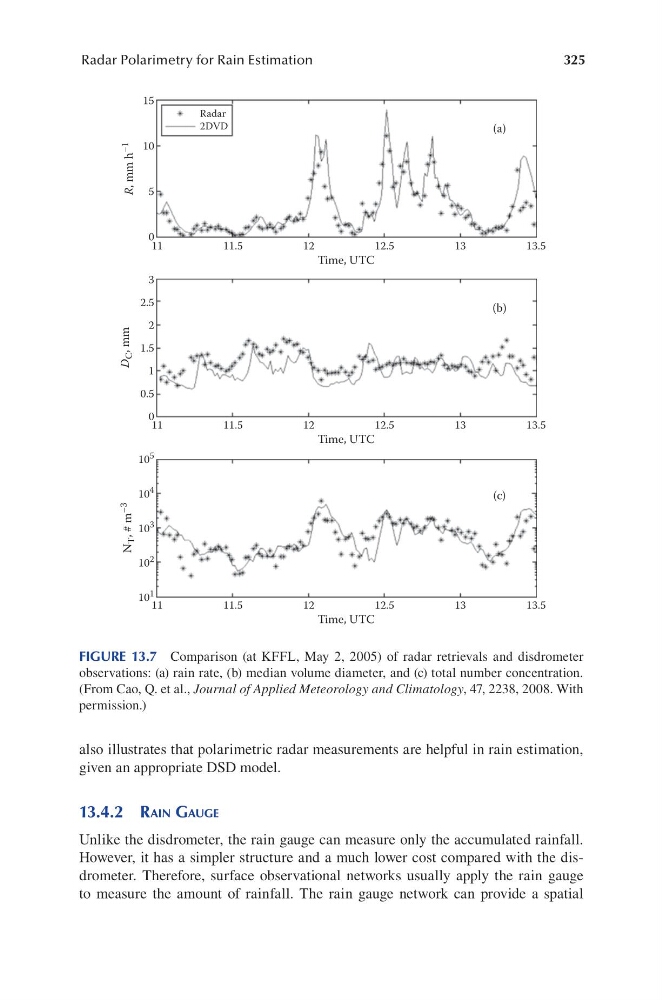
also illustrates that polarimetric radar measurements are helpful in rain estimation,
given an appropriate DSD model.
13.4.2 Rain gauge
Unlike the disdrometer, the rain gauge can measure only the accumulated rainfall.
However, it has a simpler structure and a much lower cost compared with the disdrometer. Therefore, surface observational networks usually apply the rain gauge
to measure the amount of rainfall. The rain gauge network can provide a spatial
15
Radar
2DVD
10
5
0
11
11.5
12.5
13.5
Time, UTC
R, mm h –1
N
T , # m –3
D
C , mm
13
12
3
2.5
1.5
0.5
0
10 5
10 4
10 3
10 2
10 1
1
2
(a)
(b)
(c)
11
11.5
12.5
13.5
Time, UTC
13
12
11
11.5
12.5
13.5
Time, UTC
13
12
FIGURE 13.7 Comparison (at KFFL, May 2, 2005) of radar retrievals and disdrometer
observations: (a) rain rate, (b) median volume diameter, and (c) total number concentration.
(From Cao, Q. et al., Journal of Applied Meteorology and Climatology, 47, 2238, 2008. With
permission.)
Radar Polarimetry for Rain Estimation
also illustrates that polarimetric radar measurements are helpful in rain estimation,
given an appropriate DSD model.
13.4.2 Rain gauge
Unlike the disdrometer, the rain gauge can measure only the accumulated rainfall.
However, it has a simpler structure and a much lower cost compared with the disdrometer. Therefore, surface observational networks usually apply the rain gauge
to measure the amount of rainfall. The rain gauge network can provide a spatial
15
Radar
2DVD
10
5
0
11
11.5
12.5
13.5
Time, UTC
R, mm h –1
N
T , # m –3
D
C , mm
13
12
3
2.5
1.5
0.5
0
10 5
10 4
10 3
10 2
10 1
1
2
(a)
(b)
(c)
11
11.5
12.5
13.5
Time, UTC
13
12
11
11.5
12.5
13.5
Time, UTC
13
12
FIGURE 13.7 Comparison (at KFFL, May 2, 2005) of radar retrievals and disdrometer
observations: (a) rain rate, (b) median volume diameter, and (c) total number concentration.
(From Cao, Q. et al., Journal of Applied Meteorology and Climatology, 47, 2238, 2008. With
permission.)