

315
Radar Polarimetry for Rain Estimation
approach is the correct prior information on these DSD parameters. Cao et al. (2010)
applied the C-G model as the basis of the DSD retrieval, setting x = [ , ]
′⋅ ′
N 0 Λ and
y = [Z H , Z DR ], where ′ =
− −
−
N
N
0
10
0
10
1
3
log
[log (
)]
mm m
µ
and Λ′ = Λ 0.25 (mm –1/4 ). To
construct the prior probability, they utilized a large dataset of disdrometer measurements (>30,000 1-min DSDs). The DSD fitting procedure followed the truncated
moment fit (TMF) method described by Vivekanandan et al. (2004), which utilizes
the second, fourth, and sixth DSD moments to fit gamma parameters, N 0 , Λ, and µ.
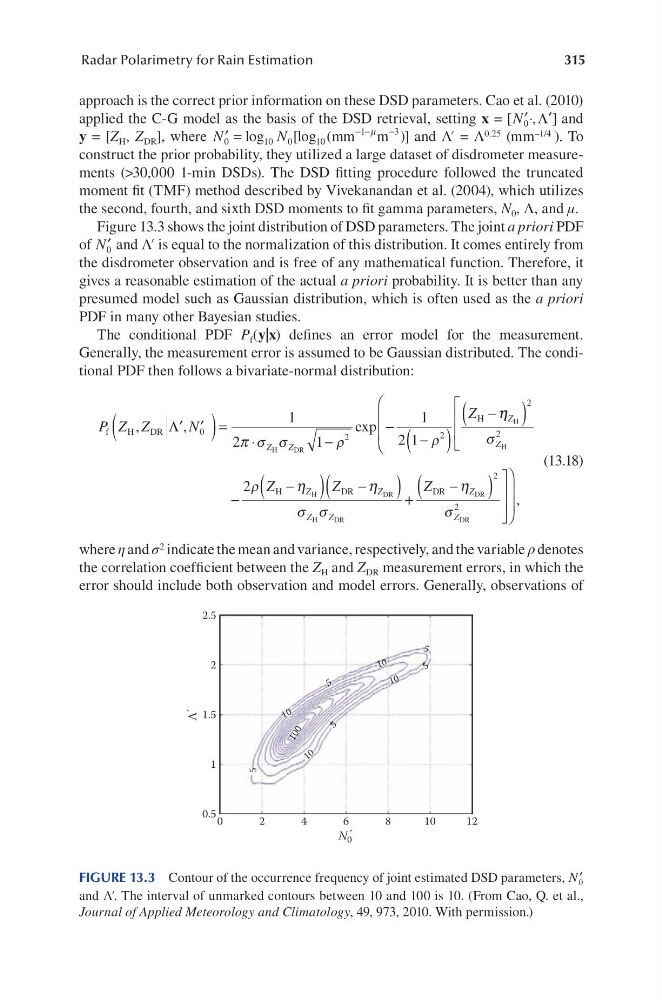
Figure 13.3 shows the joint distribution of DSD parameters. The joint a priori PDF
of ′
N 0 and Λ′ is equal to the normalization of this distribution. It comes entirely from
the disdrometer observation and is free of any mathematical function. Therefore, it
gives a reasonable estimation of the actual a priori probability. It is better than any
presumed model such as Gaussian distribution, which is often used as the a priori
PDF in many other Bayesian studies.
The conditional PDF P f (y|x) defines an error model for the measurement.
Generally, the measurement error is assumed to be Gaussian distributed. The conditional PDF then follows a bivariate-normal distribution:
P Z Z
N
Z
Z
Z
f
H
DR
H
H
DR
,
,
exp
′ ′
(
) =
⋅
−
−
−
( )
−
Λ 0
2
2
1
2
1
1
2 1
π σ σ
ρ
ρ
η η
η
η
σ
ρ
σ σ
Z
Z
Z
Z
Z
Z
Z
Z
H
H
H
DR
H
DR
H
DR
(
)
−
−
(
) −
(
)
2
2
2
+ +
−
(
)
Z
Z
Z
DR
DR
DR
η
σ
2
2
,
(13.18)
where η and σ 2 indicate the mean and variance, respectively, and the variable ρ denotes
the correlation coefficient between the Z H and Z DR measurement errors, in which the
error should include both observation and model errors. Generally, observations of
2.5
1.5
0.5 0
2
4
6
8
10
12
N´ 0
Λ´
1
2
5
1 0
1 0
1 0
1 0
1 0 0
5
5
5
5
FIGURE 13.3 Contour of the occurrence frequency of joint estimated DSD parameters, ′
N 0
and Λ′. The interval of unmarked contours between 10 and 100 is 10. (From Cao, Q. et al.,
Journal of Applied Meteorology and Climatology, 49, 973, 2010. With permission.)
Radar Polarimetry for Rain Estimation
approach is the correct prior information on these DSD parameters. Cao et al. (2010)
applied the C-G model as the basis of the DSD retrieval, setting x = [ , ]
′⋅ ′
N 0 Λ and
y = [Z H , Z DR ], where ′ =
− −
−
N
N
0
10
0
10
1
3
log
[log (
)]
mm m
µ
and Λ′ = Λ 0.25 (mm –1/4 ). To
construct the prior probability, they utilized a large dataset of disdrometer measurements (>30,000 1-min DSDs). The DSD fitting procedure followed the truncated
moment fit (TMF) method described by Vivekanandan et al. (2004), which utilizes
the second, fourth, and sixth DSD moments to fit gamma parameters, N 0 , Λ, and µ.
Figure 13.3 shows the joint distribution of DSD parameters. The joint a priori PDF
of ′
N 0 and Λ′ is equal to the normalization of this distribution. It comes entirely from
the disdrometer observation and is free of any mathematical function. Therefore, it
gives a reasonable estimation of the actual a priori probability. It is better than any
presumed model such as Gaussian distribution, which is often used as the a priori
PDF in many other Bayesian studies.
The conditional PDF P f (y|x) defines an error model for the measurement.
Generally, the measurement error is assumed to be Gaussian distributed. The conditional PDF then follows a bivariate-normal distribution:
P Z Z
N
Z
Z
Z
f
H
DR
H
H
DR
,
,
exp
′ ′
(
) =
⋅
−
−
−
( )
−
Λ 0
2
2
1
2
1
1
2 1
π σ σ
ρ
ρ
η η
η
η
σ
ρ
σ σ
Z
Z
Z
Z
Z
Z
Z
Z
H
H
H
DR
H
DR
H
DR
(
)
−
−
(
) −
(
)
2
2
2
+ +
−
(
)
Z
Z
Z
DR
DR
DR
η
σ
2
2
,
(13.18)
where η and σ 2 indicate the mean and variance, respectively, and the variable ρ denotes
the correlation coefficient between the Z H and Z DR measurement errors, in which the
error should include both observation and model errors. Generally, observations of
2.5
1.5
0.5 0
2
4
6
8
10
12
N´ 0
Λ´
1
2
5
1 0
1 0
1 0
1 0
1 0 0
5
5
5
5
FIGURE 13.3 Contour of the occurrence frequency of joint estimated DSD parameters, ′
N 0
and Λ′. The interval of unmarked contours between 10 and 100 is 10. (From Cao, Q. et al.,
Journal of Applied Meteorology and Climatology, 49, 973, 2010. With permission.)