

314
Multiscale Hydrologic Remote Sensing: Perspectives and Applications
melting layer. The similarity is due to the fact that both methods apply the same
polarimetric measurements. However, it is worth noting that the DSD retrieval is
able to estimate other rain variables such as N T and D 0 . To achieve this goal with the
empirical method, different empirical relations are required.
The direct approach is straightforward and applied by many researchers not only
for rain estimation but also for attenuation correction issues. For example, Meneghini
and Liao (2007) applied the DSD retrieved directly from measurements to correct the
attenuation backward along the radar beam path. Unfortunately, the direct approach
does not consider the effect of measurement error in the retrieval. This approach
regards measurement error as a physical change in the DSD, sometimes causing the
retrieval result to be unreliable, especially when the SNR is low. For example, light
rain generally has a small differential reflectivity where the measurement might be
negative due to the system error. In such a case, the direct retrieval would have no
solution.
13.3.2.2.2 Bayesian Approach
Considering its potential to reduce error effects, the Bayesian theory offers a promising approach to optimize the use of measurements (Evans et al. 1995; McFarlane
et al. 2002; Di Michele et al. 2005; Chiu and Petty 2006). Let us suppose that x
represents a set of rain parameters that need to be retrieved from radar measurement
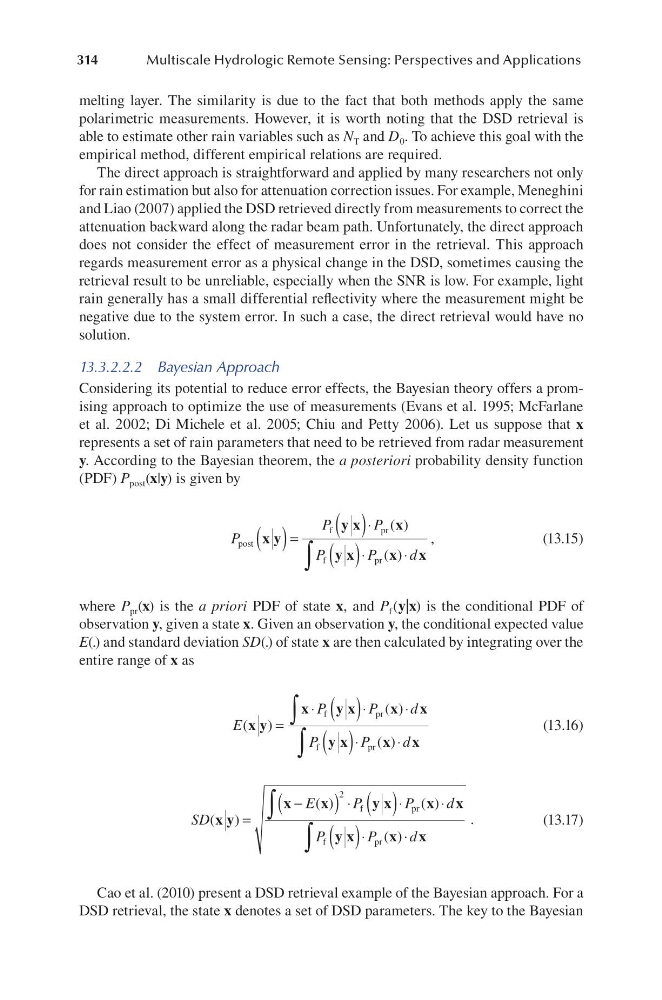
y. According to the Bayesian theorem, the a posteriori probability density function
(PDF) P post (x|y) is given by
P
P
P
P
P
d
post
f
pr
f
pr
x y
y x
x
y x
x x
( ) = ( ) ⋅
( ) ⋅ ⋅
∫
( )
( )
,
(13.15)
where P pr (x) is the a priori PDF of state x, and P f (y|x) is the conditional PDF of
observation y, given a state x. Given an observation y, the conditional expected value
E(.) and standard deviation SD(.) of state x are then calculated by integrating over the
entire range of x as
E
P
P
d
P
P
d
( )
( )
( )
x y
x
y x
x x
y x
x x
=
⋅ ( ) ⋅ ⋅
( ) ⋅ ⋅
∫
∫
f
pr
f
pr
(13.16)
SD
E
P
P
d
P
P
( )
( )
( )
( )
x y
x
x
y x
x x
y x
x
=
−
(
) ⋅ ( ) ⋅ ⋅
( ) ⋅
∫
2
f
pr
f
pr
⋅ ⋅
∫
d x
.
(13.17)
Cao et al. (2010) present a DSD retrieval example of the Bayesian approach. For a
DSD retrieval, the state x denotes a set of DSD parameters. The key to the Bayesian
Multiscale Hydrologic Remote Sensing: Perspectives and Applications
melting layer. The similarity is due to the fact that both methods apply the same
polarimetric measurements. However, it is worth noting that the DSD retrieval is
able to estimate other rain variables such as N T and D 0 . To achieve this goal with the
empirical method, different empirical relations are required.
The direct approach is straightforward and applied by many researchers not only
for rain estimation but also for attenuation correction issues. For example, Meneghini
and Liao (2007) applied the DSD retrieved directly from measurements to correct the
attenuation backward along the radar beam path. Unfortunately, the direct approach
does not consider the effect of measurement error in the retrieval. This approach
regards measurement error as a physical change in the DSD, sometimes causing the
retrieval result to be unreliable, especially when the SNR is low. For example, light
rain generally has a small differential reflectivity where the measurement might be
negative due to the system error. In such a case, the direct retrieval would have no
solution.
13.3.2.2.2 Bayesian Approach
Considering its potential to reduce error effects, the Bayesian theory offers a promising approach to optimize the use of measurements (Evans et al. 1995; McFarlane
et al. 2002; Di Michele et al. 2005; Chiu and Petty 2006). Let us suppose that x
represents a set of rain parameters that need to be retrieved from radar measurement
y. According to the Bayesian theorem, the a posteriori probability density function
(PDF) P post (x|y) is given by
P
P
P
P
P
d
post
f
pr
f
pr
x y
y x
x
y x
x x
( ) = ( ) ⋅
( ) ⋅ ⋅
∫
( )
( )
,
(13.15)
where P pr (x) is the a priori PDF of state x, and P f (y|x) is the conditional PDF of
observation y, given a state x. Given an observation y, the conditional expected value
E(.) and standard deviation SD(.) of state x are then calculated by integrating over the
entire range of x as
E
P
P
d
P
P
d
( )
( )
( )
x y
x
y x
x x
y x
x x
=
⋅ ( ) ⋅ ⋅
( ) ⋅ ⋅
∫
∫
f
pr
f
pr
(13.16)
SD
E
P
P
d
P
P
( )
( )
( )
( )
x y
x
x
y x
x x
y x
x
=
−
(
) ⋅ ( ) ⋅ ⋅
( ) ⋅
∫
2
f
pr
f
pr
⋅ ⋅
∫
d x
.
(13.17)
Cao et al. (2010) present a DSD retrieval example of the Bayesian approach. For a
DSD retrieval, the state x denotes a set of DSD parameters. The key to the Bayesian