

306
Multiscale Hydrologic Remote Sensing: Perspectives and Applications
where “| . |” means the complex norm, and s hh (or s vv ) is the backscattering amplitude
of a particle at the horizontal (or vertical) polarization. Generally, the correlation
coefficient would decrease when particles have irregular shapes or when there is
much uncertainty in the canting angles. In addition, if there are mixed particles with
different phases, the correlation coefficient would be reduced as well. The value is
normally high for hydrometers that are oriented and smooth. For example, the correlation coefficient for rain is about 0.98–1.
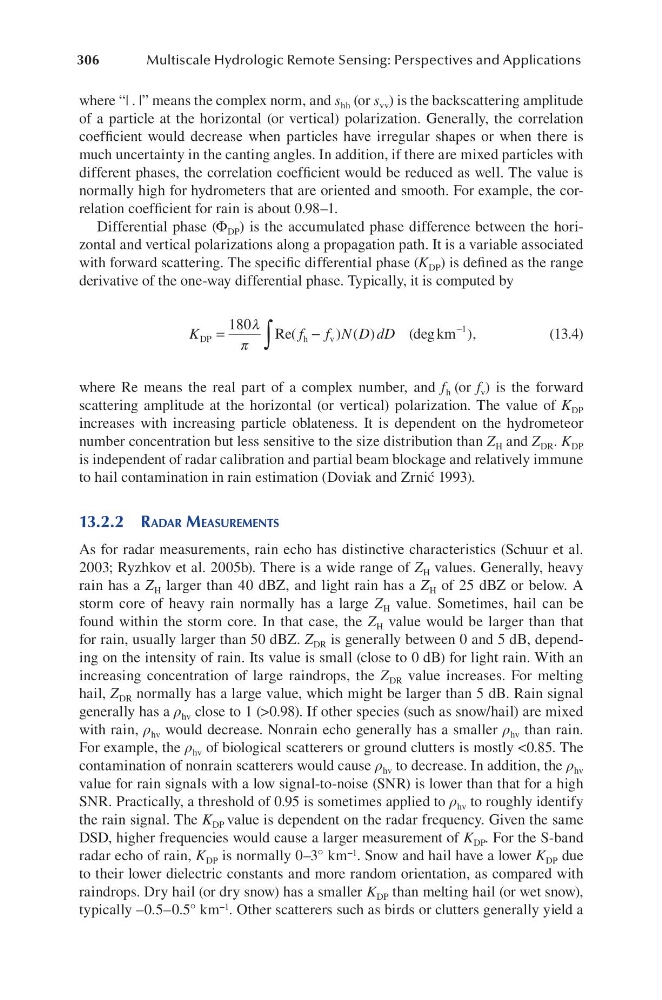
Differential phase (Φ DP ) is the accumulated phase difference between the horizontal and vertical polarizations along a propagation path. It is a variable associated
with forward scattering. The specific differential phase (K DP ) is defined as the range
derivative of the one-way differential phase. Typically, it is computed by
K
f f N D dD
DP
h
v
km
=
−
−
∫
180
1
λ
π
Re(
) ( )
(deg
),
(13.4)
where Re means the real part of a complex number, and f h (or f v ) is the forward
scattering amplitude at the horizontal (or vertical) polarization. The value of K DP
increases with increasing particle oblateness. It is dependent on the hydrometeor
number concentration but less sensitive to the size distribution than Z H and Z DR . K DP
is independent of radar calibration and partial beam blockage and relatively immune
to hail contamination in rain estimation (Doviak and Zrnić 1993).
13.2.2 RadaR MeaSuReMentS
As for radar measurements, rain echo has distinctive characteristics (Schuur et al.
2003; Ryzhkov et al. 2005b). There is a wide range of Z H values. Generally, heavy
rain has a Z H larger than 40 dBZ, and light rain has a Z H of 25 dBZ or below. A
storm core of heavy rain normally has a large Z H value. Sometimes, hail can be
found within the storm core. In that case, the Z H value would be larger than that
for rain, usually larger than 50 dBZ. Z DR is generally between 0 and 5 dB, depending on the intensity of rain. Its value is small (close to 0 dB) for light rain. With an
increasing concentration of large raindrops, the Z DR value increases. For melting
hail, Z DR normally has a large value, which might be larger than 5 dB. Rain signal
generally has a ρ hv close to 1 (>0.98). If other species (such as snow/hail) are mixed
with rain, ρ hv would decrease. Nonrain echo generally has a smaller ρ hv than rain.
For example, the ρ hv of biological scatterers or ground clutters is mostly <0.85. The
contamination of nonrain scatterers would cause ρ hv to decrease. In addition, the ρ hv
value for rain signals with a low signal-to-noise (SNR) is lower than that for a high
SNR. Practically, a threshold of 0.95 is sometimes applied to ρ hv to roughly identify
the rain signal. The K DP value is dependent on the radar frequency. Given the same
DSD, higher frequencies would cause a larger measurement of K DP . For the S-band
radar echo of rain, K DP is normally 0–3° km −1 . Snow and hail have a lower K DP due
to their lower dielectric constants and more random orientation, as compared with
raindrops. Dry hail (or dry snow) has a smaller K DP than melting hail (or wet snow),
typically –0.5–0.5° km −1 . Other scatterers such as birds or clutters generally yield a
Multiscale Hydrologic Remote Sensing: Perspectives and Applications
where “| . |” means the complex norm, and s hh (or s vv ) is the backscattering amplitude
of a particle at the horizontal (or vertical) polarization. Generally, the correlation
coefficient would decrease when particles have irregular shapes or when there is
much uncertainty in the canting angles. In addition, if there are mixed particles with
different phases, the correlation coefficient would be reduced as well. The value is
normally high for hydrometers that are oriented and smooth. For example, the correlation coefficient for rain is about 0.98–1.
Differential phase (Φ DP ) is the accumulated phase difference between the horizontal and vertical polarizations along a propagation path. It is a variable associated
with forward scattering. The specific differential phase (K DP ) is defined as the range
derivative of the one-way differential phase. Typically, it is computed by
K
f f N D dD
DP
h
v
km
=
−
−
∫
180
1
λ
π
Re(
) ( )
(deg
),
(13.4)
where Re means the real part of a complex number, and f h (or f v ) is the forward
scattering amplitude at the horizontal (or vertical) polarization. The value of K DP
increases with increasing particle oblateness. It is dependent on the hydrometeor
number concentration but less sensitive to the size distribution than Z H and Z DR . K DP
is independent of radar calibration and partial beam blockage and relatively immune
to hail contamination in rain estimation (Doviak and Zrnić 1993).
13.2.2 RadaR MeaSuReMentS
As for radar measurements, rain echo has distinctive characteristics (Schuur et al.
2003; Ryzhkov et al. 2005b). There is a wide range of Z H values. Generally, heavy
rain has a Z H larger than 40 dBZ, and light rain has a Z H of 25 dBZ or below. A
storm core of heavy rain normally has a large Z H value. Sometimes, hail can be
found within the storm core. In that case, the Z H value would be larger than that
for rain, usually larger than 50 dBZ. Z DR is generally between 0 and 5 dB, depending on the intensity of rain. Its value is small (close to 0 dB) for light rain. With an
increasing concentration of large raindrops, the Z DR value increases. For melting
hail, Z DR normally has a large value, which might be larger than 5 dB. Rain signal
generally has a ρ hv close to 1 (>0.98). If other species (such as snow/hail) are mixed
with rain, ρ hv would decrease. Nonrain echo generally has a smaller ρ hv than rain.
For example, the ρ hv of biological scatterers or ground clutters is mostly <0.85. The
contamination of nonrain scatterers would cause ρ hv to decrease. In addition, the ρ hv
value for rain signals with a low signal-to-noise (SNR) is lower than that for a high
SNR. Practically, a threshold of 0.95 is sometimes applied to ρ hv to roughly identify
the rain signal. The K DP value is dependent on the radar frequency. Given the same
DSD, higher frequencies would cause a larger measurement of K DP . For the S-band
radar echo of rain, K DP is normally 0–3° km −1 . Snow and hail have a lower K DP due
to their lower dielectric constants and more random orientation, as compared with
raindrops. Dry hail (or dry snow) has a smaller K DP than melting hail (or wet snow),
typically –0.5–0.5° km −1 . Other scatterers such as birds or clutters generally yield a