

305
Radar Polarimetry for Rain Estimation
is essential in understanding radar measurements. This section focuses on the basis
of radar measurements associated with the DSD and rain physics. The following
part first introduces several radar variables, which are important for rain estimation.
13.2.1 RadaR vaRiaBleS
While a radar wave is incident on hydrometeors, its energy is either scattered or
absorbed by the hydrometers. For monostatic radar applications, the backscattering
energy is usually represented using the backscattering cross section σ h (or σ v ), with
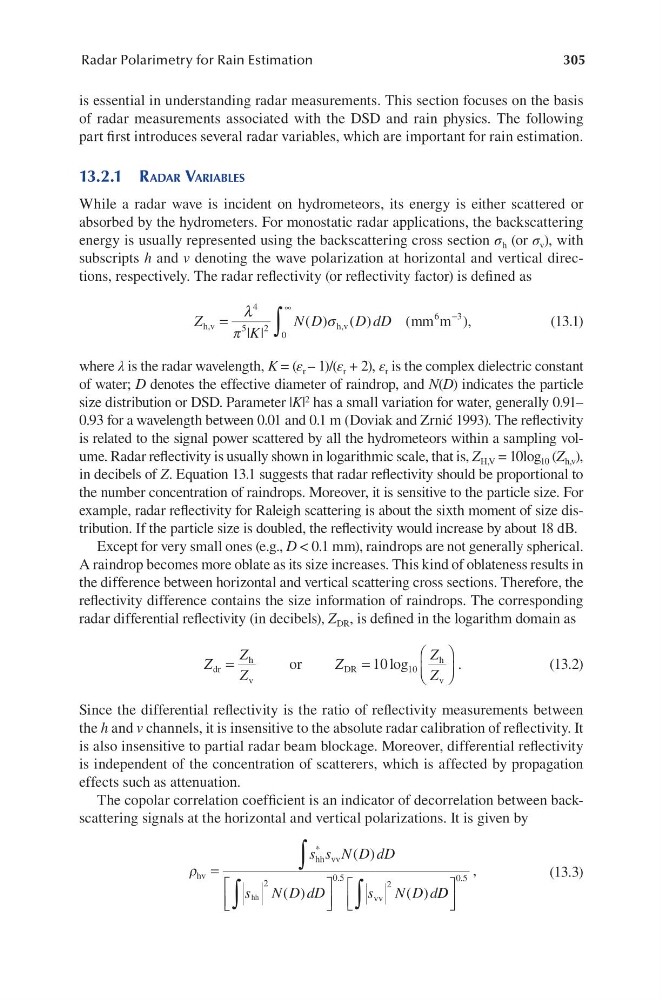
subscripts h and v denoting the wave polarization at horizontal and vertical directions, respectively. The radar reflectivity (or reflectivity factor) is defined as
Z
K
N D
D dD
h,v
2
h,v
6
| |
mm m
=
−
∞
∫
λ
π
σ
4
5
3
0
( ) ( )
(
),
(13.1)
where λ is the radar wavelength, K = (ε r – 1)/(ε r + 2), ε r is the complex dielectric constant
of water; D denotes the effective diameter of raindrop, and N(D) indicates the particle
size distribution or DSD. Parameter |K| 2 has a small variation for water, generally 0.91–
0.93 for a wavelength between 0.01 and 0.1 m (Doviak and Zrnić 1993). The reflectivity
is related to the signal power scattered by all the hydrometeors within a sampling volume. Radar reflectivity is usually shown in logarithmic scale, that is, Z H,V = 10log 10 (Z h,v ),
in decibels of Z. Equation 13.1 suggests that radar reflectivity should be proportional to
the number concentration of raindrops. Moreover, it is sensitive to the particle size. For
example, radar reflectivity for Raleigh scattering is about the sixth moment of size distribution. If the particle size is doubled, the reflectivity would increase by about 18 dB.
Except for very small ones (e.g., D < 0.1 mm), raindrops are not generally spherical.
A raindrop becomes more oblate as its size increases. This kind of oblateness results in
the difference between horizontal and vertical scattering cross sections. Therefore, the
reflectivity difference contains the size information of raindrops. The corresponding
radar differential reflectivity (in decibels), Z DR , is defined in the logarithm domain as
Z
Z
Z
dr
h
v
=
or
Z
Z
Z
DR
h
v
=
10 10
log
.
(13.2)
Since the differential reflectivity is the ratio of reflectivity measurements between
the h and v channels, it is insensitive to the absolute radar calibration of reflectivity. It
is also insensitive to partial radar beam blockage. Moreover, differential reflectivity
is independent of the concentration of scatterers, which is affected by propagation
effects such as attenuation.
The copolar correlation coefficient is an indicator of decorrelation between backscattering signals at the horizontal and vertical polarizations. It is given by
ρ hv
hh vv
vv
hh
=
∫
∫
s s N D dD
s N D dD
s N D d
*
.
( )
( )
( )
2
0 5
2
D D
∫
0 5
.
,
(13.3)
Radar Polarimetry for Rain Estimation
is essential in understanding radar measurements. This section focuses on the basis
of radar measurements associated with the DSD and rain physics. The following
part first introduces several radar variables, which are important for rain estimation.
13.2.1 RadaR vaRiaBleS
While a radar wave is incident on hydrometeors, its energy is either scattered or
absorbed by the hydrometers. For monostatic radar applications, the backscattering
energy is usually represented using the backscattering cross section σ h (or σ v ), with
subscripts h and v denoting the wave polarization at horizontal and vertical directions, respectively. The radar reflectivity (or reflectivity factor) is defined as
Z
K
N D
D dD
h,v
2
h,v
6
| |
mm m
=
−
∞
∫
λ
π
σ
4
5
3
0
( ) ( )
(
),
(13.1)
where λ is the radar wavelength, K = (ε r – 1)/(ε r + 2), ε r is the complex dielectric constant
of water; D denotes the effective diameter of raindrop, and N(D) indicates the particle
size distribution or DSD. Parameter |K| 2 has a small variation for water, generally 0.91–
0.93 for a wavelength between 0.01 and 0.1 m (Doviak and Zrnić 1993). The reflectivity
is related to the signal power scattered by all the hydrometeors within a sampling volume. Radar reflectivity is usually shown in logarithmic scale, that is, Z H,V = 10log 10 (Z h,v ),
in decibels of Z. Equation 13.1 suggests that radar reflectivity should be proportional to
the number concentration of raindrops. Moreover, it is sensitive to the particle size. For
example, radar reflectivity for Raleigh scattering is about the sixth moment of size distribution. If the particle size is doubled, the reflectivity would increase by about 18 dB.
Except for very small ones (e.g., D < 0.1 mm), raindrops are not generally spherical.
A raindrop becomes more oblate as its size increases. This kind of oblateness results in
the difference between horizontal and vertical scattering cross sections. Therefore, the
reflectivity difference contains the size information of raindrops. The corresponding
radar differential reflectivity (in decibels), Z DR , is defined in the logarithm domain as
Z
Z
Z
dr
h
v
=
or
Z
Z
Z
DR
h
v
=
10 10
log
.
(13.2)
Since the differential reflectivity is the ratio of reflectivity measurements between
the h and v channels, it is insensitive to the absolute radar calibration of reflectivity. It
is also insensitive to partial radar beam blockage. Moreover, differential reflectivity
is independent of the concentration of scatterers, which is affected by propagation
effects such as attenuation.
The copolar correlation coefficient is an indicator of decorrelation between backscattering signals at the horizontal and vertical polarizations. It is given by
ρ hv
hh vv
vv
hh
=
∫
∫
s s N D dD
s N D dD
s N D d
*
.
( )
( )
( )
2
0 5
2
D D
∫
0 5
.
,
(13.3)