

147
Remote Sensing Drought Assessment in a Coastal Urban Region
× 10 −8 W m −2 K −4 ); T s is the surface or canopy temperature (in Kelvin), retrieved from
remote-sensing data such as TM/ETM+ and MODIS data; T a is the air temperature
(in Kelvin) of reference height (Z2); and ε a is the atmospheric emissivity (dimensionless), calculated by the empirical formula (Bastiaanssen et al. 1998a,b).
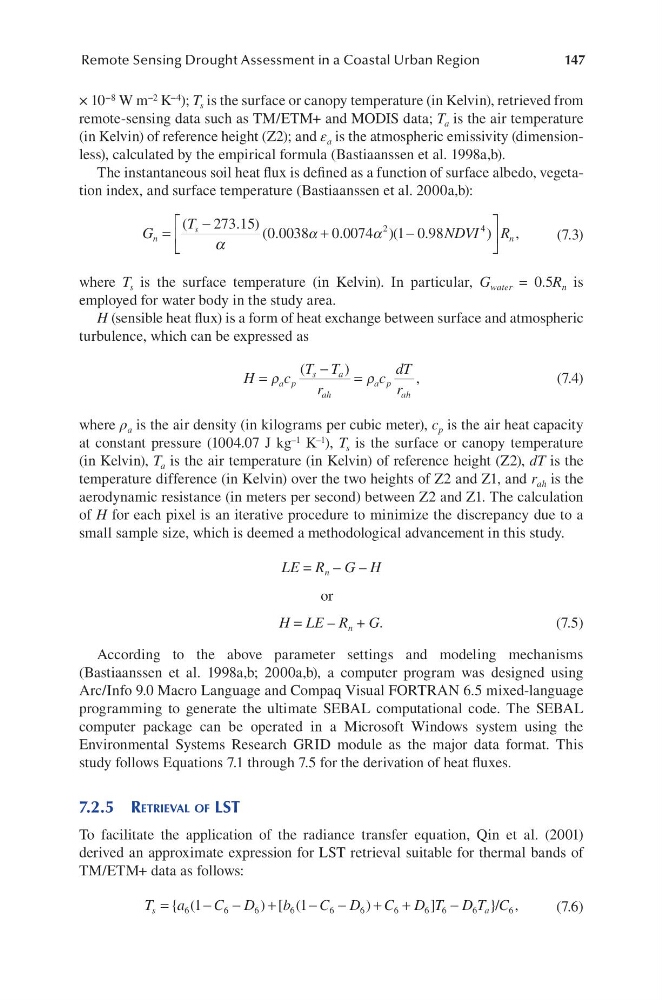
The instantaneous soil heat flux is defined as a function of surface albedo, vegetation index, and surface temperature (Bastiaanssen et al. 2000a,b):
G
T
NDVI
n
s
=
−
+
−
(
. ) ( .
.
)(
.
)
273 15 0 0038
0 0074
1 0 98
2
4
α
α
α
R n ,
(7.3)
where T s is the surface temperature (in Kelvin). In particular, G water = 0.5R n is
employed for water body in the study area.
H (sensible heat flux) is a form of heat exchange between surface and atmospheric
turbulence, which can be expressed as
H
c
T T
r
c
dT
r
a p
s
a
ah
a p
ah
=
−
=
ρ
ρ
(
)
,
(7.4)
where ρ a is the air density (in kilograms per cubic meter), c p is the air heat capacity
at constant pressure (1004.07 J kg –1 K –1 ), T s is the surface or canopy temperature
(in Kelvin), T a is the air temperature (in Kelvin) of reference height (Z2), dT is the
temperature difference (in Kelvin) over the two heights of Z2 and Z1, and r ah is the
aerodynamic resistance (in meters per second) between Z2 and Z1. The calculation
of H for each pixel is an iterative procedure to minimize the discrepancy due to a
small sample size, which is deemed a methodological advancement in this study.
LE = R n – G – H
or
H = LE – R n + G.
(7.5)
According to the above parameter settings and modeling mechanisms
(Bastiaanssen et al. 1998a,b; 2000a,b), a computer program was designed using
Arc/Info 9.0 Macro Language and Compaq Visual FORTRAN 6.5 mixed-language
programming to generate the ultimate SEBAL computational code. The SEBAL
computer package can be operated in a Microsoft Windows system using the
Environmental Systems Research GRID module as the major data format. This
study follows Equations 7.1 through 7.5 for the derivation of heat fluxes.
7.2.5 RetRieval of lSt
To facilitate the application of the radiance transfer equation, Qin et al. (2001)
derived an approximate expression for LST retrieval suitable for thermal bands of
TM/ETM+ data as follows:
T
a
C D
b
C D
C D T D T C
s
a
=
− −
+
− −
+ +
−
{ (
) [ (
)
]
}/ ,
6
6
6
6
6
6
6
6 6
6
6
1
1
(7.6)
Remote Sensing Drought Assessment in a Coastal Urban Region
× 10 −8 W m −2 K −4 ); T s is the surface or canopy temperature (in Kelvin), retrieved from
remote-sensing data such as TM/ETM+ and MODIS data; T a is the air temperature
(in Kelvin) of reference height (Z2); and ε a is the atmospheric emissivity (dimensionless), calculated by the empirical formula (Bastiaanssen et al. 1998a,b).
The instantaneous soil heat flux is defined as a function of surface albedo, vegetation index, and surface temperature (Bastiaanssen et al. 2000a,b):
G
T
NDVI
n
s
=
−
+
−
(
. ) ( .
.
)(
.
)
273 15 0 0038
0 0074
1 0 98
2
4
α
α
α
R n ,
(7.3)
where T s is the surface temperature (in Kelvin). In particular, G water = 0.5R n is
employed for water body in the study area.
H (sensible heat flux) is a form of heat exchange between surface and atmospheric
turbulence, which can be expressed as
H
c
T T
r
c
dT
r
a p
s
a
ah
a p
ah
=
−
=
ρ
ρ
(
)
,
(7.4)
where ρ a is the air density (in kilograms per cubic meter), c p is the air heat capacity
at constant pressure (1004.07 J kg –1 K –1 ), T s is the surface or canopy temperature
(in Kelvin), T a is the air temperature (in Kelvin) of reference height (Z2), dT is the
temperature difference (in Kelvin) over the two heights of Z2 and Z1, and r ah is the
aerodynamic resistance (in meters per second) between Z2 and Z1. The calculation
of H for each pixel is an iterative procedure to minimize the discrepancy due to a
small sample size, which is deemed a methodological advancement in this study.
LE = R n – G – H
or
H = LE – R n + G.
(7.5)
According to the above parameter settings and modeling mechanisms
(Bastiaanssen et al. 1998a,b; 2000a,b), a computer program was designed using
Arc/Info 9.0 Macro Language and Compaq Visual FORTRAN 6.5 mixed-language
programming to generate the ultimate SEBAL computational code. The SEBAL
computer package can be operated in a Microsoft Windows system using the
Environmental Systems Research GRID module as the major data format. This
study follows Equations 7.1 through 7.5 for the derivation of heat fluxes.
7.2.5 RetRieval of lSt
To facilitate the application of the radiance transfer equation, Qin et al. (2001)
derived an approximate expression for LST retrieval suitable for thermal bands of
TM/ETM+ data as follows:
T
a
C D
b
C D
C D T D T C
s
a
=
− −
+
− −
+ +
−
{ (
) [ (
)
]
}/ ,
6
6
6
6
6
6
6
6 6
6
6
1
1
(7.6)