

have thorns and small or hard leathery leaves that
resist water loss. The major areas of occurrence
are in Africa, covering a large part of the low
latitudes, and in the interior of Brazil.
Ribbons of dense tropical forest along most of
the streams are a distinguishing characteristic of
this type of region. Where the streams are small,
the tall trees form a complete arch so that the
streams flow through tunnels, described as
galeria forests.
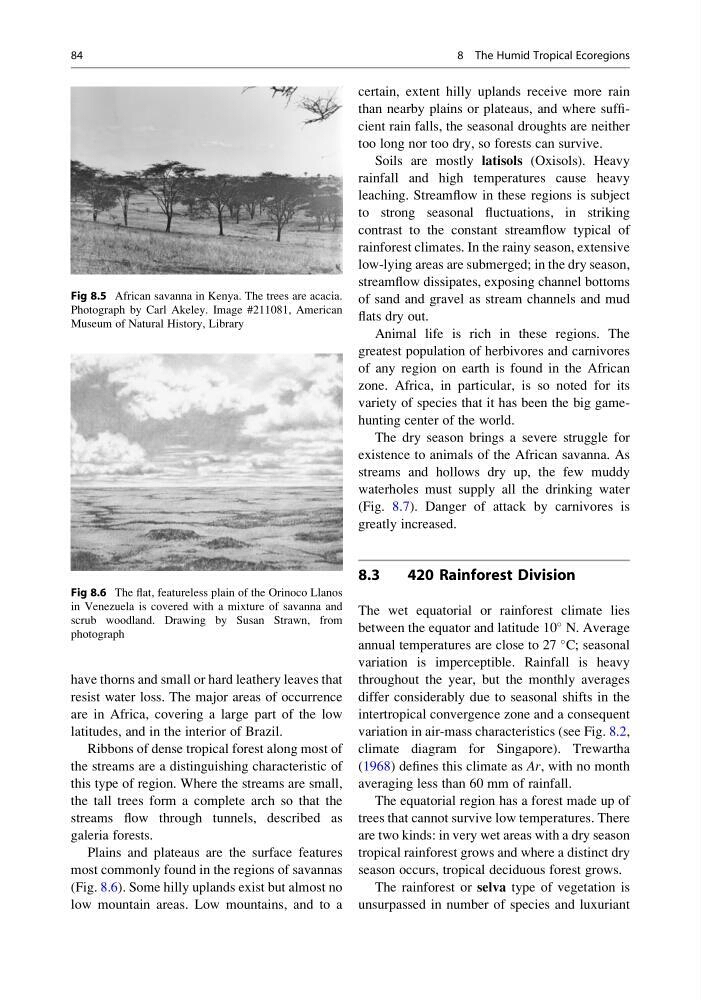
Plains and plateaus are the surface features
most commonly found in the regions of savannas
(Fig. 8.6). Some hilly uplands exist but almost no
low mountain areas. Low mountains, and to a
certain, extent hilly uplands receive more rain
than nearby plains or plateaus, and where sufficient rain falls, the seasonal droughts are neither
too long nor too dry, so forests can survive.
Soils are mostly latisols (Oxisols). Heavy
rainfall and high temperatures cause heavy
leaching. Streamflow in these regions is subject
to strong seasonal fluctuations, in striking
contrast to the constant streamflow typical of
rainforest climates. In the rainy season, extensive
low-lying areas are submerged; in the dry season,
streamflow dissipates, exposing channel bottoms
of sand and gravel as stream channels and mud
flats dry out.
Animal life is rich in these regions. The
greatest population of herbivores and carnivores
of any region on earth is found in the African
zone. Africa, in particular, is so noted for its
variety of species that it has been the big gamehunting center of the world.
The dry season brings a severe struggle for
existence to animals of the African savanna. As
streams and hollows dry up, the few muddy
waterholes must supply all the drinking water
(Fig. 8.7). Danger of attack by carnivores is
greatly increased.
8.3
420 Rainforest Division
The wet equatorial or rainforest climate lies
between the equator and latitude 10
N. Average
annual temperatures are close to 27
C; seasonal
variation is imperceptible. Rainfall is heavy
throughout the year, but the monthly averages
differ considerably due to seasonal shifts in the
intertropical convergence zone and a consequent
variation in air-mass characteristics (see Fig. 8.2,
climate diagram for Singapore). Trewartha
(1968) defines this climate as Ar, with no month
averaging less than 60 mm of rainfall.
The equatorial region has a forest made up of
trees that cannot survive low temperatures. There
are two kinds: in very wet areas with a dry season
tropical rainforest grows and where a distinct dry
season occurs, tropical deciduous forest grows.
The rainforest or selva type of vegetation is
unsurpassed in number of species and luxuriant
Fig 8.5 African savanna in Kenya. The trees are acacia.
Photograph by Carl Akeley. Image #211081, American
Museum of Natural History, Library
Fig 8.6 The flat, featureless plain of the Orinoco Llanos
in Venezuela is covered with a mixture of savanna and
scrub woodland. Drawing by Susan Strawn, from
photograph
84
8 The Humid Tropical Ecoregions
resist water loss. The major areas of occurrence
are in Africa, covering a large part of the low
latitudes, and in the interior of Brazil.
Ribbons of dense tropical forest along most of
the streams are a distinguishing characteristic of
this type of region. Where the streams are small,
the tall trees form a complete arch so that the
streams flow through tunnels, described as
galeria forests.
Plains and plateaus are the surface features
most commonly found in the regions of savannas
(Fig. 8.6). Some hilly uplands exist but almost no
low mountain areas. Low mountains, and to a
certain, extent hilly uplands receive more rain
than nearby plains or plateaus, and where sufficient rain falls, the seasonal droughts are neither
too long nor too dry, so forests can survive.
Soils are mostly latisols (Oxisols). Heavy
rainfall and high temperatures cause heavy
leaching. Streamflow in these regions is subject
to strong seasonal fluctuations, in striking
contrast to the constant streamflow typical of
rainforest climates. In the rainy season, extensive
low-lying areas are submerged; in the dry season,
streamflow dissipates, exposing channel bottoms
of sand and gravel as stream channels and mud
flats dry out.
Animal life is rich in these regions. The
greatest population of herbivores and carnivores
of any region on earth is found in the African
zone. Africa, in particular, is so noted for its
variety of species that it has been the big gamehunting center of the world.
The dry season brings a severe struggle for
existence to animals of the African savanna. As
streams and hollows dry up, the few muddy
waterholes must supply all the drinking water
(Fig. 8.7). Danger of attack by carnivores is
greatly increased.
8.3
420 Rainforest Division
The wet equatorial or rainforest climate lies
between the equator and latitude 10
N. Average
annual temperatures are close to 27
C; seasonal
variation is imperceptible. Rainfall is heavy
throughout the year, but the monthly averages
differ considerably due to seasonal shifts in the
intertropical convergence zone and a consequent
variation in air-mass characteristics (see Fig. 8.2,
climate diagram for Singapore). Trewartha
(1968) defines this climate as Ar, with no month
averaging less than 60 mm of rainfall.
The equatorial region has a forest made up of
trees that cannot survive low temperatures. There
are two kinds: in very wet areas with a dry season
tropical rainforest grows and where a distinct dry
season occurs, tropical deciduous forest grows.
The rainforest or selva type of vegetation is
unsurpassed in number of species and luxuriant
Fig 8.5 African savanna in Kenya. The trees are acacia.
Photograph by Carl Akeley. Image #211081, American
Museum of Natural History, Library
Fig 8.6 The flat, featureless plain of the Orinoco Llanos
in Venezuela is covered with a mixture of savanna and
scrub woodland. Drawing by Susan Strawn, from
photograph
84
8 The Humid Tropical Ecoregions