

and south, and in places on the east as well. On
the equatorward side of the deserts it is transitional to the wet-dry tropical climate. Locally,
altitude causes a semiarid steppe climate on
plateaus and high plains that would otherwise
be desert. Steppes on the poleward fringes of
the tropical deserts grade into the Mediterranean
climate in many places. In the United States, they
are cut off from the Mediterranean climate by
coastal mountains which allow the tropical
deserts to extend farther north. Other important
steppes of this type are the interior of the
Kalahari Desert of South Africa, the dry eastern
piedmont of the Andes, and northeastern Brazil.
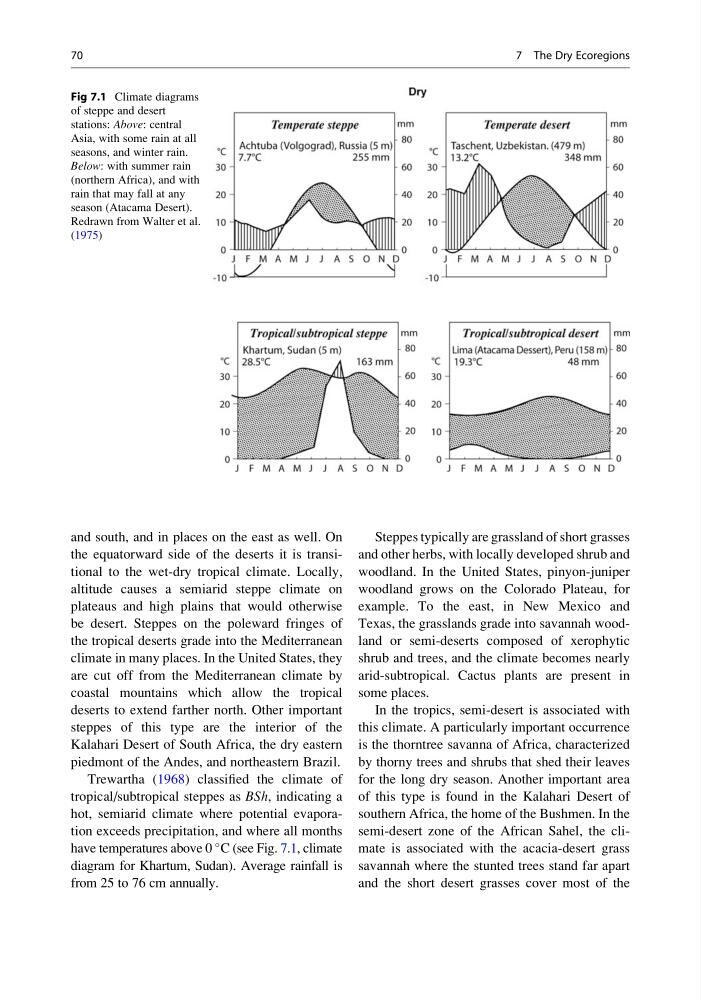
Trewartha (1968) classified the climate of
tropical/subtropical steppes as BSh, indicating a
hot, semiarid climate where potential evaporation exceeds precipitation, and where all months
have temperatures above 0
C (see Fig. 7.1, climate
diagram for Khartum, Sudan). Average rainfall is
from 25 to 76 cm annually.
Steppes typically are grassland of short grasses
and other herbs, with locally developed shrub and
woodland. In the United States, pinyon-juniper
woodland grows on the Colorado Plateau, for
example. To the east, in New Mexico and
Texas, the grasslands grade into savannah woodland or semi-deserts composed of xerophytic
shrub and trees, and the climate becomes nearly
arid-subtropical. Cactus plants are present in
some places.
In the tropics, semi-desert is associated with
this climate. A particularly important occurrence
is the thorntree savanna of Africa, characterized
by thorny trees and shrubs that shed their leaves
for the long dry season. Another important area
of this type is found in the Kalahari Desert of
southern Africa, the home of the Bushmen. In the
semi-desert zone of the African Sahel, the climate is associated with the acacia-desert grass
savannah where the stunted trees stand far apart
and the short desert grasses cover most of the
Fig 7.1 Climate diagrams
of steppe and desert
stations: Above: central
Asia, with some rain at all
seasons, and winter rain.
Below: with summer rain
(northern Africa), and with
rain that may fall at any
season (Atacama Desert).
Redrawn from Walter et al.
(1975)
70
7 The Dry Ecoregions
the equatorward side of the deserts it is transitional to the wet-dry tropical climate. Locally,
altitude causes a semiarid steppe climate on
plateaus and high plains that would otherwise
be desert. Steppes on the poleward fringes of
the tropical deserts grade into the Mediterranean
climate in many places. In the United States, they
are cut off from the Mediterranean climate by
coastal mountains which allow the tropical
deserts to extend farther north. Other important
steppes of this type are the interior of the
Kalahari Desert of South Africa, the dry eastern
piedmont of the Andes, and northeastern Brazil.
Trewartha (1968) classified the climate of
tropical/subtropical steppes as BSh, indicating a
hot, semiarid climate where potential evaporation exceeds precipitation, and where all months
have temperatures above 0
C (see Fig. 7.1, climate
diagram for Khartum, Sudan). Average rainfall is
from 25 to 76 cm annually.
Steppes typically are grassland of short grasses
and other herbs, with locally developed shrub and
woodland. In the United States, pinyon-juniper
woodland grows on the Colorado Plateau, for
example. To the east, in New Mexico and
Texas, the grasslands grade into savannah woodland or semi-deserts composed of xerophytic
shrub and trees, and the climate becomes nearly
arid-subtropical. Cactus plants are present in
some places.
In the tropics, semi-desert is associated with
this climate. A particularly important occurrence
is the thorntree savanna of Africa, characterized
by thorny trees and shrubs that shed their leaves
for the long dry season. Another important area
of this type is found in the Kalahari Desert of
southern Africa, the home of the Bushmen. In the
semi-desert zone of the African Sahel, the climate is associated with the acacia-desert grass
savannah where the stunted trees stand far apart
and the short desert grasses cover most of the
Fig 7.1 Climate diagrams
of steppe and desert
stations: Above: central
Asia, with some rain at all
seasons, and winter rain.
Below: with summer rain
(northern Africa), and with
rain that may fall at any
season (Atacama Desert).
Redrawn from Walter et al.
(1975)
70
7 The Dry Ecoregions