

6.7
260 Mediterranean Division
Situated on the western margins of the continents
between latitudes 30
and 45
N is a zone subject
to alternately wet and dry seasons, the transition
zone between the dry west coast desert and the
wet west coast. There are five such locations in
the world. The largest borders the Mediterranean
Sea. In North America the area included in this
division lies primarily in California. Other areas
are found in Chile, in South Africa around
Capetown, and in Australia, where they are
divided into a western area around Perth and an
eastern area around Adelaide. They occupy only
2 % of the Earth’s surface.
Trewartha (1968) classified the climate of
these lands as Cs, signifying a temperate, rainy
climate with dry, hot summers. The symbol
s signifies a dry summer (see Fig. 6.3, climate
diagram for Los Angeles, Calif.).
This climate is a product of subsidence
associated with the subtropical high. In the summer the high moves poleward over these areas
bringing essentially desert weather. In the winter
the anticyclonic circulation moves equatorward
allowing the westerlies to bring moisture into the
area. These weather patterns often lead to summer wildfires (Fig. 6.13).
The combination of wet winters with dry summers is unique among climate types, and
produces a distinctive natural vegetation of
hard-leaved evergreen trees and shrubs called
sclerophyll, scrub woodland. They reduce
water loss with leaves which are small, thick,
and stiff, with hard, leathery, and shiny surfaces.
Various forms of sclerophyll woodland and scrub
are also typical. Trees and shrubs must withstand
the severe summer drought—two to four rainless
months—and severe evaporation. Although in
the different continents different species compose the woodland, the appearance of the
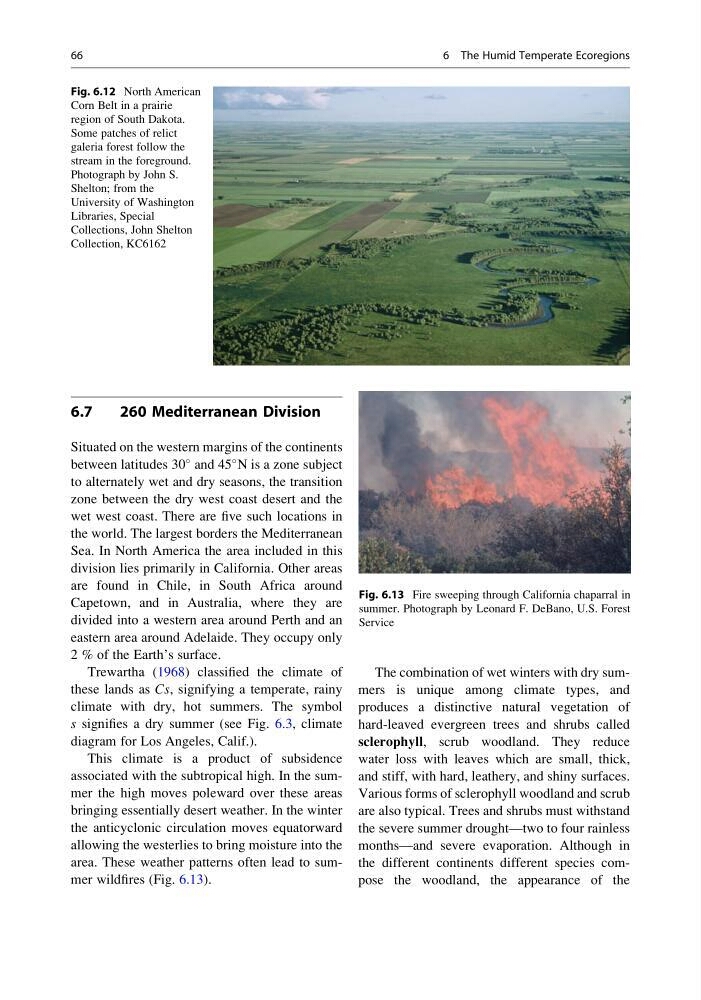
Fig. 6.12 North American
Corn Belt in a prairie
region of South Dakota.
Some patches of relict
galeria forest follow the
stream in the foreground.
Photograph by John S.
Shelton; from the
University of Washington
Libraries, Special
Collections, John Shelton
Collection, KC6162
Fig. 6.13 Fire sweeping through California chaparral in
summer. Photograph by Leonard F. DeBano, U.S. Forest
Service
66
6 The Humid Temperate Ecoregions
260 Mediterranean Division
Situated on the western margins of the continents
between latitudes 30
and 45
N is a zone subject
to alternately wet and dry seasons, the transition
zone between the dry west coast desert and the
wet west coast. There are five such locations in
the world. The largest borders the Mediterranean
Sea. In North America the area included in this
division lies primarily in California. Other areas
are found in Chile, in South Africa around
Capetown, and in Australia, where they are
divided into a western area around Perth and an
eastern area around Adelaide. They occupy only
2 % of the Earth’s surface.
Trewartha (1968) classified the climate of
these lands as Cs, signifying a temperate, rainy
climate with dry, hot summers. The symbol
s signifies a dry summer (see Fig. 6.3, climate
diagram for Los Angeles, Calif.).
This climate is a product of subsidence
associated with the subtropical high. In the summer the high moves poleward over these areas
bringing essentially desert weather. In the winter
the anticyclonic circulation moves equatorward
allowing the westerlies to bring moisture into the
area. These weather patterns often lead to summer wildfires (Fig. 6.13).
The combination of wet winters with dry summers is unique among climate types, and
produces a distinctive natural vegetation of
hard-leaved evergreen trees and shrubs called
sclerophyll, scrub woodland. They reduce
water loss with leaves which are small, thick,
and stiff, with hard, leathery, and shiny surfaces.
Various forms of sclerophyll woodland and scrub
are also typical. Trees and shrubs must withstand
the severe summer drought—two to four rainless
months—and severe evaporation. Although in
the different continents different species compose the woodland, the appearance of the
Fig. 6.12 North American
Corn Belt in a prairie
region of South Dakota.
Some patches of relict
galeria forest follow the
stream in the foreground.
Photograph by John S.
Shelton; from the
University of Washington
Libraries, Special
Collections, John Shelton
Collection, KC6162
Fig. 6.13 Fire sweeping through California chaparral in
summer. Photograph by Leonard F. DeBano, U.S. Forest
Service
66
6 The Humid Temperate Ecoregions