

matter forms a heavy surface deposit. Organic
acids from decomposing vegetation react with
soil compounds, removing bases such as calcium, sodium, and potassium. Under the lower
precipitation of the British Isles and western
Europe, mid-latitude deciduous forests are
underlain by gray-brown podzols (Alfisols).
Productivity is fairly high in these forests, but
it chiefly goes into wood. Available forage is not
high, so that the biomass of large animals is not
great, although deer, elk, and mountain lions
form part of the American marine ecosystem. In
New Zealand, no mammals or reptiles existed in
the original forest. The niches were filled by
birds, such as the kiwi.
The marine regions of western Europe and the
British Isles have been intensively developed for
centuries for such diverse use as crop farming,
dairying, orchards, and forests. In North America, the mountainous terrain is not suitable for
agricultural use, except in limited valley floors.
Forests are the primary resource here and constitute the greatest structural and pulpwood timber
resource on Earth. Douglas-fir, western cedar,
and western hemlock are the principal lumber
trees. The same mountainous terrain that limits
agriculture is a producer of enormous water
surpluses that run to the sea in rivers. These
rivers support anadromous fisheries.
In spite of the heavy rainfall, periods of
drought up to several weeks can occur, so that
many areas in the northwestern United States and
the western coast of New Zealand have been
burned. In New Zealand, the introduction of
many species of deer proved to be a serious
mistake, since these forests evolved in the
absence of grazing mammals. Deer and sheep
have seriously overbrowsed these forests.
6.6
250 Prairie Division
The deciduous forests of the temperate zone are
confined to climatic regions of an oceanic nature,
where extremes of temperature are not sharp, and
where rainfall is more or less evenly distributed
throughout the year. Two chief kinds of
grasslands thrive in the transition zone of the
middle latitudes between the forests and the
deserts. On the dry margins are the short-grass
steppes (p. 75) and on the wet margins are the
tall-grass prairies.
Prairies are typically associated with continental, mid-latitude climates designated as subhumid. Precipitation in these climates ranges
from 510 and 1,020 mm per year, and is almost
entirely offset by evapotranspiration (see
Fig. 6.3, climate diagram for Edmonton,
Alberta). In summer, air and soil temperatures
are high. Soil moisture in the uplands is inadequate for tree growth, and deeper sources of
water are beyond the reach of tree roots. In
North America, prairies form a broad belt
extending from Texas northward to southern
Alberta and Saskatchewan. Similar prairies
occur in the humid pampa of Argentina, in
Uruguay and southern Brazil, in the puszta of
Hungary and on the northern side of Russian
steppes, in South Africa, in Manchuria, and in
Australia.
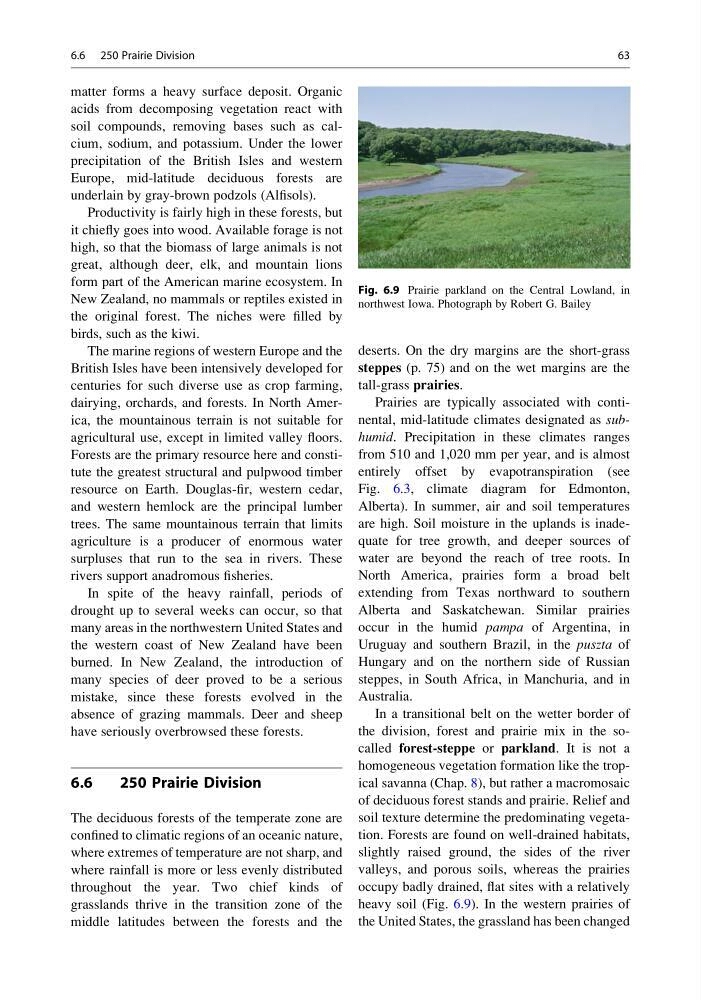
In a transitional belt on the wetter border of
the division, forest and prairie mix in the socalled forest-steppe or parkland. It is not a
homogeneous vegetation formation like the tropical savanna (Chap. 8), but rather a macromosaic
of deciduous forest stands and prairie. Relief and
soil texture determine the predominating vegetation. Forests are found on well-drained habitats,
slightly raised ground, the sides of the river
valleys, and porous soils, whereas the prairies
occupy badly drained, flat sites with a relatively
heavy soil (Fig. 6.9). In the western prairies of
the United States, the grassland has been changed
Fig. 6.9 Prairie parkland on the Central Lowland, in
northwest Iowa. Photograph by Robert G. Bailey
6.6 250 Prairie Division
63
acids from decomposing vegetation react with
soil compounds, removing bases such as calcium, sodium, and potassium. Under the lower
precipitation of the British Isles and western
Europe, mid-latitude deciduous forests are
underlain by gray-brown podzols (Alfisols).
Productivity is fairly high in these forests, but
it chiefly goes into wood. Available forage is not
high, so that the biomass of large animals is not
great, although deer, elk, and mountain lions
form part of the American marine ecosystem. In
New Zealand, no mammals or reptiles existed in
the original forest. The niches were filled by
birds, such as the kiwi.
The marine regions of western Europe and the
British Isles have been intensively developed for
centuries for such diverse use as crop farming,
dairying, orchards, and forests. In North America, the mountainous terrain is not suitable for
agricultural use, except in limited valley floors.
Forests are the primary resource here and constitute the greatest structural and pulpwood timber
resource on Earth. Douglas-fir, western cedar,
and western hemlock are the principal lumber
trees. The same mountainous terrain that limits
agriculture is a producer of enormous water
surpluses that run to the sea in rivers. These
rivers support anadromous fisheries.
In spite of the heavy rainfall, periods of
drought up to several weeks can occur, so that
many areas in the northwestern United States and
the western coast of New Zealand have been
burned. In New Zealand, the introduction of
many species of deer proved to be a serious
mistake, since these forests evolved in the
absence of grazing mammals. Deer and sheep
have seriously overbrowsed these forests.
6.6
250 Prairie Division
The deciduous forests of the temperate zone are
confined to climatic regions of an oceanic nature,
where extremes of temperature are not sharp, and
where rainfall is more or less evenly distributed
throughout the year. Two chief kinds of
grasslands thrive in the transition zone of the
middle latitudes between the forests and the
deserts. On the dry margins are the short-grass
steppes (p. 75) and on the wet margins are the
tall-grass prairies.
Prairies are typically associated with continental, mid-latitude climates designated as subhumid. Precipitation in these climates ranges
from 510 and 1,020 mm per year, and is almost
entirely offset by evapotranspiration (see
Fig. 6.3, climate diagram for Edmonton,
Alberta). In summer, air and soil temperatures
are high. Soil moisture in the uplands is inadequate for tree growth, and deeper sources of
water are beyond the reach of tree roots. In
North America, prairies form a broad belt
extending from Texas northward to southern
Alberta and Saskatchewan. Similar prairies
occur in the humid pampa of Argentina, in
Uruguay and southern Brazil, in the puszta of
Hungary and on the northern side of Russian
steppes, in South Africa, in Manchuria, and in
Australia.
In a transitional belt on the wetter border of
the division, forest and prairie mix in the socalled forest-steppe or parkland. It is not a
homogeneous vegetation formation like the tropical savanna (Chap. 8), but rather a macromosaic
of deciduous forest stands and prairie. Relief and
soil texture determine the predominating vegetation. Forests are found on well-drained habitats,
slightly raised ground, the sides of the river
valleys, and porous soils, whereas the prairies
occupy badly drained, flat sites with a relatively
heavy soil (Fig. 6.9). In the western prairies of
the United States, the grassland has been changed
Fig. 6.9 Prairie parkland on the Central Lowland, in
northwest Iowa. Photograph by Robert G. Bailey
6.6 250 Prairie Division
63