

northwestern United States, it is the redwood
zone. Farther north, this vegetation is succeeded
by Douglas-fir, western red cedar (Fig. 6.8), and
spruce which grow to enormous heights, forming
some of the densest of all coniferous forest with
some of the world’s largest trees. Under the
lower precipitation regime of Ireland, southern
England, France, and the Low Countries, a
broadleaf deciduous forest was the native vegetation. However, much of it disappeared many
centuries ago under cultivation, so that only
scattered forest plots or groves remain. Dominant
tree species of this forest type in western Europe
are oak and ash, with beech in the cooler, moister
areas. In the Southern Hemisphere, the forests of
Tasmania and New Zealand, and the mountainous coastal belt of southern Chile are of the
temperate rainforest class.
The trees are covered with mosses, epiphytes,
and ferns. They cover everything from living
branches and leaves to rotting logs. Because of
the cool climate, decomposition works slowly;
log piles upon logs to form a moss and ferncovered jumble over the forest floor, which is
deep in humus. This is very much unlike the
tropical rainforest, where decomposers make
short work of falling debris so that the forest
floor has little humus and few fallen logs.
Because of recent Pleistocene glaciation,
landforms of glacial erosion and deposition are
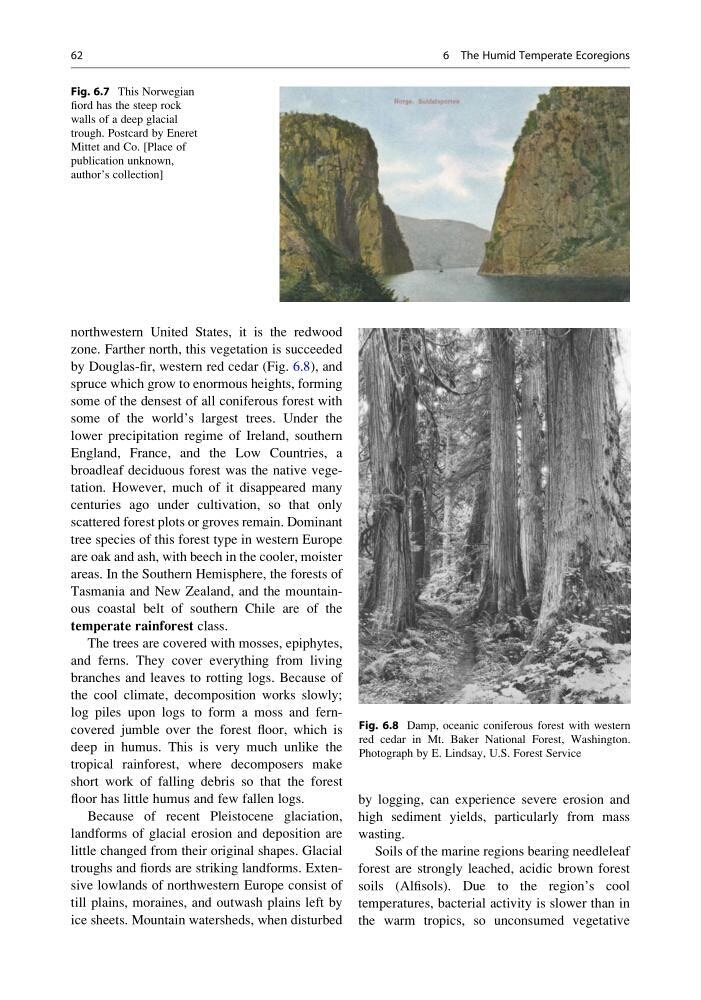
little changed from their original shapes. Glacial
troughs and fiords are striking landforms. Extensive lowlands of northwestern Europe consist of
till plains, moraines, and outwash plains left by
ice sheets. Mountain watersheds, when disturbed
by logging, can experience severe erosion and
high sediment yields, particularly from mass
wasting.
Soils of the marine regions bearing needleleaf
forest are strongly leached, acidic brown forest
soils (Alfisols). Due to the region’s cool
temperatures, bacterial activity is slower than in
the warm tropics, so unconsumed vegetative
Fig. 6.8 Damp, oceanic coniferous forest with western
red cedar in Mt. Baker National Forest, Washington.
Photograph by E. Lindsay, U.S. Forest Service
Fig. 6.7 This Norwegian
fiord has the steep rock
walls of a deep glacial
trough. Postcard by Eneret
Mittet and Co. [Place of
publication unknown,
author’s collection]
62
6 The Humid Temperate Ecoregions
zone. Farther north, this vegetation is succeeded
by Douglas-fir, western red cedar (Fig. 6.8), and
spruce which grow to enormous heights, forming
some of the densest of all coniferous forest with
some of the world’s largest trees. Under the
lower precipitation regime of Ireland, southern
England, France, and the Low Countries, a
broadleaf deciduous forest was the native vegetation. However, much of it disappeared many
centuries ago under cultivation, so that only
scattered forest plots or groves remain. Dominant
tree species of this forest type in western Europe
are oak and ash, with beech in the cooler, moister
areas. In the Southern Hemisphere, the forests of
Tasmania and New Zealand, and the mountainous coastal belt of southern Chile are of the
temperate rainforest class.
The trees are covered with mosses, epiphytes,
and ferns. They cover everything from living
branches and leaves to rotting logs. Because of
the cool climate, decomposition works slowly;
log piles upon logs to form a moss and ferncovered jumble over the forest floor, which is
deep in humus. This is very much unlike the
tropical rainforest, where decomposers make
short work of falling debris so that the forest
floor has little humus and few fallen logs.
Because of recent Pleistocene glaciation,
landforms of glacial erosion and deposition are
little changed from their original shapes. Glacial
troughs and fiords are striking landforms. Extensive lowlands of northwestern Europe consist of
till plains, moraines, and outwash plains left by
ice sheets. Mountain watersheds, when disturbed
by logging, can experience severe erosion and
high sediment yields, particularly from mass
wasting.
Soils of the marine regions bearing needleleaf
forest are strongly leached, acidic brown forest
soils (Alfisols). Due to the region’s cool
temperatures, bacterial activity is slower than in
the warm tropics, so unconsumed vegetative
Fig. 6.8 Damp, oceanic coniferous forest with western
red cedar in Mt. Baker National Forest, Washington.
Photograph by E. Lindsay, U.S. Forest Service
Fig. 6.7 This Norwegian
fiord has the steep rock
walls of a deep glacial
trough. Postcard by Eneret
Mittet and Co. [Place of
publication unknown,
author’s collection]
62
6 The Humid Temperate Ecoregions