

against the trees since it cannot push the solid
permafrost down. This annual freeze-thaw cycle
produces a topsy-turvy forest with tree trunks and
utility poles leaning in all directions (Fig. 5.9).
The great north-flowing rivers of these
regions, like those of the Arctic tundra, are subject to extensive spring floods, and the lowlands,
even where they are not glaciated, do not dry out
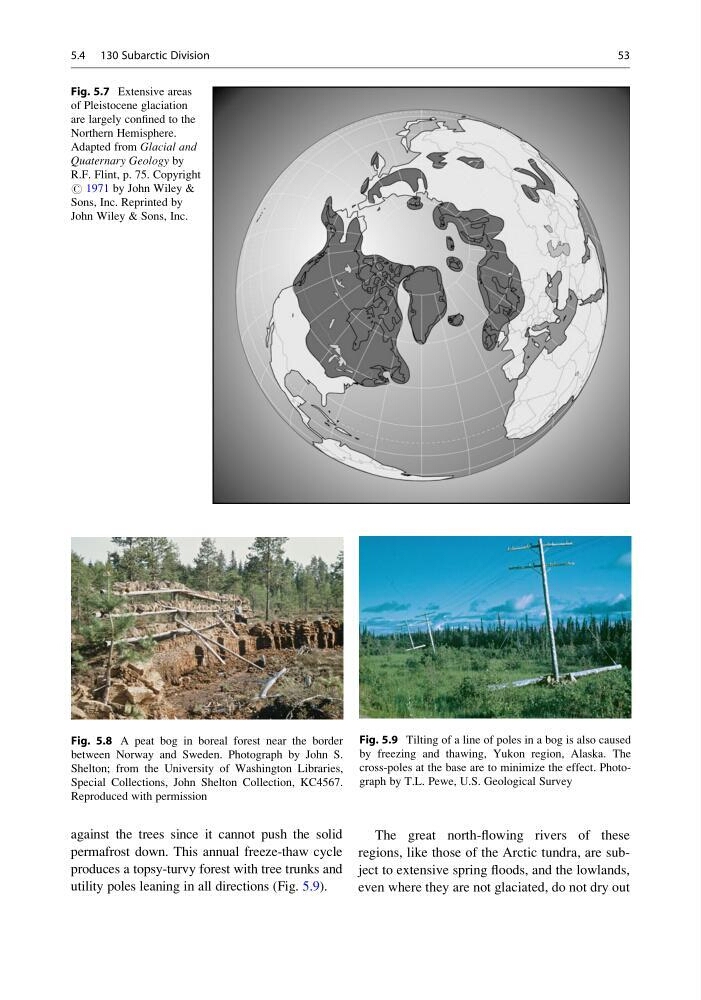
Fig. 5.7 Extensive areas
of Pleistocene glaciation
are largely confined to the
Northern Hemisphere.
Adapted from Glacial and
Quaternary Geology by
R.F. Flint, p. 75. Copyright
# 1971 by John Wiley &
Sons, Inc. Reprinted by
John Wiley & Sons, Inc.
Fig. 5.8 A peat bog in boreal forest near the border
between Norway and Sweden. Photograph by John S.
Shelton; from the University of Washington Libraries,
Special Collections, John Shelton Collection, KC4567.
Reproduced with permission
Fig. 5.9 Tilting of a line of poles in a bog is also caused
by freezing and thawing, Yukon region, Alaska. The
cross-poles at the base are to minimize the effect. Photograph by T.L. Pewe, U.S. Geological Survey
5.4 130 Subarctic Division
53
permafrost down. This annual freeze-thaw cycle
produces a topsy-turvy forest with tree trunks and
utility poles leaning in all directions (Fig. 5.9).
The great north-flowing rivers of these
regions, like those of the Arctic tundra, are subject to extensive spring floods, and the lowlands,
even where they are not glaciated, do not dry out
Fig. 5.7 Extensive areas
of Pleistocene glaciation
are largely confined to the
Northern Hemisphere.
Adapted from Glacial and
Quaternary Geology by
R.F. Flint, p. 75. Copyright
# 1971 by John Wiley &
Sons, Inc. Reprinted by
John Wiley & Sons, Inc.
Fig. 5.8 A peat bog in boreal forest near the border
between Norway and Sweden. Photograph by John S.
Shelton; from the University of Washington Libraries,
Special Collections, John Shelton Collection, KC4567.
Reproduced with permission
Fig. 5.9 Tilting of a line of poles in a bog is also caused
by freezing and thawing, Yukon region, Alaska. The
cross-poles at the base are to minimize the effect. Photograph by T.L. Pewe, U.S. Geological Survey
5.4 130 Subarctic Division
53