

Chaps. 5–8, we describe the characteristics of
each of the ecoregion domains and divisions of
the continents. These characteristics result from
the interplay of surface features, climate, vegetation, soil, water, and fauna. The proportion of the
Earth’s land area included in each group is shown
in Table 4.4.
The descriptions are based on information
compiled and summarized from many sources,
the most important of which are James (1959),
Hidore (1974), Strahler and Strahler (1989),
Walter (1984), and Schultz (1995). Climate
descriptions are based largely on the
Ko ¨ppen–Trewartha classification, but we also
explain them in terms of air masses and frontal
zones which are shown in Appendix A. In
presenting the climate, we make use of climate
diagrams of representative stations adapted from
the well-known system of Heinrich Walter
(Walter and Lieth 1960–1967; Walter et al.
1975). Soil information is founded on the soil
classification established by the USDA Soil
Conservation Service (U.S. Department of Agriculture 1938; U.S. Department of Agriculture
and Soil Survey Staff 1975), now the Natural
Resources Conservation Service.
4.4
Relationship to Other
Ecoregional Zoning Systems
Several different approaches for defining
ecoregions have grown out of the system
presented in this book (for details, see Appendix
D). One example would be The Nature Conservancy (TNC), which has shifted its focus from
conservation of single species and small sites to
conservation planning on an ecoregional basis
(The Nature Conservancy 1997). On their map,
this text appears:
This map was developed as a coordinated effort by
TNC US ecoregional planning teams. Based on
Bailey 1994, the ecoregions have been modified
for both biological and administrative purposes.
They included other criteria, such as the distribution of species as well as the location of
conservation units within ecoregions to be
administered or managed. According to Denny
Grossman of The Nature Conservancy (personal
communication), land use may have been
included in the mix of factors they considered.
Hargrove and Luxmore (1998) created
ecoregions of the United States by applying a
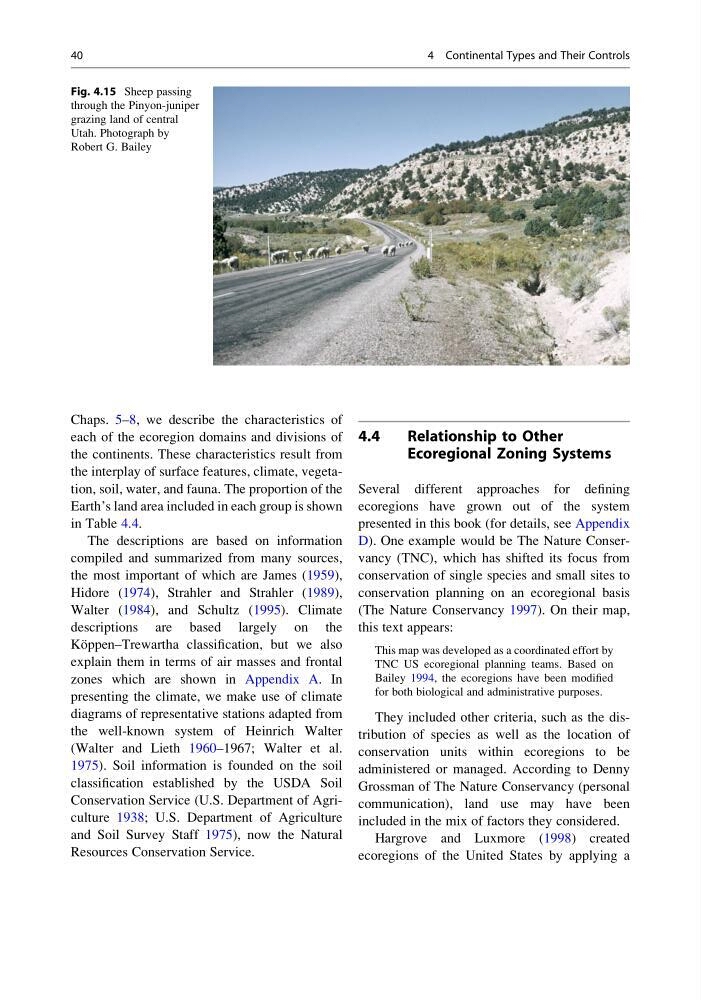
Fig. 4.15 Sheep passing
through the Pinyon-juniper
grazing land of central
Utah. Photograph by
Robert G. Bailey
40
4 Continental Types and Their Controls
each of the ecoregion domains and divisions of
the continents. These characteristics result from
the interplay of surface features, climate, vegetation, soil, water, and fauna. The proportion of the
Earth’s land area included in each group is shown
in Table 4.4.
The descriptions are based on information
compiled and summarized from many sources,
the most important of which are James (1959),
Hidore (1974), Strahler and Strahler (1989),
Walter (1984), and Schultz (1995). Climate
descriptions are based largely on the
Ko ¨ppen–Trewartha classification, but we also
explain them in terms of air masses and frontal
zones which are shown in Appendix A. In
presenting the climate, we make use of climate
diagrams of representative stations adapted from
the well-known system of Heinrich Walter
(Walter and Lieth 1960–1967; Walter et al.
1975). Soil information is founded on the soil
classification established by the USDA Soil
Conservation Service (U.S. Department of Agriculture 1938; U.S. Department of Agriculture
and Soil Survey Staff 1975), now the Natural
Resources Conservation Service.
4.4
Relationship to Other
Ecoregional Zoning Systems
Several different approaches for defining
ecoregions have grown out of the system
presented in this book (for details, see Appendix
D). One example would be The Nature Conservancy (TNC), which has shifted its focus from
conservation of single species and small sites to
conservation planning on an ecoregional basis
(The Nature Conservancy 1997). On their map,
this text appears:
This map was developed as a coordinated effort by
TNC US ecoregional planning teams. Based on
Bailey 1994, the ecoregions have been modified
for both biological and administrative purposes.
They included other criteria, such as the distribution of species as well as the location of
conservation units within ecoregions to be
administered or managed. According to Denny
Grossman of The Nature Conservancy (personal
communication), land use may have been
included in the mix of factors they considered.
Hargrove and Luxmore (1998) created
ecoregions of the United States by applying a
Fig. 4.15 Sheep passing
through the Pinyon-juniper
grazing land of central
Utah. Photograph by
Robert G. Bailey
40
4 Continental Types and Their Controls