

structuring global and continent-scale conservation efforts. For example, The Nature Conservancy has shifted the focus from conservation
of single species and small sites to conservation
planning on an ecoregional basis (Stein et al.
2000; Valutis and Mullen 2000). The Nature
Conservancy modified Bailey’s classification to
identify 63 ecoregions across the United States.
Organizations such as the National Wildlife Federation
2 and the U.S. Fish and Wildlife Service
(cf. Corace et al. 2012) have found that
ecoregions (sensu Bailey) define useful geographical units for conservation. Likewise the
Department of Interior has initiated a national
network of 22 Landscape Conservation
Cooperatives (LLCs) that are based on bird conservation areas, which are loosely based on
ecoregions. The World Wildlife Fund has developed an ecoregion classification system to assess
the status of the world’s wildlife and conserve the
most biologically valuable ecoregions (Olson
and Dinerstein 1998). It builds on Omernik
(1987) and other analyses to provide a globallevel view of ecoregions and to highlight those
ecoregions worldwide that are particularly significant and should be priorities for conservation
action. The U.S. Forest Service uses the Bailey
ecoregion classification (Bailey 1995) to evaluate the adequacy of ecosystem representation
within the National Wilderness Preservation System (Loomis and Echohawk 1999; Cordell
2012). Jepson et al. (2011) provide a critique of
the various approaches to ecoregion-style conservation planning.
12.3 Significance to Research
It is important to link the ecosystem hierarchy
with the research hierarchy. In so doing, research
structures and ecosystem hierarchies correlate
such that research information, mapping levels,
and research studies work well together. Comparison of research structures and ecosystem
levels can identify gaps in the research network.
At the ecoregional scale, existing research
locations can be compared with ecoregion maps
to identify underrepresented regions or gaps in
the network (Fig. 12.10). For example, experimental forests or ranges administered by the Forest Service occur in only 26 of 52 ecoregion
provinces (Lugo et al. 2006). Several ecoregions
have no research facilities while others have
more than one. The greatest number (14) falls
within the Laurentian mixed forest ecoregion of
the Lake States and Northeast. A more comprehensive analysis could include other types of
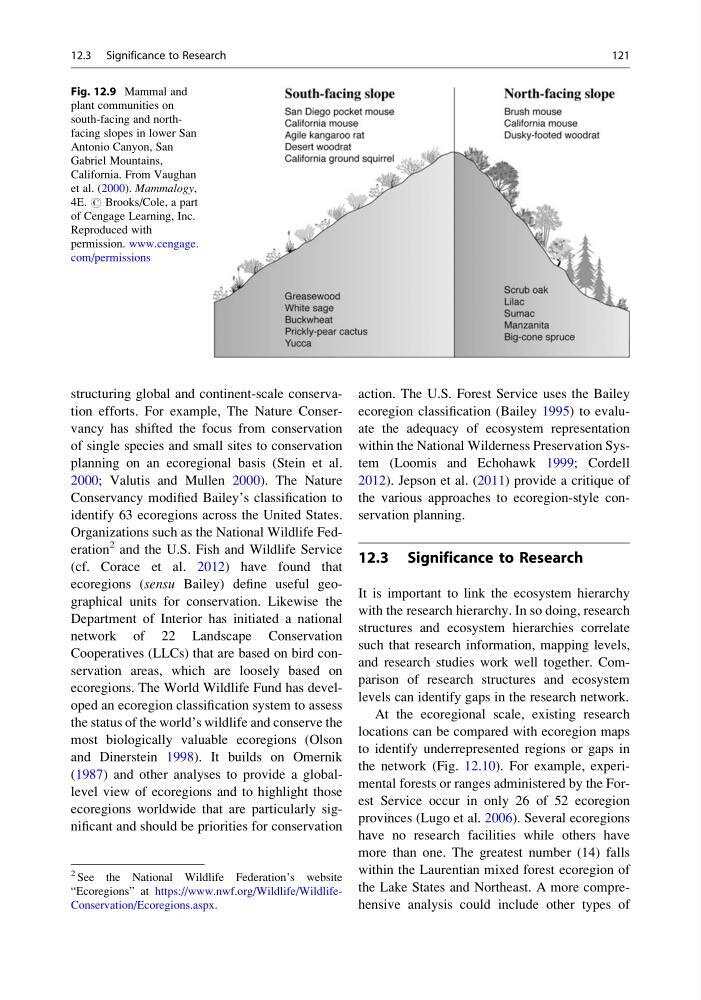
Fig. 12.9 Mammal and
plant communities on
south-facing and northfacing slopes in lower San
Antonio Canyon, San
Gabriel Mountains,
California. From Vaughan
et al. (2000). Mammalogy,
4E. # Brooks/Cole, a part
of Cengage Learning, Inc.
Reproduced with
permission. www.cengage.
com/permissions
2 See the National Wildlife Federation’s website
“Ecoregions” at https://www.nwf.org/Wildlife/WildlifeConservation/Ecoregions.aspx.
12.3 Significance to Research
121
of single species and small sites to conservation
planning on an ecoregional basis (Stein et al.
2000; Valutis and Mullen 2000). The Nature
Conservancy modified Bailey’s classification to
identify 63 ecoregions across the United States.
Organizations such as the National Wildlife Federation
2 and the U.S. Fish and Wildlife Service
(cf. Corace et al. 2012) have found that
ecoregions (sensu Bailey) define useful geographical units for conservation. Likewise the
Department of Interior has initiated a national
network of 22 Landscape Conservation
Cooperatives (LLCs) that are based on bird conservation areas, which are loosely based on
ecoregions. The World Wildlife Fund has developed an ecoregion classification system to assess
the status of the world’s wildlife and conserve the
most biologically valuable ecoregions (Olson
and Dinerstein 1998). It builds on Omernik
(1987) and other analyses to provide a globallevel view of ecoregions and to highlight those
ecoregions worldwide that are particularly significant and should be priorities for conservation
action. The U.S. Forest Service uses the Bailey
ecoregion classification (Bailey 1995) to evaluate the adequacy of ecosystem representation
within the National Wilderness Preservation System (Loomis and Echohawk 1999; Cordell
2012). Jepson et al. (2011) provide a critique of
the various approaches to ecoregion-style conservation planning.
12.3 Significance to Research
It is important to link the ecosystem hierarchy
with the research hierarchy. In so doing, research
structures and ecosystem hierarchies correlate
such that research information, mapping levels,
and research studies work well together. Comparison of research structures and ecosystem
levels can identify gaps in the research network.
At the ecoregional scale, existing research
locations can be compared with ecoregion maps
to identify underrepresented regions or gaps in
the network (Fig. 12.10). For example, experimental forests or ranges administered by the Forest Service occur in only 26 of 52 ecoregion
provinces (Lugo et al. 2006). Several ecoregions
have no research facilities while others have
more than one. The greatest number (14) falls
within the Laurentian mixed forest ecoregion of
the Lake States and Northeast. A more comprehensive analysis could include other types of
Fig. 12.9 Mammal and
plant communities on
south-facing and northfacing slopes in lower San
Antonio Canyon, San
Gabriel Mountains,
California. From Vaughan
et al. (2000). Mammalogy,
4E. # Brooks/Cole, a part
of Cengage Learning, Inc.
Reproduced with
permission. www.cengage.
com/permissions
2 See the National Wildlife Federation’s website
“Ecoregions” at https://www.nwf.org/Wildlife/WildlifeConservation/Ecoregions.aspx.
12.3 Significance to Research
121