

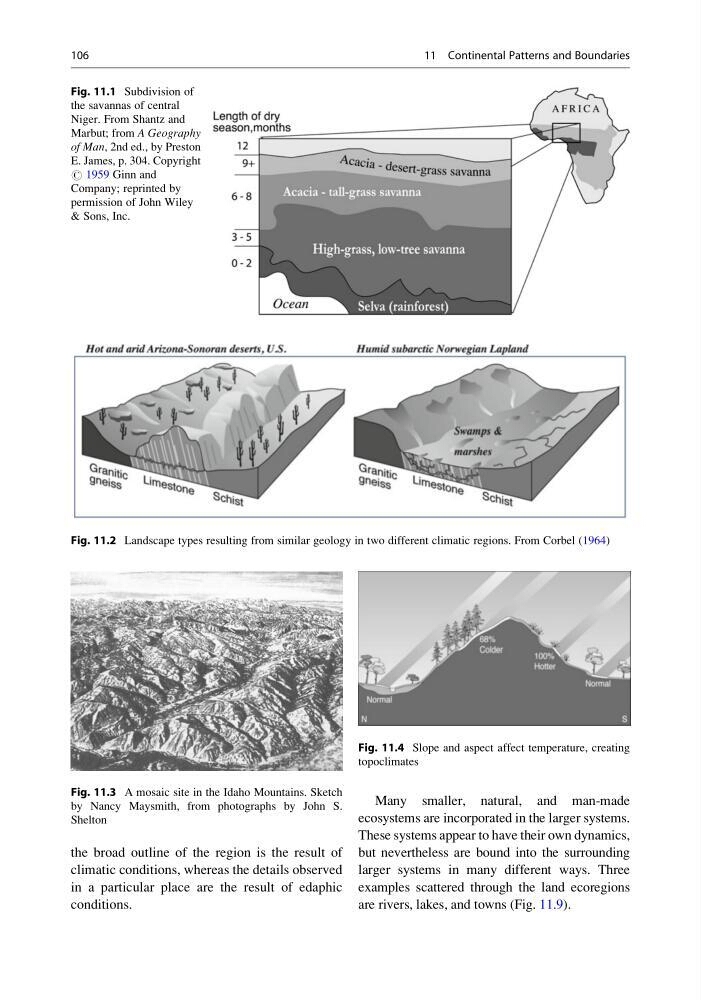
the broad outline of the region is the result of
climatic conditions, whereas the details observed
in a particular place are the result of edaphic
conditions.
Many smaller, natural, and man-made
ecosystems are incorporated in the larger systems.
These systems appear to have their own dynamics,
but nevertheless are bound into the surrounding
larger systems in many different ways. Three
examples scattered through the land ecoregions
are rivers, lakes, and towns (Fig. 11.9).
Fig. 11.1 Subdivision of
the savannas of central
Niger. From Shantz and
Marbut; from A Geography
of Man, 2nd ed., by Preston
E. James, p. 304. Copyright
# 1959 Ginn and
Company; reprinted by
permission of John Wiley
& Sons, Inc.
Fig. 11.2 Landscape types resulting from similar geology in two different climatic regions. From Corbel (1964)
Fig. 11.4 Slope and aspect affect temperature, creating
topoclimates
Fig. 11.3 A mosaic site in the Idaho Mountains. Sketch
by Nancy Maysmith, from photographs by John S.
Shelton
106
11 Continental Patterns and Boundaries
climatic conditions, whereas the details observed
in a particular place are the result of edaphic
conditions.
Many smaller, natural, and man-made
ecosystems are incorporated in the larger systems.
These systems appear to have their own dynamics,
but nevertheless are bound into the surrounding
larger systems in many different ways. Three
examples scattered through the land ecoregions
are rivers, lakes, and towns (Fig. 11.9).
Fig. 11.1 Subdivision of
the savannas of central
Niger. From Shantz and
Marbut; from A Geography
of Man, 2nd ed., by Preston
E. James, p. 304. Copyright
# 1959 Ginn and
Company; reprinted by
permission of John Wiley
& Sons, Inc.
Fig. 11.2 Landscape types resulting from similar geology in two different climatic regions. From Corbel (1964)
Fig. 11.4 Slope and aspect affect temperature, creating
topoclimates
Fig. 11.3 A mosaic site in the Idaho Mountains. Sketch
by Nancy Maysmith, from photographs by John S.
Shelton
106
11 Continental Patterns and Boundaries