

Axial s UJlUlll t qraben
a
Morphology of the Mid-Ocean Ridge
23
b
DB
(' r .... :
G
-<-«"'7.
<. <. <.
~-<-<
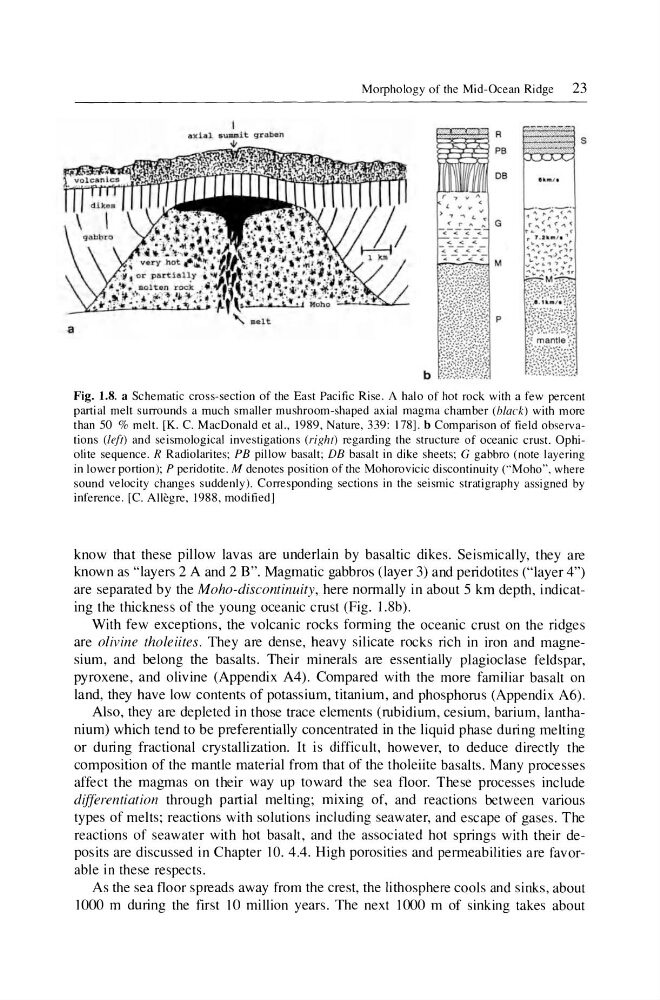
than 50 % melt. [K. C. MacDonald et aI. , 1989, Nature , 339: 178]. b Comparison of field observations (left) and se ismological investigations (ri[;ht) regarding the structure of oceanic crust. Ophiolite sequence. R Radiolarites; PB pillow basalt; DB basalt in dike sheets; G gabbro (note layering
in lower portion); P peridotite. M denotes position of the Mohorovicic di scontinuity ("Moho", where
sound velocity changes suddenly). Corresponding sections in the seismic stratigraphy assigned by
inference. [CO Allegre, 1988 , modified]
know that these pillow lavas are underlain by basaltic dikes. Seismically, they are
known as "layers 2 A and 2 B", Magmatic gabbros (layer 3) and peridotites ("layer 4")
are separated by the Moho-discontinuity, here normally in about 5 km depth , indicating the thickness of the young oceanic crust (Fig, 1.8b).
With few exceptions, the volcanic rocks forming the oceanic crust on the ridges
are olivine tholeiites. They are dense, heavy silicate rocks rich in iron and magnesium, and belong the basalts, Their minerals are essentially plagioclase feldspar,
pyroxene, and olivine (Appendix A4). Compared with the more familiar basalt on
land, they have low contents of potassium, titanium, and phosphorus (Appendix A6) .
Also, they are depleted in those trace elements (rubidium, cesium, barium, lanthanium) which tend to be preferentially concentrated in the liquid phase during melting
or during fractional crystallization. It is difficult, however, to deduce directly the
composition of the mantle material from that of the tholeiite basalts. Many processes
affect the magmas on their way up toward the sea floor. These processes include
differentiation through partial melting; mixing of, and reactions between various
types of melts; reactions with solutions including seawater, and escape of gases. The
reactions of seawater with hot basalt, and the associated hot springs with their deposits are discussed in Chapter 10. 4.4. High porosities and permeabilities are favorable in these respects.
As the sea floor spreads away from the crest, the lithosphere cools and sinks, about
1000 m during the first 10 mi Ilion years . The next 1000 m of sinking takes about
a
Morphology of the Mid-Ocean Ridge
23
b
DB
(' r .... :
G
-<-«"'7.
<. <. <.
~-<-<
than 50 % melt. [K. C. MacDonald et aI. , 1989, Nature , 339: 178]. b Comparison of field observations (left) and se ismological investigations (ri[;ht) regarding the structure of oceanic crust. Ophiolite sequence. R Radiolarites; PB pillow basalt; DB basalt in dike sheets; G gabbro (note layering
in lower portion); P peridotite. M denotes position of the Mohorovicic di scontinuity ("Moho", where
sound velocity changes suddenly). Corresponding sections in the seismic stratigraphy assigned by
inference. [CO Allegre, 1988 , modified]
know that these pillow lavas are underlain by basaltic dikes. Seismically, they are
known as "layers 2 A and 2 B", Magmatic gabbros (layer 3) and peridotites ("layer 4")
are separated by the Moho-discontinuity, here normally in about 5 km depth , indicating the thickness of the young oceanic crust (Fig, 1.8b).
With few exceptions, the volcanic rocks forming the oceanic crust on the ridges
are olivine tholeiites. They are dense, heavy silicate rocks rich in iron and magnesium, and belong the basalts, Their minerals are essentially plagioclase feldspar,
pyroxene, and olivine (Appendix A4). Compared with the more familiar basalt on
land, they have low contents of potassium, titanium, and phosphorus (Appendix A6) .
Also, they are depleted in those trace elements (rubidium, cesium, barium, lanthanium) which tend to be preferentially concentrated in the liquid phase during melting
or during fractional crystallization. It is difficult, however, to deduce directly the
composition of the mantle material from that of the tholeiite basalts. Many processes
affect the magmas on their way up toward the sea floor. These processes include
differentiation through partial melting; mixing of, and reactions between various
types of melts; reactions with solutions including seawater, and escape of gases. The
reactions of seawater with hot basalt, and the associated hot springs with their deposits are discussed in Chapter 10. 4.4. High porosities and permeabilities are favorable in these respects.
As the sea floor spreads away from the crest, the lithosphere cools and sinks, about
1000 m during the first 10 mi Ilion years . The next 1000 m of sinking takes about