

22
Vi
o
z
o
u
~ ~
Origin and Morphology of Ocean Basin s
M I D ATLANTIC R I DG E
CREST
FL A NK
BE RMUDA RI SE
o
~m
5
I
I
• ' , :
"
9
sec
HA TTE RAS
ABYSS AL P L AIN
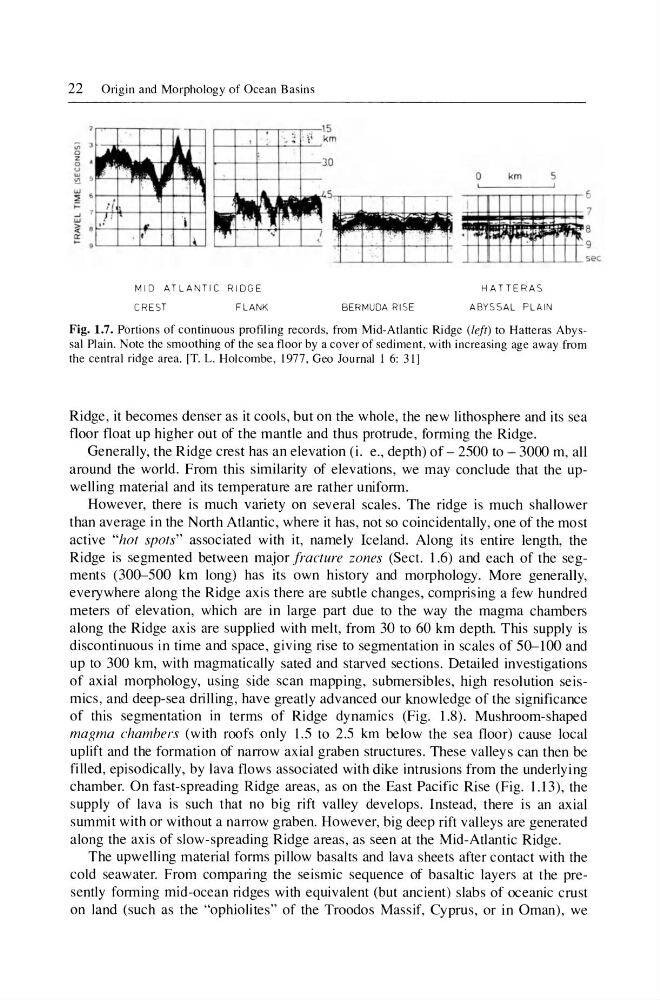
Fig. 1.7. Portions of continuous profiling records, from Mid-Atlantic Ridge (left) to Hatteras Abyssal Plain. Note the smoothing of the sea floor by a cover of sediment. with increasing age away from
the central ridge area. [T. L. Holcombe, 1977, Geo Journal I 6: 31]
Ridge, it becomes denser as it cools, but on the whole, the new lithosphere and its sea
floor float up higher out of the mantle and thus protrude, forming the Ridge.
Generally, the Ridge crest has an elevation (i. e., depth) of - 2500 to - 3000 m, all
around the world. From this similarity of elevations, we may conclude that the upwelling material and its temperature are rather uniform.
However, there is much variety on several scales. The ridge is much shallower
than average in the North Atlantic, where it has, not so coincidentally, one of the most
active "hot spots" associated with it, namely Iceland. Along its entire length, the
Ridge is segmented between major fracture zones (Sect. 1.6) and each of the segments (300-500 km long) has its own history and morphology. More generally,
everywhere along the Ridge axis there are subtle changes, comprising a few hundred
meters of elevation, which are in large part due to the way the magma chambers
along the Ridge axis are supplied with melt, from 30 to 60 km depth. This supply is
discontinuous in time and space, giving rise to segmentation in scales of 50-100 and
up to 300 km, with magmatically sated and starved sections. Detailed investigations
of axial morphology, using side scan mapping, submersibles, high resolution seismics, and deep-sea drilling, have greatly advanced our knowledge of the significance
of this segmentation in terms of Ridge dynamics (Fig. 1.8). Mushroom-shaped
magma chamhers (with roofs only 1.5 to 2.5 km below the sea floor) cause local
uplift and the formation of narrow axial graben structures. These valleys can then be
filled , episodically, by lava flows associated with dike intrusions from the underlying
chamber. On fast-spreading Ridge areas, as on the East Pacific Rise (Fig. 1.13), the
supply of lava is such that no big rift valley develops. Instead, there is an axial
summit with or without a narrow graben. However, big deep rift valleys are generated
along the axis of slow-spreading Ridge areas, as seen at the Mid-Atlantic Ridge.
The upwelling material forms pillow basalts and lava sheets after contact with the
cold seawater. From comparing the seismic sequence of basaltic layers at the presently forming mid-ocean ridges with equivalent (but ancient) slabs of oceanic crust
on land (such as the "ophiolites" of the Troodos Massif, Cyprus, or in Oman), we
Vi
o
z
o
u
~ ~
Origin and Morphology of Ocean Basin s
M I D ATLANTIC R I DG E
CREST
FL A NK
BE RMUDA RI SE
o
~m
5
I
I
• ' , :
"
9
sec
HA TTE RAS
ABYSS AL P L AIN
Fig. 1.7. Portions of continuous profiling records, from Mid-Atlantic Ridge (left) to Hatteras Abyssal Plain. Note the smoothing of the sea floor by a cover of sediment. with increasing age away from
the central ridge area. [T. L. Holcombe, 1977, Geo Journal I 6: 31]
Ridge, it becomes denser as it cools, but on the whole, the new lithosphere and its sea
floor float up higher out of the mantle and thus protrude, forming the Ridge.
Generally, the Ridge crest has an elevation (i. e., depth) of - 2500 to - 3000 m, all
around the world. From this similarity of elevations, we may conclude that the upwelling material and its temperature are rather uniform.
However, there is much variety on several scales. The ridge is much shallower
than average in the North Atlantic, where it has, not so coincidentally, one of the most
active "hot spots" associated with it, namely Iceland. Along its entire length, the
Ridge is segmented between major fracture zones (Sect. 1.6) and each of the segments (300-500 km long) has its own history and morphology. More generally,
everywhere along the Ridge axis there are subtle changes, comprising a few hundred
meters of elevation, which are in large part due to the way the magma chambers
along the Ridge axis are supplied with melt, from 30 to 60 km depth. This supply is
discontinuous in time and space, giving rise to segmentation in scales of 50-100 and
up to 300 km, with magmatically sated and starved sections. Detailed investigations
of axial morphology, using side scan mapping, submersibles, high resolution seismics, and deep-sea drilling, have greatly advanced our knowledge of the significance
of this segmentation in terms of Ridge dynamics (Fig. 1.8). Mushroom-shaped
magma chamhers (with roofs only 1.5 to 2.5 km below the sea floor) cause local
uplift and the formation of narrow axial graben structures. These valleys can then be
filled , episodically, by lava flows associated with dike intrusions from the underlying
chamber. On fast-spreading Ridge areas, as on the East Pacific Rise (Fig. 1.13), the
supply of lava is such that no big rift valley develops. Instead, there is an axial
summit with or without a narrow graben. However, big deep rift valleys are generated
along the axis of slow-spreading Ridge areas, as seen at the Mid-Atlantic Ridge.
The upwelling material forms pillow basalts and lava sheets after contact with the
cold seawater. From comparing the seismic sequence of basaltic layers at the presently forming mid-ocean ridges with equivalent (but ancient) slabs of oceanic crust
on land (such as the "ophiolites" of the Troodos Massif, Cyprus, or in Oman), we