

318 Appendix
A4 Common Minerals
Silicate Minerals
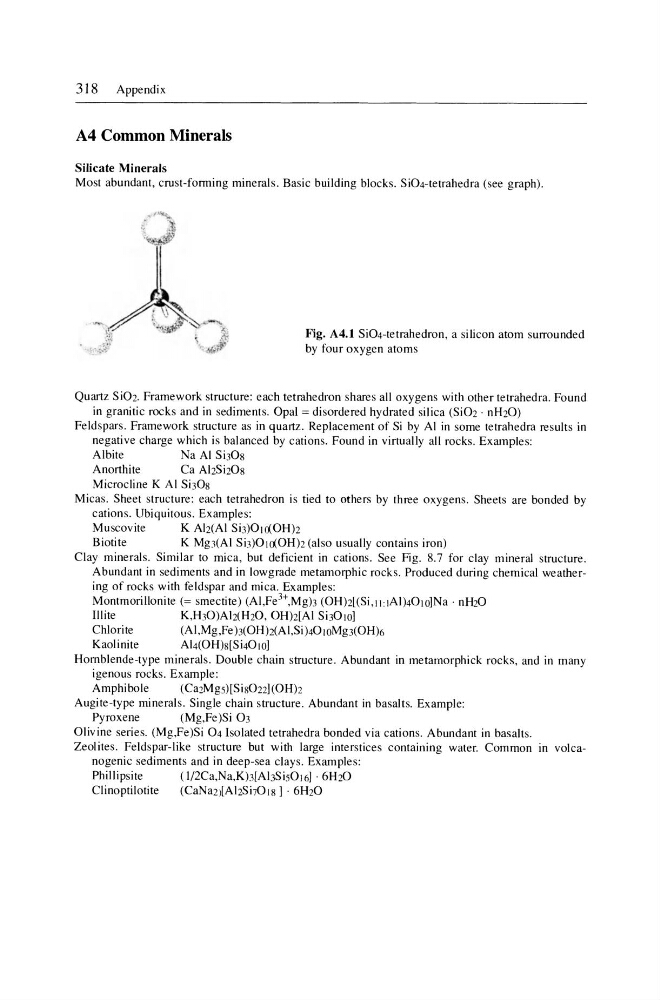
Most abundant, crust-fonning minerals. Basic building blocks. Si04-letrahedra (see graph).
Fig. A4.1 Si04-tetrahedron, a silicon atom surrounded
by four oxygen atoms
Quartz Si02. Framework structure: each tetrahedron shares all oxygens with other tetrahedra. Found
in granitic rocks and in sediments. Opal = disordered hydrated silica (Si02 . nH20)
Feldspars. Framework structure as in quartz. Replacement of Si by AI in some tetrahedra results in
negative charge which is balanced by cations. Found in virtually all rocks. Examples:
Albite
Na AI Si30S
Anorthite
Ca AIzSi20s
Microcline K Al Si30S
Micas. Sheet structure: each tetrahedron is tied to others by three oxygens. Sheets are bonded by
cations . Ubiquitous. Examples:
Muscovite
K Ah(AI Si3)Ot!XOH)2
Biotite
K Mg3(AI Si3)O\ifOH)2 (also usually contains iron)
Clay minerals. Similar to mica, but deficient in cations. See Fig. 8.7 for clay mineral structure.
Abundant in sediments and in lowgrade metamorphic rocks. Produced during chemical weathering of rocks with feldspar and mica. Examples:
Montmorillonite (= smectite) (AI,Fe 3 +,Mg)3 (OH)2[(Si,\I:IAI)40Io]Na' nH20
Illite
K,H30)AIz(H20, OH)2[AI Si301O]
Chlorite
(AI ,Mg,Fe)3(OH)2(AI,Si)40IOMg3(OH)6
Kaolinite
AI4(OH)8[Si4010]
Hornblende-type minerals. Double chain structure. Abundant in metarnorphick rocks, and in many
igenous rocks. Example:
Amphibole
(CazMgs)[Sis022](OH)2
Augite-type minerals. Single chain structure. Abundant in basalts. Example:
Pyroxene
(Mg,Fe)Si 03
Olivine series. (Mg,Fe)Si 04 Isolated tetrahedra bonded via cations. Abundant in basalts.
Zeolites. Feldspar-like structure but with large interstices containing water. Common in volcanogenic sediments and in deep-sea clays. Examples:
Phillipsite
(1/2Ca,Na,K)3[AbSisOI6] . 6H20
Clinoptilotite
(CaNa2)[AIzSi?Ols] ·6H20
A4 Common Minerals
Silicate Minerals
Most abundant, crust-fonning minerals. Basic building blocks. Si04-letrahedra (see graph).
Fig. A4.1 Si04-tetrahedron, a silicon atom surrounded
by four oxygen atoms
Quartz Si02. Framework structure: each tetrahedron shares all oxygens with other tetrahedra. Found
in granitic rocks and in sediments. Opal = disordered hydrated silica (Si02 . nH20)
Feldspars. Framework structure as in quartz. Replacement of Si by AI in some tetrahedra results in
negative charge which is balanced by cations. Found in virtually all rocks. Examples:
Albite
Na AI Si30S
Anorthite
Ca AIzSi20s
Microcline K Al Si30S
Micas. Sheet structure: each tetrahedron is tied to others by three oxygens. Sheets are bonded by
cations . Ubiquitous. Examples:
Muscovite
K Ah(AI Si3)Ot!XOH)2
Biotite
K Mg3(AI Si3)O\ifOH)2 (also usually contains iron)
Clay minerals. Similar to mica, but deficient in cations. See Fig. 8.7 for clay mineral structure.
Abundant in sediments and in lowgrade metamorphic rocks. Produced during chemical weathering of rocks with feldspar and mica. Examples:
Montmorillonite (= smectite) (AI,Fe 3 +,Mg)3 (OH)2[(Si,\I:IAI)40Io]Na' nH20
Illite
K,H30)AIz(H20, OH)2[AI Si301O]
Chlorite
(AI ,Mg,Fe)3(OH)2(AI,Si)40IOMg3(OH)6
Kaolinite
AI4(OH)8[Si4010]
Hornblende-type minerals. Double chain structure. Abundant in metarnorphick rocks, and in many
igenous rocks. Example:
Amphibole
(CazMgs)[Sis022](OH)2
Augite-type minerals. Single chain structure. Abundant in basalts. Example:
Pyroxene
(Mg,Fe)Si 03
Olivine series. (Mg,Fe)Si 04 Isolated tetrahedra bonded via cations. Abundant in basalts.
Zeolites. Feldspar-like structure but with large interstices containing water. Common in volcanogenic sediments and in deep-sea clays. Examples:
Phillipsite
(1/2Ca,Na,K)3[AbSisOI6] . 6H20
Clinoptilotite
(CaNa2)[AIzSi?Ols] ·6H20