

Raw Materials from Shelves: Placer Deposits
287
10.3.2 Shell Deposits. Calcareous shell deposits were or are dredged in places as raw
material for calcium carbonate, and also for building roads. For example, oyster
shells have been mined in San Francisco Bay for use in making cement, and in
Galveston Bay in the Gulf of Mexico for calcination and reacton with seawater, to
extract magnesium. Dredging of shells hinders the growth of benthic organisms and
adversely affects the productivity of the sea bed. Conflicts commonly arise where
dredging and fishing activites overlap.
With the advent of worldwide souvenir markets and of face-mask diving, the
collecting of shells and corals has become an important source of income for islanders of the Pacific and other coastal peoples. Not surprisingly, attractive and rare
species suffer considerable depredation from such collecting.
10.3.3 Placer Deposits. Concentrations of heavy minerals and ore particles on
beaches and in estuaries are locally mined for metals such as titanium, gold, platinum, thorium, zirconium, and valuable minerals such as diamond. Seventy percent of
the world production of zirconium is being extracted from placer deposits off East
Australia. Diamonds are found in beach deposits of Southwest Africa, as well as
offshore. Magnetite is being mined from beach placers in certain areas in Japan and
New Zealand. In the USA, gold has been mined from beach deposits near Nome,
Alaska; thousands of tons of ilmenite (FeTi03) were extracted at one time from
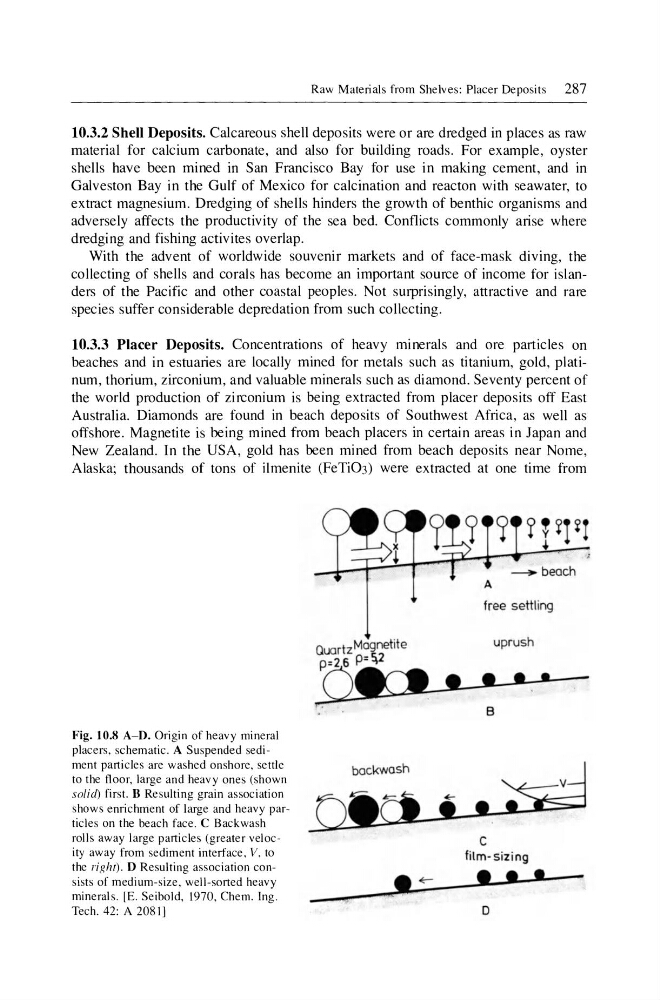
Fig. 10.8 A- D. Origin of heavy mineral
placers, schematic. A Suspended sediment particles are washed onshore, settle
to the floor, large and heavy ones (shown
solid) first. 8 Re sulting grain association
shows enrichment of large and heav y particles on the beach face. C Backwash
rolls away large particles (greater velocity away from sediment interface, V, to
the right). D Result ing association consists of medium-size, well-sorted heavy
minerals. [E. Seibold, 1970, Chern. Ing .
Tech. 42: A 2081]
free settling
uprush
Quartz Magnetite
p=26 p= 5,2
:.a-=-~.~.L..-J.~. - - : -
B
baCKwash
+•
C
film- sizing
• • •
;;
o
287
10.3.2 Shell Deposits. Calcareous shell deposits were or are dredged in places as raw
material for calcium carbonate, and also for building roads. For example, oyster
shells have been mined in San Francisco Bay for use in making cement, and in
Galveston Bay in the Gulf of Mexico for calcination and reacton with seawater, to
extract magnesium. Dredging of shells hinders the growth of benthic organisms and
adversely affects the productivity of the sea bed. Conflicts commonly arise where
dredging and fishing activites overlap.
With the advent of worldwide souvenir markets and of face-mask diving, the
collecting of shells and corals has become an important source of income for islanders of the Pacific and other coastal peoples. Not surprisingly, attractive and rare
species suffer considerable depredation from such collecting.
10.3.3 Placer Deposits. Concentrations of heavy minerals and ore particles on
beaches and in estuaries are locally mined for metals such as titanium, gold, platinum, thorium, zirconium, and valuable minerals such as diamond. Seventy percent of
the world production of zirconium is being extracted from placer deposits off East
Australia. Diamonds are found in beach deposits of Southwest Africa, as well as
offshore. Magnetite is being mined from beach placers in certain areas in Japan and
New Zealand. In the USA, gold has been mined from beach deposits near Nome,
Alaska; thousands of tons of ilmenite (FeTi03) were extracted at one time from
Fig. 10.8 A- D. Origin of heavy mineral
placers, schematic. A Suspended sediment particles are washed onshore, settle
to the floor, large and heavy ones (shown
solid) first. 8 Re sulting grain association
shows enrichment of large and heav y particles on the beach face. C Backwash
rolls away large particles (greater velocity away from sediment interface, V, to
the right). D Result ing association consists of medium-size, well-sorted heavy
minerals. [E. Seibold, 1970, Chern. Ing .
Tech. 42: A 2081]
free settling
uprush
Quartz Magnetite
p=26 p= 5,2
:.a-=-~.~.L..-J.~. - - : -
B
baCKwash
+•
C
film- sizing
• • •
;;
o