

286 Resource s from the Ocean Roor
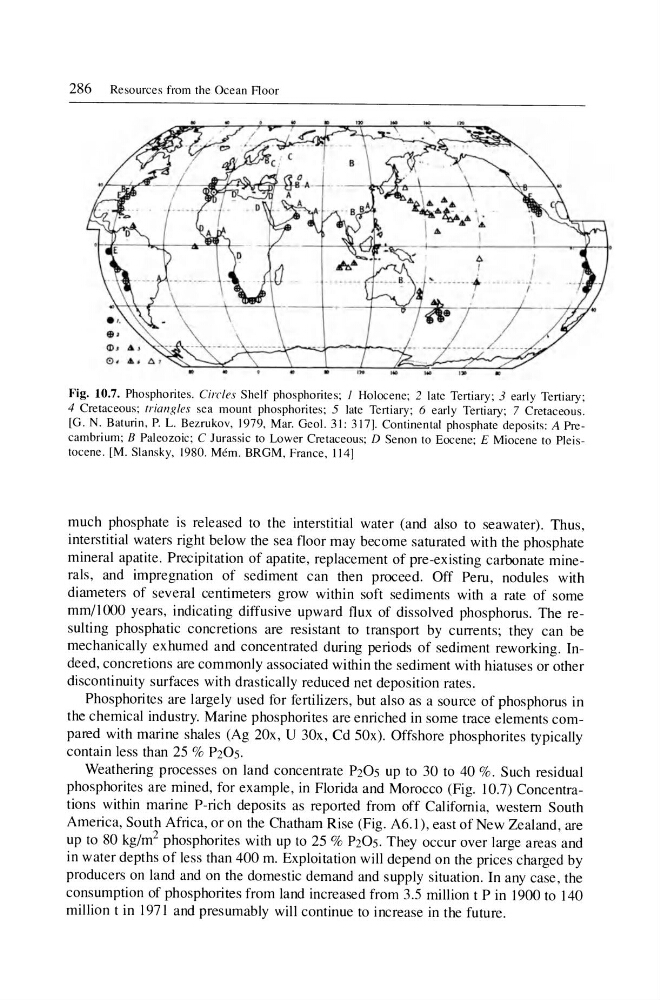
Fig. 10.7. Phosphorites. Circles Shelf phosphorites; I Holocene; 2 late Tertiary; 3 early Tertiary;
4 Cretaceous; triangles sea mount phosphorites; 5 late Tertiary; 6 early Tertiary; 7 Cretaceous.
[G . N. Baturin, P. L. Bezrukov, 1979, Mar. Geol. 31: 317). Continental phosphate deposits: A Precambrium ; B Paleozoic ; C Jurassic to Lower Cretaceous; D Senon to Eocene; E Miocene to Pleistocene. lM. Siansky, 1980. Mem. BRGM, France, 114)
much phosphate is released to the interstitial water (and also to seawater). Thus,
interstitial waters right below the sea floor may become saturated with the phosphate
mineral apatite. Precipitation of apatite, replacement of pre-existing carbonate minerals, and impregnation of sediment can then proceed. Off Peru, nodules with
diameters of several centimeters grow within soft sediments with a rate of some
mm/lOOO years, indicating diffusive upward flux of dissolved phosphorus. The resulting phosphatic concretions are resistant to transport by currents; they can be
mechanically exhumed and concentrated during periods of sediment reworking. Indeed, concretions are commonly associated within the sediment with hiatuses or other
discontinuity surfaces with drastically reduced net deposition rates.
Phosphorites are largely used for fertilizers, but also as a source of phosphorus in
the chemical industry. Marine phosphorites are enriched in some trace elements compared with marine shales (Ag 20x, U 30x, Cd SOx) . Offshore phosphorites typically
contain less than 25 % P20S.
Weatheting processes on land concentrate P20S up to 30 to 40 %. Such residual
phosphorites are mined, for example, in Florida and Morocco (Fig. 10.7) Concentrations within marine P-rich deposits as reported from off California, western South
America, South Africa, or on the Chatham Rise (Fig. A6.1), east of New Zealand, are
up to 80 kg/m 2 phosphorites with up to 2S % P20S. They occur over large areas and
in water depths of less than 400 m. Exploitation will depend on the prices charged by
producers on land and on the domestic demand and supply situation. In any case, the
consumption of phosphorites from land increased from 3.5 million t P in 1900 to 140
million tin 1971 and presumably will continue to increase in the future.
Fig. 10.7. Phosphorites. Circles Shelf phosphorites; I Holocene; 2 late Tertiary; 3 early Tertiary;
4 Cretaceous; triangles sea mount phosphorites; 5 late Tertiary; 6 early Tertiary; 7 Cretaceous.
[G . N. Baturin, P. L. Bezrukov, 1979, Mar. Geol. 31: 317). Continental phosphate deposits: A Precambrium ; B Paleozoic ; C Jurassic to Lower Cretaceous; D Senon to Eocene; E Miocene to Pleistocene. lM. Siansky, 1980. Mem. BRGM, France, 114)
much phosphate is released to the interstitial water (and also to seawater). Thus,
interstitial waters right below the sea floor may become saturated with the phosphate
mineral apatite. Precipitation of apatite, replacement of pre-existing carbonate minerals, and impregnation of sediment can then proceed. Off Peru, nodules with
diameters of several centimeters grow within soft sediments with a rate of some
mm/lOOO years, indicating diffusive upward flux of dissolved phosphorus. The resulting phosphatic concretions are resistant to transport by currents; they can be
mechanically exhumed and concentrated during periods of sediment reworking. Indeed, concretions are commonly associated within the sediment with hiatuses or other
discontinuity surfaces with drastically reduced net deposition rates.
Phosphorites are largely used for fertilizers, but also as a source of phosphorus in
the chemical industry. Marine phosphorites are enriched in some trace elements compared with marine shales (Ag 20x, U 30x, Cd SOx) . Offshore phosphorites typically
contain less than 25 % P20S.
Weatheting processes on land concentrate P20S up to 30 to 40 %. Such residual
phosphorites are mined, for example, in Florida and Morocco (Fig. 10.7) Concentrations within marine P-rich deposits as reported from off California, western South
America, South Africa, or on the Chatham Rise (Fig. A6.1), east of New Zealand, are
up to 80 kg/m 2 phosphorites with up to 2S % P20S. They occur over large areas and
in water depths of less than 400 m. Exploitation will depend on the prices charged by
producers on land and on the domestic demand and supply situation. In any case, the
consumption of phosphorites from land increased from 3.5 million t P in 1900 to 140
million tin 1971 and presumably will continue to increase in the future.