

a
b
268 Paleoceanography - the Deep-Sea Record
65
1600Z
1400Z
•
' ,I
J
1
,
" !I,. .
• I , 1 • . . : :
r.'
,I
I
•
, '.
I I .
'f '
' .
.. I
.~
. , ' .
I I.
I , : I f; of' It' ~ .
I I
,
t I
--~~~~f.--~~~~~~~i~;. ~i+ i~ , ·.--~--~--~~i~ ·'~: _' ~.~----65
.,
,'. ..'
'j . •
'"
.0 I", '\"
, .
, r:
2200Z
2000Z
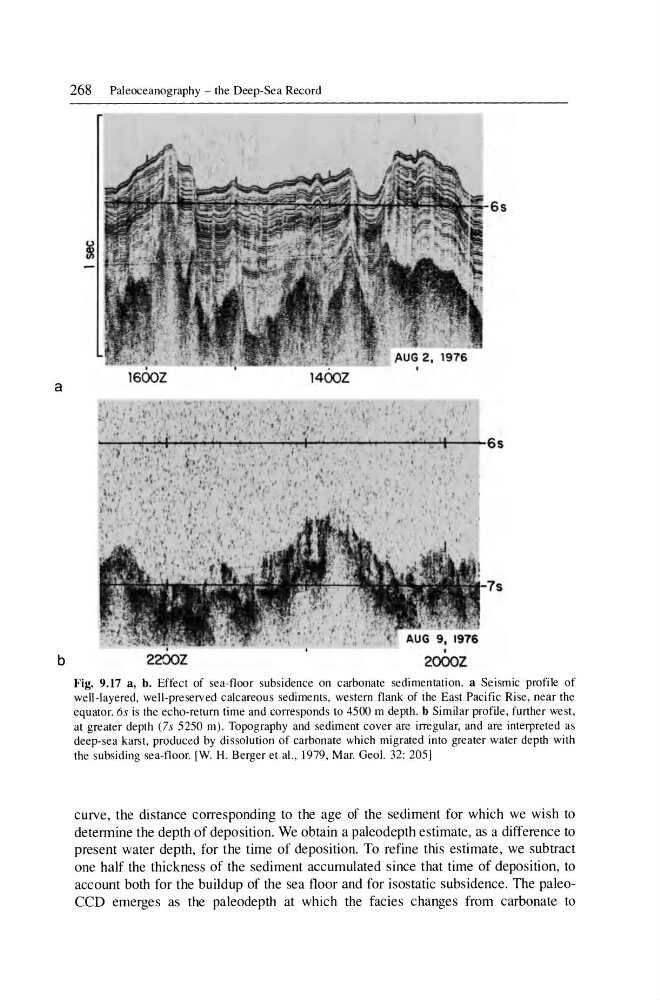
Fig. 9.17 a, b. Effect of sea-floor subsidence on carbonate sedimentation. a Seismic profile of
well-layered, well-preserved calcareous sediments, western flank of the East Pacific Rise , near the
equator. 6s is the echo-return time and corresponds to 4500 m depth. b Similar profile, further west,
at greater depth (75 5250 m). Topography and sediment cover are irregular, and are interpreted as
deep-sea karst, produced by dissolution of carbonate which migrated into greater water depth with
the subsiding sea-floor. [w. H. Berger et aI., 1979, Mar. Geol. 32: 205]
curve, the distance corresponding to the age of the sediment for which we wish to
determine the depth of deposition. We obtain a paleodepth estimate, as a difference to
present water depth, for the time of deposition. To refine this estimate, we subtract
one half the thickness of the sediment accumulated since that time of deposition, to
account both for the buildup of the sea floor and for isostatic subsidence. The paleoCCD emerges as the paleodepth at which the facies changes from carbonate to
b
268 Paleoceanography - the Deep-Sea Record
65
1600Z
1400Z
•
' ,I
J
1
,
" !I,. .
• I , 1 • . . : :
r.'
,I
I
•
, '.
I I .
'f '
' .
.. I
.~
. , ' .
I I.
I , : I f; of' It' ~ .
I I
,
t I
--~~~~f.--~~~~~~~i~;. ~i+ i~ , ·.--~--~--~~i~ ·'~: _' ~.~----65
.,
,'. ..'
'j . •
'"
.0 I", '\"
, .
, r:
2200Z
2000Z
Fig. 9.17 a, b. Effect of sea-floor subsidence on carbonate sedimentation. a Seismic profile of
well-layered, well-preserved calcareous sediments, western flank of the East Pacific Rise , near the
equator. 6s is the echo-return time and corresponds to 4500 m depth. b Similar profile, further west,
at greater depth (75 5250 m). Topography and sediment cover are irregular, and are interpreted as
deep-sea karst, produced by dissolution of carbonate which migrated into greater water depth with
the subsiding sea-floor. [w. H. Berger et aI., 1979, Mar. Geol. 32: 205]
curve, the distance corresponding to the age of the sediment for which we wish to
determine the depth of deposition. We obtain a paleodepth estimate, as a difference to
present water depth, for the time of deposition. To refine this estimate, we subtract
one half the thickness of the sediment accumulated since that time of deposition, to
account both for the buildup of the sea floor and for isostatic subsidence. The paleoCCD emerges as the paleodepth at which the facies changes from carbonate to