

CD
Cl
n.
l
P
'" Ql :>
iii en Ql
Z
2.5
2
1.5
0.5
The Carbon Connection
253
200 400 600 800 1000 1 200 1400 1600 1800 2000
Age (k.y.)
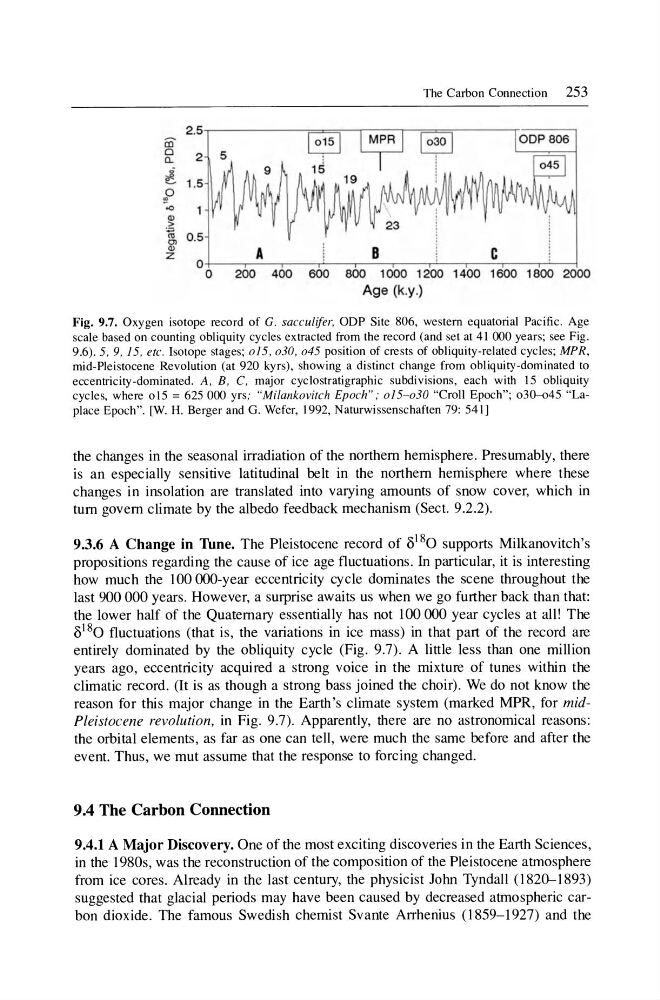
Fig. 9.7. Oxygen isotope record of G. sacculifer. ODP Site 806. western equatorial Pacific. Age
scale based on counting obliquity cycles extracted from the record (and set at 41 000 years; see Fig.
9.6).5, 9, IS, etc. Isotope stages; 015,030,045 position of crests of obliquity-related cycles; MPR ,
mid-Pleistocene Revolution (at 920 kyrs) , showing a distinct change from obliquity-dominated to
eccentricity-dominated. A, B , C, major cyclostratigraphic subdivisions, each with 15 obliquity
cycles, where 015 = 625000 yrs; "Milankovitch Epoch"; 015-030 "Croll Epoch"; 030--<>45 "Laplace Epoch". [W. H. Berger and G . Wefer, 1992, Naturwissenschaften 79: 541]
the changes in the seasonal irradiation of the northern hemisphere. Presumably, there
is an especially sensitive latitudinal belt in the northern hemisphere where these
changes in insolation are translated into varying amounts of snow cover, which in
tum govern climate by the albedo feedback mechanism (Sect. 9.2.2).
9.3.6 A Change in Thne. The Pleistocene record of 8 18 0 supports Milkanovitch's
propositions regarding the cause of ice age fluctuations. In particular, it is interesting
how much the 100000-year eccentricity cycle dominates the scene throughout the
last 900000 years. However, a surprise awaits us when we go further back than that:
the lower half of the Quaternary essentially has not 100 000 year cycles at all! The
8 18 0 fluctuations (that is, the variations in ice mass) in that part of the record are
entirely dominated by the obliquity cycle (Fig. 9.7). A little less than one million
years ago, eccentricity acquired a strong voice in the mixture of tunes within the
climatic record. (It is as though a strong bass joined the choir). We do not know the
reason for this major change in the Earth's climate system (marked MPR, for midPleistocene revolution, in Fig. 9.7). Apparently, there are no astronomical reasons:
the orbital elements, as far as one can tell, were much the same before and after the
event. Thus, we mut assume that the response to forcing changed.
9.4 The Carbon Connection
9.4.1 A Major Discovery. One of the most exciting discoveries in the Earth Sciences,
in the 1980s, was the reconstruction of the composition of the Pleistocene atmosphere
from ice cores. Already in the last century, the physicist John Tyndall (1820-1893)
suggested that glacial periods may have been caused by decreased atmospheric carbon dioxide. The famous Swedish chemist Svante Arrhenius (1859-1927) and the
Cl
n.
l
P
'" Ql :>
iii en Ql
Z
2.5
2
1.5
0.5
The Carbon Connection
253
200 400 600 800 1000 1 200 1400 1600 1800 2000
Age (k.y.)
Fig. 9.7. Oxygen isotope record of G. sacculifer. ODP Site 806. western equatorial Pacific. Age
scale based on counting obliquity cycles extracted from the record (and set at 41 000 years; see Fig.
9.6).5, 9, IS, etc. Isotope stages; 015,030,045 position of crests of obliquity-related cycles; MPR ,
mid-Pleistocene Revolution (at 920 kyrs) , showing a distinct change from obliquity-dominated to
eccentricity-dominated. A, B , C, major cyclostratigraphic subdivisions, each with 15 obliquity
cycles, where 015 = 625000 yrs; "Milankovitch Epoch"; 015-030 "Croll Epoch"; 030--<>45 "Laplace Epoch". [W. H. Berger and G . Wefer, 1992, Naturwissenschaften 79: 541]
the changes in the seasonal irradiation of the northern hemisphere. Presumably, there
is an especially sensitive latitudinal belt in the northern hemisphere where these
changes in insolation are translated into varying amounts of snow cover, which in
tum govern climate by the albedo feedback mechanism (Sect. 9.2.2).
9.3.6 A Change in Thne. The Pleistocene record of 8 18 0 supports Milkanovitch's
propositions regarding the cause of ice age fluctuations. In particular, it is interesting
how much the 100000-year eccentricity cycle dominates the scene throughout the
last 900000 years. However, a surprise awaits us when we go further back than that:
the lower half of the Quaternary essentially has not 100 000 year cycles at all! The
8 18 0 fluctuations (that is, the variations in ice mass) in that part of the record are
entirely dominated by the obliquity cycle (Fig. 9.7). A little less than one million
years ago, eccentricity acquired a strong voice in the mixture of tunes within the
climatic record. (It is as though a strong bass joined the choir). We do not know the
reason for this major change in the Earth's climate system (marked MPR, for midPleistocene revolution, in Fig. 9.7). Apparently, there are no astronomical reasons:
the orbital elements, as far as one can tell, were much the same before and after the
event. Thus, we mut assume that the response to forcing changed.
9.4 The Carbon Connection
9.4.1 A Major Discovery. One of the most exciting discoveries in the Earth Sciences,
in the 1980s, was the reconstruction of the composition of the Pleistocene atmosphere
from ice cores. Already in the last century, the physicist John Tyndall (1820-1893)
suggested that glacial periods may have been caused by decreased atmospheric carbon dioxide. The famous Swedish chemist Svante Arrhenius (1859-1927) and the