

252 Paleoceanography - the Deep-Sea Record
~'~
in o.
III
III -O. QJ.
~ - 0 .08
o
1
2
3
,
5
6
7
m
~ 0 , 03
z 0.01
III
>0' 05~
tl -0.01
III
0~--~---I~--'----r2--~~--~3----~--~'----~--~5~--~---6~--~---r7--~m
>2"5~
5 23 , 5
Q 22 . 5
...J
~ 21 .5 0
1
2
3
,
5
6
7
- 0.15
o
f
' , . . ' . . · · · · · . . 1: t
[0 ~
f
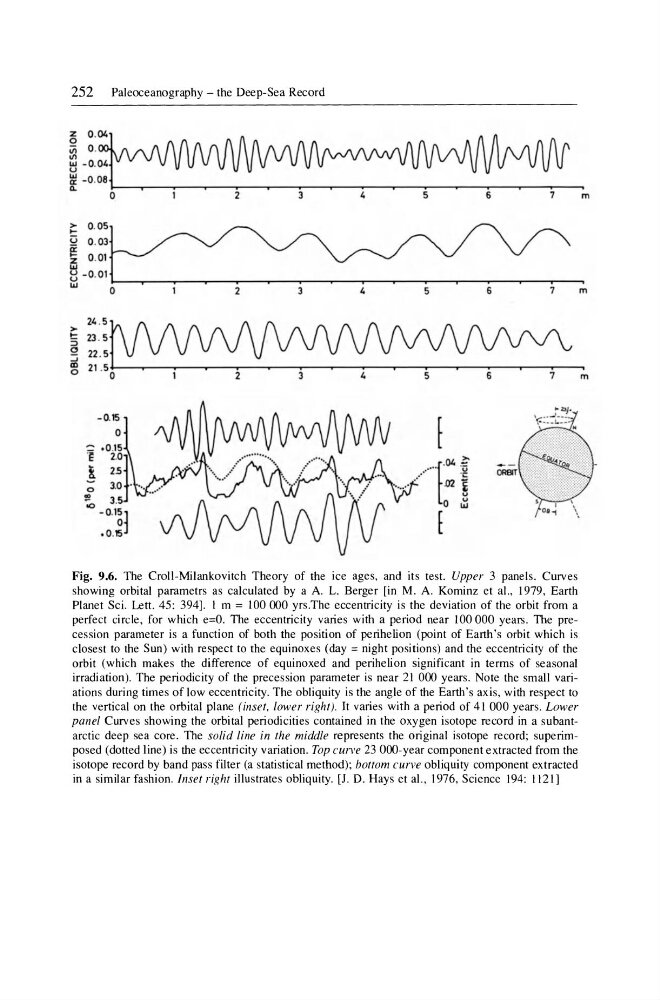
Fig. 9.6. The Croll-Milankovitch Theory of the ice ages. and its test. Upper 3 panels. Curves
showing orbilal parametrs as calculated by a A. L. Berger [in M. A. Kominz et aI., 1979, Earth
Planet Sci. Leu. 45: 394). I m = 100000 yrs.The eccentricity is the deviation of the orbit from a
perfect circle, for which e=O. The eccentricity varies with a period near 100000 years. The precession parameter is a function of both the position of perihelion (point of Earth's orbit which is
closest to the Sun) with respect to the equinoxes (day = night positions) and the eccentricity of the
orbit (which makes the difference of equinoxed and perihelion significant in tenus of seasonal
irradiation). The periodicity of the precession parameter is near 21 000 years. Note the small variations during times of low eccentricity. The obliquity is the angle of the Earth's axis , with respect to
the vertical on the orbital plane (inset, lower right). It varies with a period of 41 000 years. Lower
panel Curves showing the orbital periodicities contained in the oxygen isotope record in a subantarctic deep sea core . The solid line in the middle represents the original isotope record; superimposed (dotted line) is the eccentricity variation. Top cun'e 23 OOO-year component extracted from the
isotope record by band pass filter (a statistical method); bottom curve obliquity component extracted
in a similar fashion. Inset right illustrates obliquity. [J. D. Hays et a!. , 1976, Science 194: 1121]
m
~'~
in o.
III
III -O. QJ.
~ - 0 .08
o
1
2
3
,
5
6
7
m
~ 0 , 03
z 0.01
III
>0' 05~
tl -0.01
III
0~--~---I~--'----r2--~~--~3----~--~'----~--~5~--~---6~--~---r7--~m
>2"5~
5 23 , 5
Q 22 . 5
...J
~ 21 .5 0
1
2
3
,
5
6
7
- 0.15
o
f
' , . . ' . . · · · · · . . 1: t
[0 ~
f
Fig. 9.6. The Croll-Milankovitch Theory of the ice ages. and its test. Upper 3 panels. Curves
showing orbilal parametrs as calculated by a A. L. Berger [in M. A. Kominz et aI., 1979, Earth
Planet Sci. Leu. 45: 394). I m = 100000 yrs.The eccentricity is the deviation of the orbit from a
perfect circle, for which e=O. The eccentricity varies with a period near 100000 years. The precession parameter is a function of both the position of perihelion (point of Earth's orbit which is
closest to the Sun) with respect to the equinoxes (day = night positions) and the eccentricity of the
orbit (which makes the difference of equinoxed and perihelion significant in tenus of seasonal
irradiation). The periodicity of the precession parameter is near 21 000 years. Note the small variations during times of low eccentricity. The obliquity is the angle of the Earth's axis , with respect to
the vertical on the orbital plane (inset, lower right). It varies with a period of 41 000 years. Lower
panel Curves showing the orbital periodicities contained in the oxygen isotope record in a subantarctic deep sea core . The solid line in the middle represents the original isotope record; superimposed (dotted line) is the eccentricity variation. Top cun'e 23 OOO-year component extracted from the
isotope record by band pass filter (a statistical method); bottom curve obliquity component extracted
in a similar fashion. Inset right illustrates obliquity. [J. D. Hays et a!. , 1976, Science 194: 1121]
m