

Inventory and Overview
217
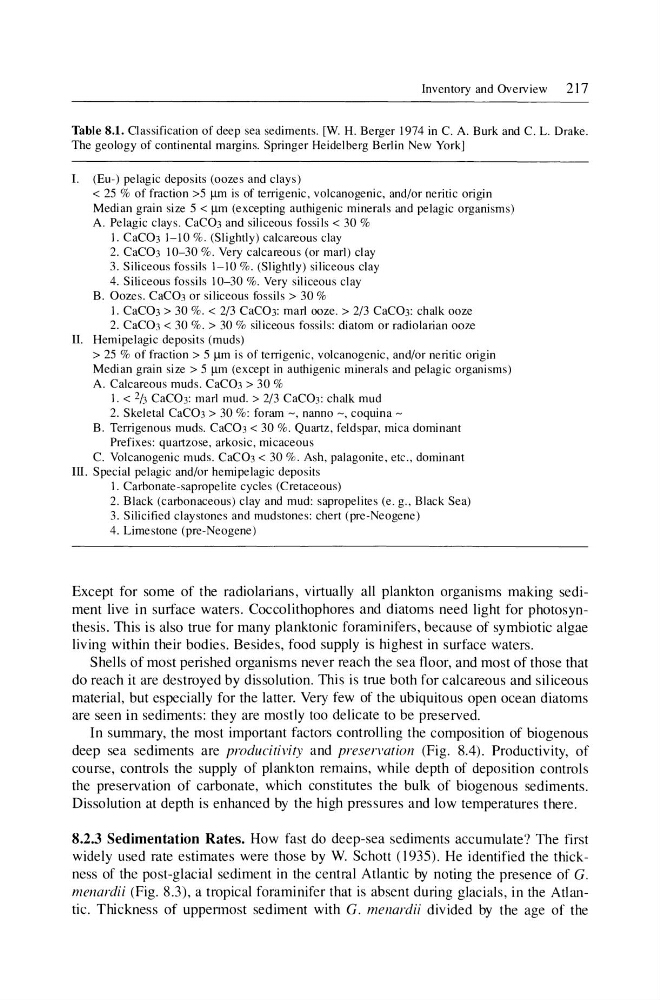
Table 8.1. Classification of deep sea sediments. [W. H. Berger 1974 in C. A. Burk and C. L. Drake.
The geology of continental margins. Springer Heidelberg Berlin New York]
I. (Eu-) pelagic deposits (oozes and clays)
< 25 % of fraction >5 J.U11 is of terrigenic, volcanogenic, and/or neritic origin
Median grain size 5 < J.U11 (excepting authigenic minerals and pelagic organisms)
A. Pelagic clays. CaC03 and siliceous fossils < 30 %
I. CaC03 1-10 %. (Slightly) calcareous clay
2. CaC03 10-30 %. Very calcareous (or marl) clay
3. Siliceous fossils 1-10 %. (Slightly) siliceous clay
4. Siliceous fossils 10-30 %. Very siliceous clay
B. Oozes. CaC03 or siliceous fossils> 30 %
I. CaC03 > 30 %. < 2/3 CaC03: marl ooze. > 2/3 CaC03: chalk ooze
2. CaC03 < 30 %. > 30 % siliceous fossils: diatom or radiolarian ooze
II. Hemipelagic deposits (muds)
> 25 % of fraction> 5 J.U11 is of terrigenic, volcanogenic, and/or neritic origin
Median grain size> 5 J.U11 (except in authigenic minerals and pelagic organisms)
A. Calcareous muds. CaC03 > 30 %
I. < 213 CaC03: marl mud. > 2/3 CaC03: chalk mud
2. Skeletal CaC03 > 30 %: foram -, nanno -, coquinaB. Terrigenous muds. CaC03 < 30 %. Quartz, feldspar, mica dominant
Prefixes: quartzose, arkosic, micaceous
C. Volcanogenic muds. CaC03 < 30 %. Ash, palagonite, etc., dominant
III. Special pelagic and/or hemipelagic deposits
I. Carbonate-sapropelite cycles (Cretaceous)
2. Black (carbonaceous) clay and mud: sapropelites (e. g., Black Sea)
3. Silicified claystones and mudstones: chert (pre-Neogene)
4. Limestone (pre-Neogene)
Except for some of the radiolarians, virtually all plankton organisms making sediment live in surface waters. Coccolithophores and diatoms need light for photosynthesis. This is also true for many planktonic foraminifers, because of symbiotic algae
living within their bodies. Besides, food supply is highest in surface waters.
Shells of most perished organisms never reach the sea floor, and most of those that
do reach it are destroyed by dissolution. This is true both for calcareous and siliceous
material, but especially for the latter. Very few of the ubiquitous open ocean diatoms
are seen in sediments: they are mostly too delicate to be preserved.
In summary, the most important factors controlling the composition of biogenous
deep sea sediments are producitivity and preservation (Fig. 8.4). Productivity, of
course, controls the supply of plankton remains, while depth of deposition controls
the preservation of carbonate, which constitutes the bulk of biogenous sediments.
Dissolution at depth is enhanced by the high pressures and low temperatures there.
8.2.3 Sedimentation Rates. How fast do deep-sea sediments accumulate? The first
widely used rate estimates were those by W. Schott (1935). He identified the thickness of the post-glacial sediment in the central Atlantic by noting the presence of G.
menardii (Fig. 8.3), a tropical foraminifer that is absent during glacials, in the Atlantic. Thickness of uppermost sediment with G. menardii divided by the age of the
217
Table 8.1. Classification of deep sea sediments. [W. H. Berger 1974 in C. A. Burk and C. L. Drake.
The geology of continental margins. Springer Heidelberg Berlin New York]
I. (Eu-) pelagic deposits (oozes and clays)
< 25 % of fraction >5 J.U11 is of terrigenic, volcanogenic, and/or neritic origin
Median grain size 5 < J.U11 (excepting authigenic minerals and pelagic organisms)
A. Pelagic clays. CaC03 and siliceous fossils < 30 %
I. CaC03 1-10 %. (Slightly) calcareous clay
2. CaC03 10-30 %. Very calcareous (or marl) clay
3. Siliceous fossils 1-10 %. (Slightly) siliceous clay
4. Siliceous fossils 10-30 %. Very siliceous clay
B. Oozes. CaC03 or siliceous fossils> 30 %
I. CaC03 > 30 %. < 2/3 CaC03: marl ooze. > 2/3 CaC03: chalk ooze
2. CaC03 < 30 %. > 30 % siliceous fossils: diatom or radiolarian ooze
II. Hemipelagic deposits (muds)
> 25 % of fraction> 5 J.U11 is of terrigenic, volcanogenic, and/or neritic origin
Median grain size> 5 J.U11 (except in authigenic minerals and pelagic organisms)
A. Calcareous muds. CaC03 > 30 %
I. < 213 CaC03: marl mud. > 2/3 CaC03: chalk mud
2. Skeletal CaC03 > 30 %: foram -, nanno -, coquinaB. Terrigenous muds. CaC03 < 30 %. Quartz, feldspar, mica dominant
Prefixes: quartzose, arkosic, micaceous
C. Volcanogenic muds. CaC03 < 30 %. Ash, palagonite, etc., dominant
III. Special pelagic and/or hemipelagic deposits
I. Carbonate-sapropelite cycles (Cretaceous)
2. Black (carbonaceous) clay and mud: sapropelites (e. g., Black Sea)
3. Silicified claystones and mudstones: chert (pre-Neogene)
4. Limestone (pre-Neogene)
Except for some of the radiolarians, virtually all plankton organisms making sediment live in surface waters. Coccolithophores and diatoms need light for photosynthesis. This is also true for many planktonic foraminifers, because of symbiotic algae
living within their bodies. Besides, food supply is highest in surface waters.
Shells of most perished organisms never reach the sea floor, and most of those that
do reach it are destroyed by dissolution. This is true both for calcareous and siliceous
material, but especially for the latter. Very few of the ubiquitous open ocean diatoms
are seen in sediments: they are mostly too delicate to be preserved.
In summary, the most important factors controlling the composition of biogenous
deep sea sediments are producitivity and preservation (Fig. 8.4). Productivity, of
course, controls the supply of plankton remains, while depth of deposition controls
the preservation of carbonate, which constitutes the bulk of biogenous sediments.
Dissolution at depth is enhanced by the high pressures and low temperatures there.
8.2.3 Sedimentation Rates. How fast do deep-sea sediments accumulate? The first
widely used rate estimates were those by W. Schott (1935). He identified the thickness of the post-glacial sediment in the central Atlantic by noting the presence of G.
menardii (Fig. 8.3), a tropical foraminifer that is absent during glacials, in the Atlantic. Thickness of uppermost sediment with G. menardii divided by the age of the