

216 Deep-Sea Sediments - Patterns, Processes, and Stratigraphic Methods
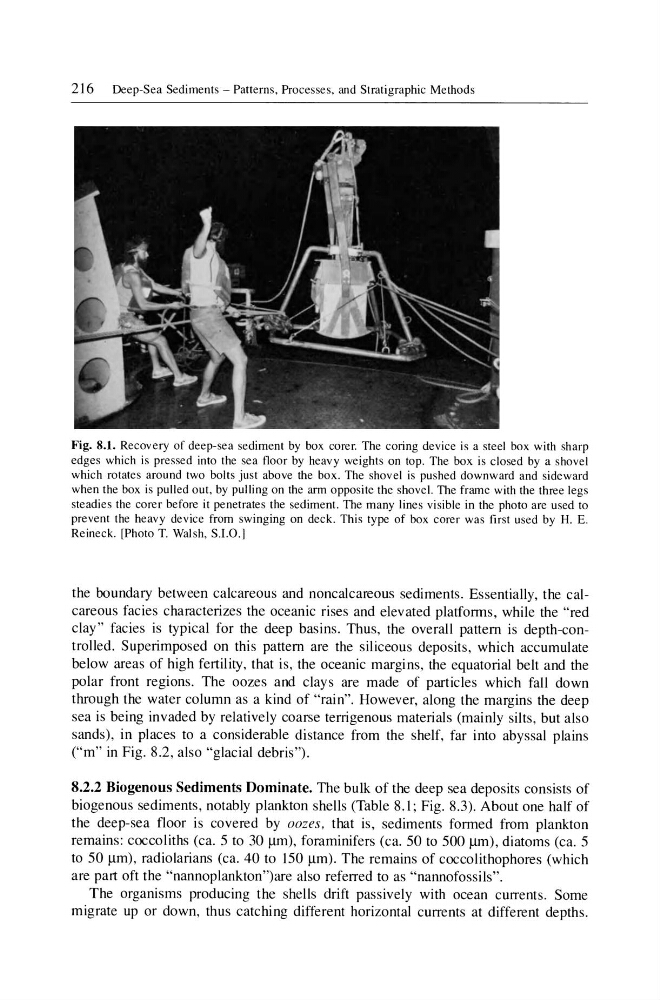
Fig. 8.1. Recovery of deep-sea sediment by box corer. The coring device is a steel box with sharp
edges which is pressed into the sea floor by heavy weights on top. The box is closed by a shovel
which rotates around two bolts just above the box. The shovel is pushed downward and sideward
when the box is pulled out, by pulling on the arm opposite the shovel. The frame with the three legs
steadies the corer before it penetrates the sediment. The many lines visible in the photo are used to
prevent the heavy device from swinging on deck. This type of box corer was first used by H. E.
Reineck. [Photo T. Walsh, S.I.O.]
the boundary between calcareous and noncalcareous sediments. Essentially, the calcareous facies characterizes the oceanic rises and elevated platforms, while the "red
clay" facies is typical for the deep basins. Thus, the overall pattern is depth-controlled. Superimposed on this pattern are the siliceous deposits, which accumulate
below areas of high fertility, that is, the oceanic margins, the equatorial belt and the
polar front regions. The oozes and clays are made of particles which fall down
through the water column as a kind of "rain". However, along the margins the deep
sea is being invaded by relatively coarse terrigenous materials (mainly silts, but also
sands), in places to a considerable distance from the shelf, far into abyssal plains
("m" in Fig. 8.2, also "glacial debris").
8.2.2 Biogenous Sediments Dominate. The bulk of the deep sea deposits consists of
biogenous sediments, notably plankton shells (Table 8.1; Fig. 8.3). About one half of
the deep-sea floor is covered by oozes, that is, sediments formed from plankton
remains: coccoliths (ca. 5 to 30 I..Im), foraminifers (ca. 50 to 500 11m), diatoms (ca. 5
to 50 11m), radiolarians (ca. 40 to 150 11m). The remains of coccolithophores (which
are part oft the "nannoplankton")are also referred to as "nannofossils".
The organisms producing the shells drift passively with ocean currents. Some
migrate up or down, thus catching different horizontal currents at different depths.
Fig. 8.1. Recovery of deep-sea sediment by box corer. The coring device is a steel box with sharp
edges which is pressed into the sea floor by heavy weights on top. The box is closed by a shovel
which rotates around two bolts just above the box. The shovel is pushed downward and sideward
when the box is pulled out, by pulling on the arm opposite the shovel. The frame with the three legs
steadies the corer before it penetrates the sediment. The many lines visible in the photo are used to
prevent the heavy device from swinging on deck. This type of box corer was first used by H. E.
Reineck. [Photo T. Walsh, S.I.O.]
the boundary between calcareous and noncalcareous sediments. Essentially, the calcareous facies characterizes the oceanic rises and elevated platforms, while the "red
clay" facies is typical for the deep basins. Thus, the overall pattern is depth-controlled. Superimposed on this pattern are the siliceous deposits, which accumulate
below areas of high fertility, that is, the oceanic margins, the equatorial belt and the
polar front regions. The oozes and clays are made of particles which fall down
through the water column as a kind of "rain". However, along the margins the deep
sea is being invaded by relatively coarse terrigenous materials (mainly silts, but also
sands), in places to a considerable distance from the shelf, far into abyssal plains
("m" in Fig. 8.2, also "glacial debris").
8.2.2 Biogenous Sediments Dominate. The bulk of the deep sea deposits consists of
biogenous sediments, notably plankton shells (Table 8.1; Fig. 8.3). About one half of
the deep-sea floor is covered by oozes, that is, sediments formed from plankton
remains: coccoliths (ca. 5 to 30 I..Im), foraminifers (ca. 50 to 500 11m), diatoms (ca. 5
to 50 11m), radiolarians (ca. 40 to 150 11m). The remains of coccolithophores (which
are part oft the "nannoplankton")are also referred to as "nannofossils".
The organisms producing the shells drift passively with ocean currents. Some
migrate up or down, thus catching different horizontal currents at different depths.