

210 Imprint of Climatic Zonation on Marine Sediments
><
:J
u:
~
Cl
.2
6.6
6.2
5.8
5.4
5.0
3.0
2.6
2.2
1.8
1.4
1950
Diatoms
Planktonic Foraminifera
1960
1970
Years
1980
1990
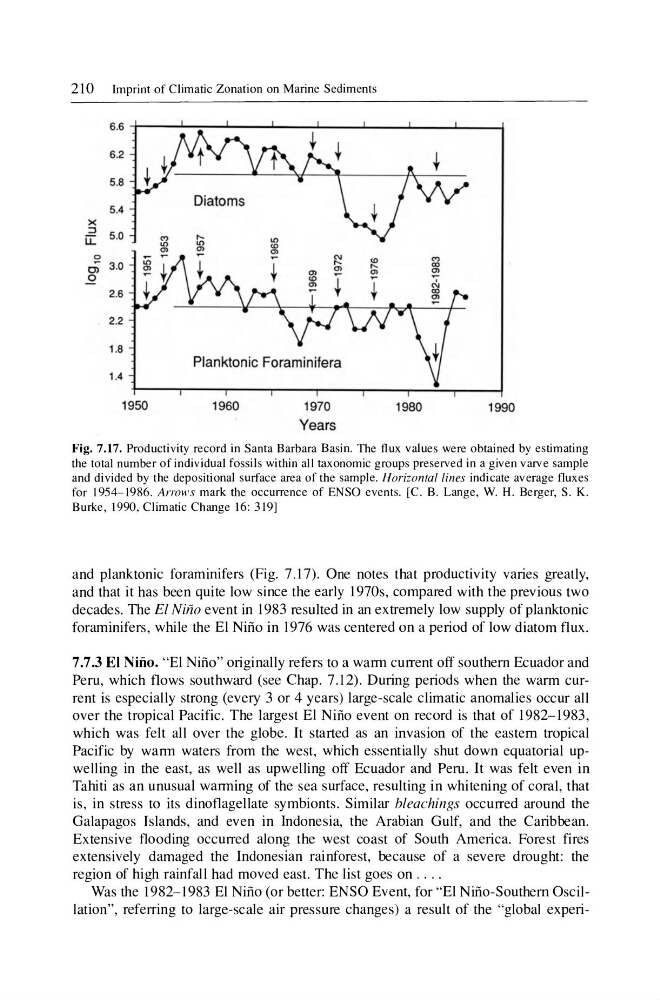
Fig. 7.17. Productivity record in Santa Barbara Basin. The flux values were obtained by estimating
the total number of individual fossils within all taxonomic groups preserved in a given varve sample
and divided by the depositional surface area of the sample. Horizon/a/lines indicate average fluxes
for 1954- 1986. Arrows mark the occurrence of ENSO events. [CO B. Lange, W. H. Berger, S. K.
Burke , 1990, Climatic Change 16: 319]
and planktonic foraminifers (Fig. 7.17). One notes that productivity varies greatly,
and that it has been quite low since the early 1970s, compared with the previous two
decades. The El Nino event in 1983 resulted in an extremely low supply of planktonic
foraminifers, while the EI Nino in 1976 was centered on a period of low diatom flux.
7.7.3 EI Nino. "EI Nino" originally refers to a warm current off southern Ecuador and
Peru, which flows southward (see Chap. 7.12). During periods when the warm current is especially strong (every 3 or 4 years) large-scale climatic anomalies occur all
over the tropical Pacific. The largest EI Nino event on record is that of 1982-1983,
which was felt all over the globe. It started as an invasion of the eastern tropical
Pacific by warm waters from the west, which essentially shut down equatorial upwelling in the east, as well as upwelling off Ecuador and Peru. It was felt even in
Tahiti as an unusual warming of the sea surface, resulting in whitening of coral, that
is, in stress to its dinoflagellate symbionts. Similar hleachings occurred around the
Galapagos Islands, and even in Indonesia, the Arabian Gulf, and the Caribbean.
Extensive flooding occurred along the west coast of South America. Forest fires
extensively damaged the Indonesian rainforest, because of a severe drought: the
region of high rainfall had moved east. The list goes on ....
Was the 1982-1983 EI Nino (or better: ENSO Event, for "El Nino-Southern Oscillation", referring to large-scale air pressure changes) a result of the "global experi-
><
:J
u:
~
Cl
.2
6.6
6.2
5.8
5.4
5.0
3.0
2.6
2.2
1.8
1.4
1950
Diatoms
Planktonic Foraminifera
1960
1970
Years
1980
1990
Fig. 7.17. Productivity record in Santa Barbara Basin. The flux values were obtained by estimating
the total number of individual fossils within all taxonomic groups preserved in a given varve sample
and divided by the depositional surface area of the sample. Horizon/a/lines indicate average fluxes
for 1954- 1986. Arrows mark the occurrence of ENSO events. [CO B. Lange, W. H. Berger, S. K.
Burke , 1990, Climatic Change 16: 319]
and planktonic foraminifers (Fig. 7.17). One notes that productivity varies greatly,
and that it has been quite low since the early 1970s, compared with the previous two
decades. The El Nino event in 1983 resulted in an extremely low supply of planktonic
foraminifers, while the EI Nino in 1976 was centered on a period of low diatom flux.
7.7.3 EI Nino. "EI Nino" originally refers to a warm current off southern Ecuador and
Peru, which flows southward (see Chap. 7.12). During periods when the warm current is especially strong (every 3 or 4 years) large-scale climatic anomalies occur all
over the tropical Pacific. The largest EI Nino event on record is that of 1982-1983,
which was felt all over the globe. It started as an invasion of the eastern tropical
Pacific by warm waters from the west, which essentially shut down equatorial upwelling in the east, as well as upwelling off Ecuador and Peru. It was felt even in
Tahiti as an unusual warming of the sea surface, resulting in whitening of coral, that
is, in stress to its dinoflagellate symbionts. Similar hleachings occurred around the
Galapagos Islands, and even in Indonesia, the Arabian Gulf, and the Caribbean.
Extensive flooding occurred along the west coast of South America. Forest fires
extensively damaged the Indonesian rainforest, because of a severe drought: the
region of high rainfall had moved east. The list goes on ....
Was the 1982-1983 EI Nino (or better: ENSO Event, for "El Nino-Southern Oscillation", referring to large-scale air pressure changes) a result of the "global experi-