

200 Imprint of Climatic Zonation on Marine Sediments
NORTH POLE
EQUATOR
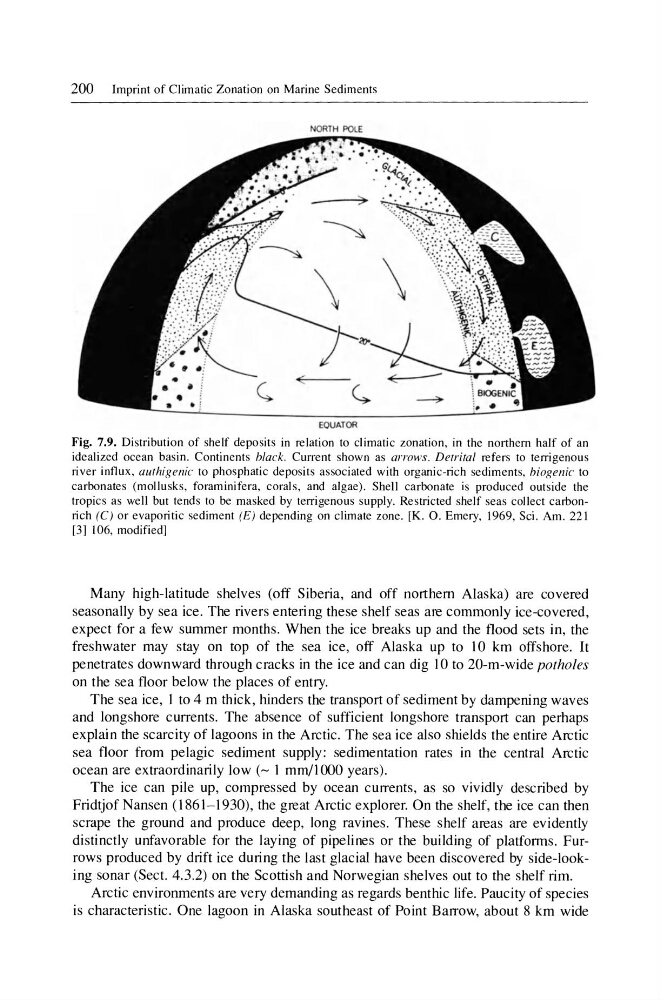
Fig. 7.9. Distribution of shelf deposits in relation to climatic zonation, in the northern half of an
idealized ocean basin. Continents hlack. Current shown as arrows. Detrital refers to terrigenous
river influx, authigenic to phosphatic deposits associated with organic-rich sediments, biogenic to
carbonates (mollusks, foraminifera, corals, and algae). Shell carbonate is produced outside the
tropics as well but tends to be masked by terrigenous supply. Restricted shelf seas collect carbonrich (e) or evaporitic sediment (E) depending on climate zone. [K. O. Emery, 1969, Sci . Am . 221
[3] 106, modified]
Many high-latitude shelves (off Siberia, and off northern Alaska) are covered
seasonally by sea ice. The rivers entering these shelf seas are commonly ice-covered,
expect for a few summer months. When the ice breaks up and the flood sets in, the
freshwater may stay on top of the sea ice, off Alaska up to lO km offshore. It
penetrates downward through cracks in the ice and can dig 10 to 20-m-wide potholes
on the sea floor below the places of entry.
The sea ice, 1 to 4 m thick, hinders the transport of sediment by dampening waves
and longshore currents. The absence of sufficient longshore transport can perhaps
explain the scarcity of lagoons in the Arctic. The sea ice also shields the entire Arctic
sea floor from pelagic sediment supply: sedimentation rates in the central Arctic
ocean are extraordinarily low (- 1 mm/lOOO years).
The ice can pile up, compressed by ocean currents, as so vividly described by
Fridtjof Nansen (1861-1930), the great Arctic explorer. On the shelf, the ice can then
scrape the ground and produce deep, long ravines. These shelf areas are evidently
distinctly unfavorable for the laying of pipelines or the building of platforms. Furrows produced by drift ice during the last glacial have been discovered by side-looking sonar (Sect. 4.3.2) on the Scottish and Norwegian shelves out to the shelf rim.
Arctic environments are very demanding as regards benthic life. Paucity of species
is characteristic. One lagoon in Alaska southeast of Point Barrow, about 8 km wide
NORTH POLE
EQUATOR
Fig. 7.9. Distribution of shelf deposits in relation to climatic zonation, in the northern half of an
idealized ocean basin. Continents hlack. Current shown as arrows. Detrital refers to terrigenous
river influx, authigenic to phosphatic deposits associated with organic-rich sediments, biogenic to
carbonates (mollusks, foraminifera, corals, and algae). Shell carbonate is produced outside the
tropics as well but tends to be masked by terrigenous supply. Restricted shelf seas collect carbonrich (e) or evaporitic sediment (E) depending on climate zone. [K. O. Emery, 1969, Sci . Am . 221
[3] 106, modified]
Many high-latitude shelves (off Siberia, and off northern Alaska) are covered
seasonally by sea ice. The rivers entering these shelf seas are commonly ice-covered,
expect for a few summer months. When the ice breaks up and the flood sets in, the
freshwater may stay on top of the sea ice, off Alaska up to lO km offshore. It
penetrates downward through cracks in the ice and can dig 10 to 20-m-wide potholes
on the sea floor below the places of entry.
The sea ice, 1 to 4 m thick, hinders the transport of sediment by dampening waves
and longshore currents. The absence of sufficient longshore transport can perhaps
explain the scarcity of lagoons in the Arctic. The sea ice also shields the entire Arctic
sea floor from pelagic sediment supply: sedimentation rates in the central Arctic
ocean are extraordinarily low (- 1 mm/lOOO years).
The ice can pile up, compressed by ocean currents, as so vividly described by
Fridtjof Nansen (1861-1930), the great Arctic explorer. On the shelf, the ice can then
scrape the ground and produce deep, long ravines. These shelf areas are evidently
distinctly unfavorable for the laying of pipelines or the building of platforms. Furrows produced by drift ice during the last glacial have been discovered by side-looking sonar (Sect. 4.3.2) on the Scottish and Norwegian shelves out to the shelf rim.
Arctic environments are very demanding as regards benthic life. Paucity of species
is characteristic. One lagoon in Alaska southeast of Point Barrow, about 8 km wide