

Climate Indicators: Isotopes
193
from the same aqueous solution should have different ratios of oxygen-18 to oxygen16, depending on the temperature at which the precipitation proceeds.
The usefulness of this concept to paleoclimatic research was establish soon after,
by S. Epstein, R. Buchsbaum, H. A. Lowenstam, and H. C. Urey. They compared the
isotopic composition of mollusks shells which grew at various temperatures, in their
natural environment. Results showed that there was an orderly relationship between
the isotopic composition and the temperature of growth. A fit to their data points
yielded an equation which is widely used for paleo-temperature determination:
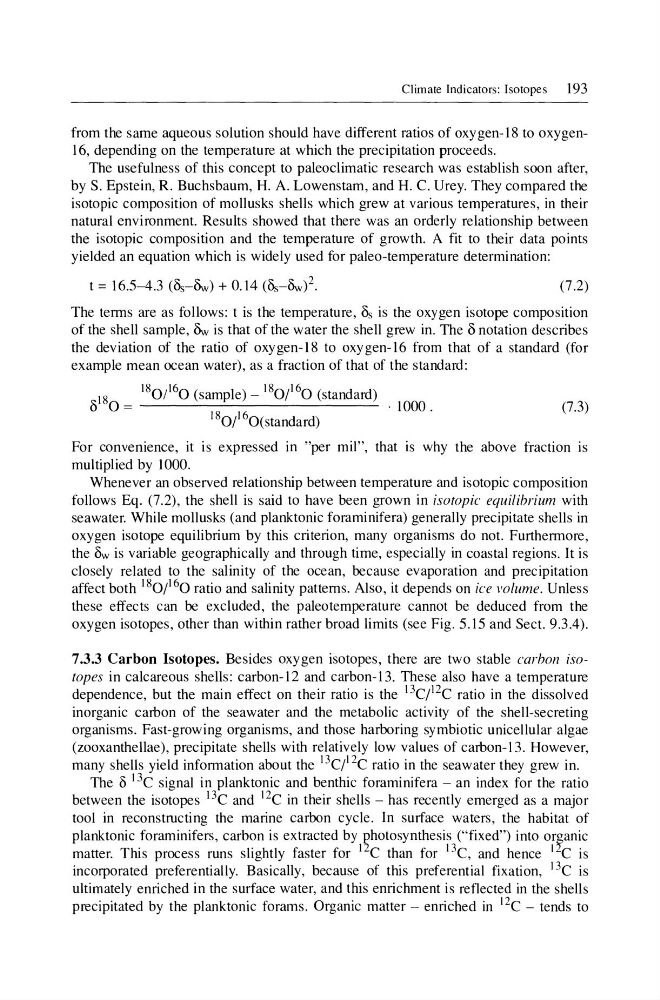
t = 16.5-4.3 (&-&,) + 0.14 (&-&,)2.
(7.2)
The terms are as follows: t is the temperature, & is the oxygen isotope composition
of the shell sample, &, is that of the water the shell grew in. The 0 notation describes
the deviation of the ratio of oxygen-18 to oxygen-16 from that of a standard (for
example mean ocean water), as a fraction of that of the standard:
18
180 /160 (sample) - 180 /160 (standard)
o 0=
·1000.
180 /160 (standard)
(7.3)
For convenience, it is expressed in "per mil", that is why the above fraction is
multiplied by 1000.
Whenever an observed relationship between temperature and isotopic composition
follows Eq. (7.2), the shell is said to have been grown in isotopic equilibrium with
seawater. While mollusks (and planktonic foraminifera) generally precipitate shells in
oxygen isotope equilibrium by this criterion, many organisms do not. Furthermore,
the &, is variable geographically and through time, especially in coastal regions. It is
closely related to the salinity of the ocean, because evaporation and precipitation
affect both 18 0/ 16 0 ratio and salinity patterns. Also, it depends on ice volume. Unless
these effects can be excluded, the paleotemperature cannot be deduced from the
oxygen isotopes, other than within rather broad limits (see Fig. 5.15 and Sect. 9.3.4).
7.3.3 Carbon Isotopes. Besides oxygen isotopes, there are two stable carbon isotopes in calcareous shells: carbon-12 and carbon-13. These also have a temperature
dependence, but the main effect on their ratio is the 13C/12C ratio in the dissolved
inorganic carbon of the seawater and the metabolic activity of the shell-secreting
organisms. Fast-growing organisms, and those harboring symbiotic unicellular algae
(zooxanthellae), precipitate shells with relatively low values of carbon-13. However,
many shells yield information about the 13C;I 2 C ratio in the seawater they grew in.
The () 13C signal in planktonic and benthic foraminifera - an index for the ratio
between the isotopes 13C and 12C in their shells - has recently emerged as a major
tool in reconstructing the marine carbon cycle. In surface waters, the habitat of
planktonic foraminifers, carbon is extracted by ~hotosynthesis ("fixed") into orfanic
matter. This process runs slightly faster for 1 C than for 13C , and hence 1 C is
incorporated preferentially. Basically, because of this preferential fixation, 13C is
ultimately enriched in the surface water, and this enrichment is reflected in the shells
precipitated by the planktonic forams. Organic matter - enriched in 12C - tends to
193
from the same aqueous solution should have different ratios of oxygen-18 to oxygen16, depending on the temperature at which the precipitation proceeds.
The usefulness of this concept to paleoclimatic research was establish soon after,
by S. Epstein, R. Buchsbaum, H. A. Lowenstam, and H. C. Urey. They compared the
isotopic composition of mollusks shells which grew at various temperatures, in their
natural environment. Results showed that there was an orderly relationship between
the isotopic composition and the temperature of growth. A fit to their data points
yielded an equation which is widely used for paleo-temperature determination:
t = 16.5-4.3 (&-&,) + 0.14 (&-&,)2.
(7.2)
The terms are as follows: t is the temperature, & is the oxygen isotope composition
of the shell sample, &, is that of the water the shell grew in. The 0 notation describes
the deviation of the ratio of oxygen-18 to oxygen-16 from that of a standard (for
example mean ocean water), as a fraction of that of the standard:
18
180 /160 (sample) - 180 /160 (standard)
o 0=
·1000.
180 /160 (standard)
(7.3)
For convenience, it is expressed in "per mil", that is why the above fraction is
multiplied by 1000.
Whenever an observed relationship between temperature and isotopic composition
follows Eq. (7.2), the shell is said to have been grown in isotopic equilibrium with
seawater. While mollusks (and planktonic foraminifera) generally precipitate shells in
oxygen isotope equilibrium by this criterion, many organisms do not. Furthermore,
the &, is variable geographically and through time, especially in coastal regions. It is
closely related to the salinity of the ocean, because evaporation and precipitation
affect both 18 0/ 16 0 ratio and salinity patterns. Also, it depends on ice volume. Unless
these effects can be excluded, the paleotemperature cannot be deduced from the
oxygen isotopes, other than within rather broad limits (see Fig. 5.15 and Sect. 9.3.4).
7.3.3 Carbon Isotopes. Besides oxygen isotopes, there are two stable carbon isotopes in calcareous shells: carbon-12 and carbon-13. These also have a temperature
dependence, but the main effect on their ratio is the 13C/12C ratio in the dissolved
inorganic carbon of the seawater and the metabolic activity of the shell-secreting
organisms. Fast-growing organisms, and those harboring symbiotic unicellular algae
(zooxanthellae), precipitate shells with relatively low values of carbon-13. However,
many shells yield information about the 13C;I 2 C ratio in the seawater they grew in.
The () 13C signal in planktonic and benthic foraminifera - an index for the ratio
between the isotopes 13C and 12C in their shells - has recently emerged as a major
tool in reconstructing the marine carbon cycle. In surface waters, the habitat of
planktonic foraminifers, carbon is extracted by ~hotosynthesis ("fixed") into orfanic
matter. This process runs slightly faster for 1 C than for 13C , and hence 1 C is
incorporated preferentially. Basically, because of this preferential fixation, 13C is
ultimately enriched in the surface water, and this enrichment is reflected in the shells
precipitated by the planktonic forams. Organic matter - enriched in 12C - tends to