

192 Imprint of Climatic Zonation on Marine Sediments
WARM
COLD
DELICATE
RESISTANT
e.
~~-~
2
~4
C!r
6
.1°'
Q.~ • .
ar- - " ..
!
. '(: ~~
11 1
.f!!
12
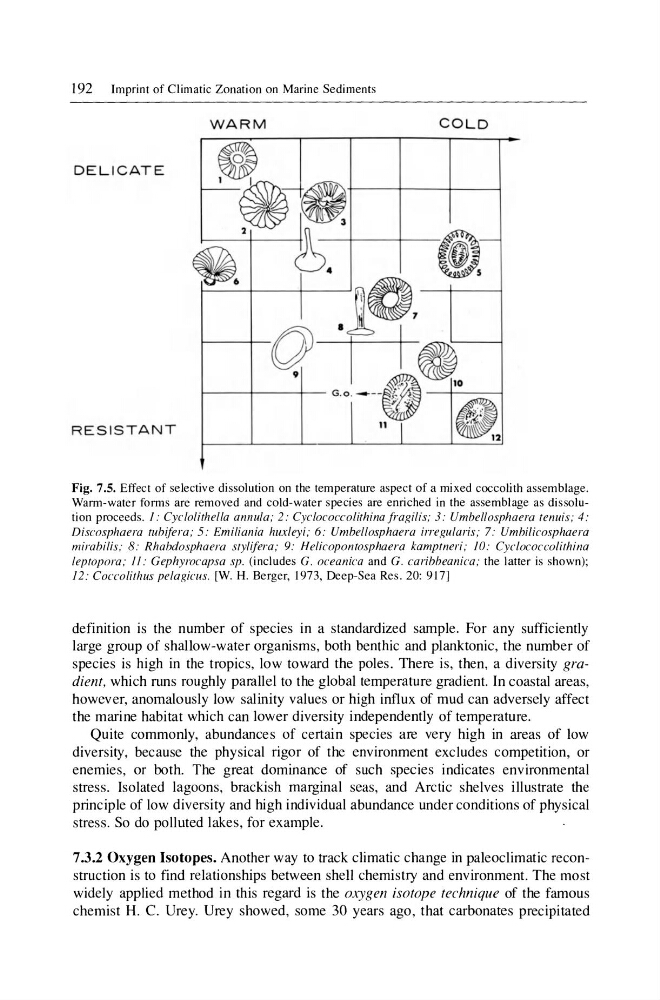
Fig. 7.5. Effect of selective dissolution on the temperature aspect of a mixed coccolith assemblage.
Warm-water forms are removed and cold-water species are enriched in the assemblage as dissolution proceeds. I: Cyclolithella annula; 2: Cyclococcolithina fragilis; 3: Umbellosphaera tenuis; 4:
Discosphaera !Ubifera; 5: Emiliania huxleyi; 6; Umbellosphaera irregularis; 7: Umhilicosphaera
mirabilis; 8: Rhahdosphaera styli/era; 9: Helicopontosphaera kamptneri; 10: Cyclococcolithina
leptopora ; /I; Gephyrocapsa sp. (includes G. oceanica and G. caribbeanica; the latter is shown);
12: Coccolith us pelagic/IS. [w. H. Berger, 1973, Deep-Sea Res. 20: 917]
definition is the number of species in a standardized sample. For any sufficiently
large group of shallow-water organisms, both benthic and planktonic, the number of
species is high in the tropics, low toward the poles. There is, then, a diversity gradient, which runs roughly parallel to the global temperature gradient. In coastal areas,
however, anomalously low salinity values or high influx of mud can adversely affect
the marine habitat which can lower diversity independently of temperature.
Quite commonly, abundances of certain species are very high in areas of low
diversity, because the physical rigor of the environment excludes competition, or
enemies, or both. The great dominance of such species indicates environmental
stress. Isolated lagoons, brackish marginal seas, and Arctic shelves illustrate the
principle of low diversity and high individual abundance under conditions of physical
stress. So do polluted lakes, for example.
7.3.2 Oxygen Isotopes. Another way to track climatic change in paleoclimatic reconstruction is to find relationships between shell chemistry and environment. The most
widely applied method in this regard is the oxygen isotope technique of the famous
chemist H. C. Urey. Urey showed, some 30 years ago, that carbonates precipitated
WARM
COLD
DELICATE
RESISTANT
e.
~~-~
2
~4
C!r
6
.1°'
Q.~ • .
ar- - " ..
!
. '(: ~~
11 1
.f!!
12
Fig. 7.5. Effect of selective dissolution on the temperature aspect of a mixed coccolith assemblage.
Warm-water forms are removed and cold-water species are enriched in the assemblage as dissolution proceeds. I: Cyclolithella annula; 2: Cyclococcolithina fragilis; 3: Umbellosphaera tenuis; 4:
Discosphaera !Ubifera; 5: Emiliania huxleyi; 6; Umbellosphaera irregularis; 7: Umhilicosphaera
mirabilis; 8: Rhahdosphaera styli/era; 9: Helicopontosphaera kamptneri; 10: Cyclococcolithina
leptopora ; /I; Gephyrocapsa sp. (includes G. oceanica and G. caribbeanica; the latter is shown);
12: Coccolith us pelagic/IS. [w. H. Berger, 1973, Deep-Sea Res. 20: 917]
definition is the number of species in a standardized sample. For any sufficiently
large group of shallow-water organisms, both benthic and planktonic, the number of
species is high in the tropics, low toward the poles. There is, then, a diversity gradient, which runs roughly parallel to the global temperature gradient. In coastal areas,
however, anomalously low salinity values or high influx of mud can adversely affect
the marine habitat which can lower diversity independently of temperature.
Quite commonly, abundances of certain species are very high in areas of low
diversity, because the physical rigor of the environment excludes competition, or
enemies, or both. The great dominance of such species indicates environmental
stress. Isolated lagoons, brackish marginal seas, and Arctic shelves illustrate the
principle of low diversity and high individual abundance under conditions of physical
stress. So do polluted lakes, for example.
7.3.2 Oxygen Isotopes. Another way to track climatic change in paleoclimatic reconstruction is to find relationships between shell chemistry and environment. The most
widely applied method in this regard is the oxygen isotope technique of the famous
chemist H. C. Urey. Urey showed, some 30 years ago, that carbonates precipitated