

Overall Zonation and Main Factors
187
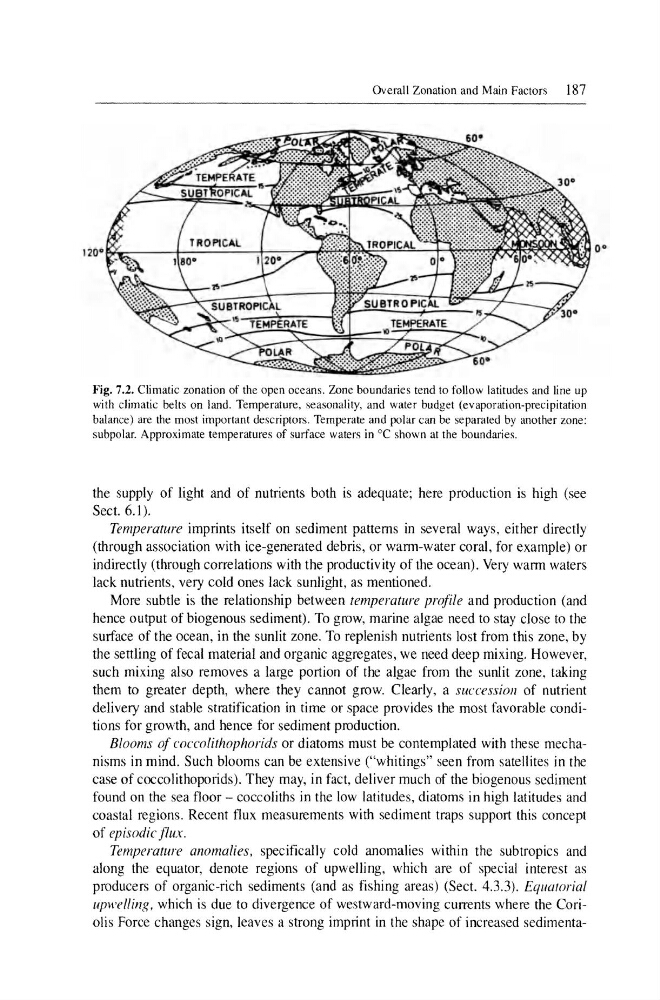
Fig. 7.2. Climatic zonation of the open oceans. Zone boundaries tend to follow latitudes and line up
with climatic belts on land. Temperature, seasonality, and water budget (evaporation-precipitation
balance) are the most important descriptors. Temperate and polar can be separated by another zone:
subpolar. Approximate temperatures of surface waters in °C shown at the boundaries.
the supply of light and of nutrients both is adequate; here production is high (see
Sect. 6.1).
Temperature imprints itself on sediment patterns in several ways, either directly
(through association with ice-generated debris, or warm-water coral, for example) or
indirectly (through correlations with the productivity of the ocean). Very warm waters
lack nutrients, very cold ones lack sunlight, as mentioned.
More subtle is the relationship between temperature profile and production (and
hence output of biogenous sediment). To grow, marine algae need to stay close to the
surface of the ocean, in the sunlit zone. To replenish nutrients lost from this zone, by
the settling of fecal material and organic aggregates, we need deep mixing. However,
such mixing also removes a large portion of the algae from the sunlit zone, taking
them to greater depth, where they cannot grow. Clearly, a succession of nutrient
delivery and stable stratification in time or space provides the most favorable conditions for growth, and hence for sediment production.
B/ooms of ('()ccolithophorids or diatoms must be contemplated with these mechanisms in mind. Such blooms can be extensive ("whitings" seen from satellites in the
case of coccolithoporids). They may, in fact, deliver much of the biogenous sediment
found on the sea floor - coccoliths in the low latitudes, diatoms in high latitudes and
coastal regions . Recent flux measurements with sediment traps support this concept
of episodic flux.
Temperature anomalies, specifically cold anomalies within the sub tropics and
along the equator, denote regions of upwelling, which are of special interest as
producers of organic-rich sediments (and as fishing areas) (Sect. 4.3.3). Equatorial
upwelling, which is due to divergence of westward-moving currents where the Coriolis Force changes sign, leaves a strong imprint in the shape of increased sedimenta-
187
Fig. 7.2. Climatic zonation of the open oceans. Zone boundaries tend to follow latitudes and line up
with climatic belts on land. Temperature, seasonality, and water budget (evaporation-precipitation
balance) are the most important descriptors. Temperate and polar can be separated by another zone:
subpolar. Approximate temperatures of surface waters in °C shown at the boundaries.
the supply of light and of nutrients both is adequate; here production is high (see
Sect. 6.1).
Temperature imprints itself on sediment patterns in several ways, either directly
(through association with ice-generated debris, or warm-water coral, for example) or
indirectly (through correlations with the productivity of the ocean). Very warm waters
lack nutrients, very cold ones lack sunlight, as mentioned.
More subtle is the relationship between temperature profile and production (and
hence output of biogenous sediment). To grow, marine algae need to stay close to the
surface of the ocean, in the sunlit zone. To replenish nutrients lost from this zone, by
the settling of fecal material and organic aggregates, we need deep mixing. However,
such mixing also removes a large portion of the algae from the sunlit zone, taking
them to greater depth, where they cannot grow. Clearly, a succession of nutrient
delivery and stable stratification in time or space provides the most favorable conditions for growth, and hence for sediment production.
B/ooms of ('()ccolithophorids or diatoms must be contemplated with these mechanisms in mind. Such blooms can be extensive ("whitings" seen from satellites in the
case of coccolithoporids). They may, in fact, deliver much of the biogenous sediment
found on the sea floor - coccoliths in the low latitudes, diatoms in high latitudes and
coastal regions . Recent flux measurements with sediment traps support this concept
of episodic flux.
Temperature anomalies, specifically cold anomalies within the sub tropics and
along the equator, denote regions of upwelling, which are of special interest as
producers of organic-rich sediments (and as fishing areas) (Sect. 4.3.3). Equatorial
upwelling, which is due to divergence of westward-moving currents where the Coriolis Force changes sign, leaves a strong imprint in the shape of increased sedimenta-