

........ 5
E
o
W 10
a::
o
(J 15
Z
20
I
f~ 25
W
o
30
o
Bioturbation
179
LAYER
- -
BOX CORE
ERDC - 92BX
-
-
14C ANOMALY or
it!" DISTUR BA NCE
- - - - - - -
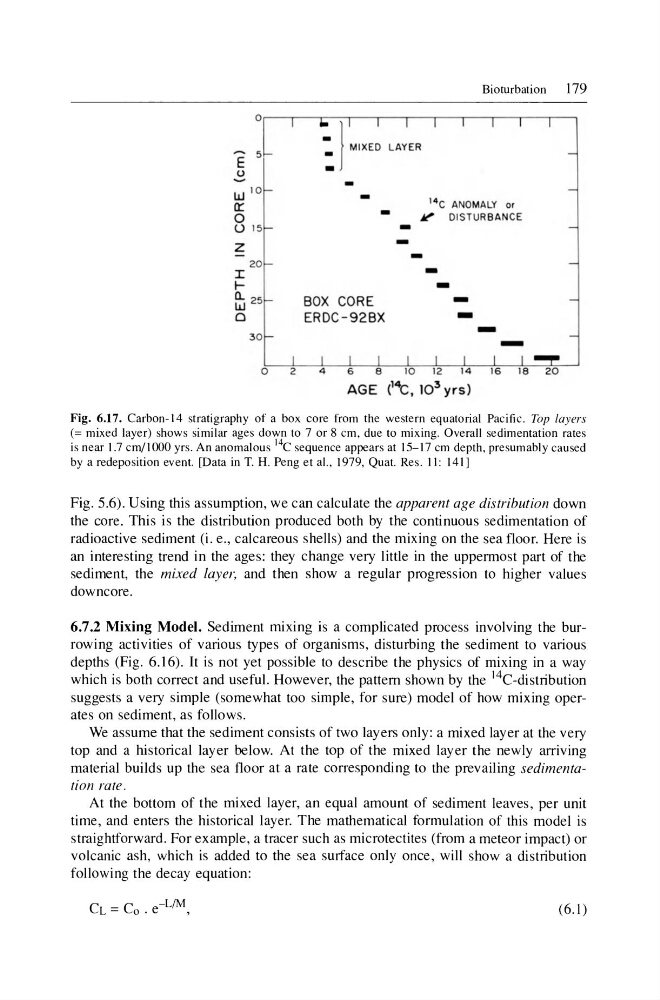
Fig. 6.17. Carbon-14 stratigraphy of a box core from the western equatorial Pacific. Top layers
(= mixed layer) shows similar ages down to 7 or 8 em, due to mixing. Overall sedimentation rates
is near 1.7 em/lOOO yrs. An anomalous 14C sequence appears at 15-17 em depth, presumably caused
by a redeposition event. [Data in T. H. Peng et aI. , 1979, Quat. Res. II: 141]
Fig. 5.6). Using this assumption, we can calculate the apparent age distribution down
the core. This is the distribution produced both by the continuous sedimentation of
radioactive sediment (i. e., calcareous shells) and the mixing on the sea floor. Here is
an interesting trend in the ages: they change very little in the uppermost part of the
sediment, the mixed layer, and then show a regular progression to higher values
downcore.
6.7.2 Mixing Model. Sediment mixing is a complicated process involving the burrowing activities of various types of organisms, disturbing the sediment to various
depths (Fig. 6.16). It is not yet possible to describe the physics of mixing in a way
which is both correct and useful. However, the pattern shown by the 14C-distribution
suggests a very simple (somewhat too simple, for sure) model of how mixing operates on sediment, as follows.
We assume that the sediment consists of two layers only: a mixed layer at the very
top and a historical layer below. At the top of the mixed layer the newly arriving
material builds up the sea floor at a rate corresponding to the prevailing sedimentation rate .
At the bottom of the mixed layer, an equal amount of sediment leaves, per unit
time, and enters the historical layer. The mathematical formulation of this model is
straightforward. For example, a tracer such as microtectites (from a meteor impact) or
volcanic ash, which is added to the sea surface only once, will show a distribution
following the decay equation:
(6.1 )
E
o
W 10
a::
o
(J 15
Z
20
I
f~ 25
W
o
30
o
Bioturbation
179
LAYER
- -
BOX CORE
ERDC - 92BX
-
-
14C ANOMALY or
it!" DISTUR BA NCE
- - - - - - -
Fig. 6.17. Carbon-14 stratigraphy of a box core from the western equatorial Pacific. Top layers
(= mixed layer) shows similar ages down to 7 or 8 em, due to mixing. Overall sedimentation rates
is near 1.7 em/lOOO yrs. An anomalous 14C sequence appears at 15-17 em depth, presumably caused
by a redeposition event. [Data in T. H. Peng et aI. , 1979, Quat. Res. II: 141]
Fig. 5.6). Using this assumption, we can calculate the apparent age distribution down
the core. This is the distribution produced both by the continuous sedimentation of
radioactive sediment (i. e., calcareous shells) and the mixing on the sea floor. Here is
an interesting trend in the ages: they change very little in the uppermost part of the
sediment, the mixed layer, and then show a regular progression to higher values
downcore.
6.7.2 Mixing Model. Sediment mixing is a complicated process involving the burrowing activities of various types of organisms, disturbing the sediment to various
depths (Fig. 6.16). It is not yet possible to describe the physics of mixing in a way
which is both correct and useful. However, the pattern shown by the 14C-distribution
suggests a very simple (somewhat too simple, for sure) model of how mixing operates on sediment, as follows.
We assume that the sediment consists of two layers only: a mixed layer at the very
top and a historical layer below. At the top of the mixed layer the newly arriving
material builds up the sea floor at a rate corresponding to the prevailing sedimentation rate .
At the bottom of the mixed layer, an equal amount of sediment leaves, per unit
time, and enters the historical layer. The mathematical formulation of this model is
straightforward. For example, a tracer such as microtectites (from a meteor impact) or
volcanic ash, which is added to the sea surface only once, will show a distribution
following the decay equation:
(6.1 )