

178 Productivity and Benthic Organisms
Scolicio
Planolites
Helminthopsis
Chondrites
?Daedolus
Zoophycos
o .
5
10 .
em
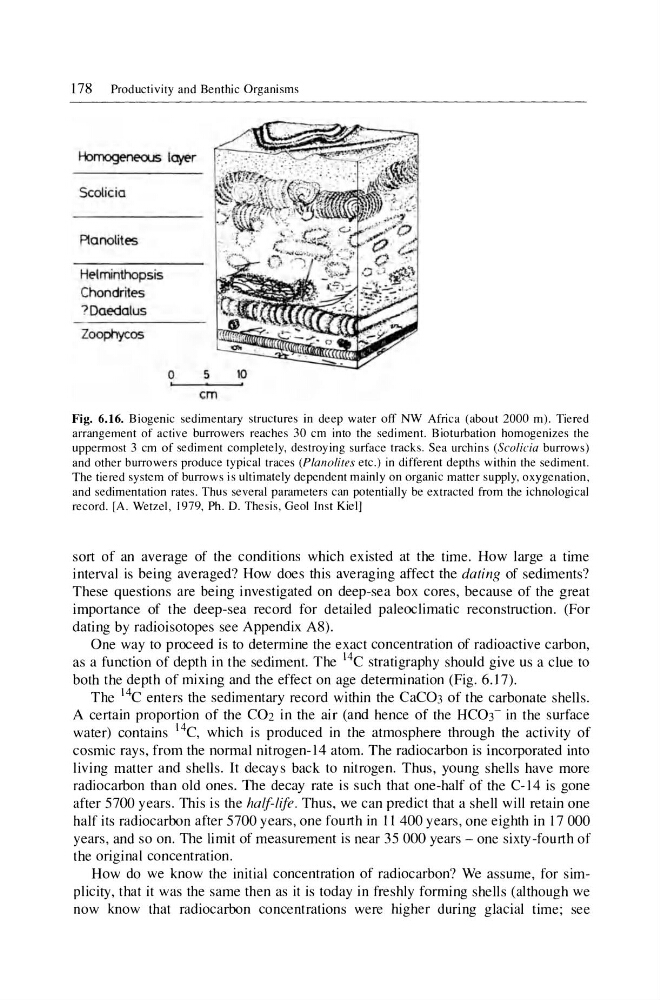
Fig. 6.16. Biogenic sedimentary structures in deep water off NW Africa (about 2000 m). Tiered
arrangement of active burrowers reaches 30 em into the sediment. Bioturbation homogenizes the
uppermost 3 em of sediment completely, destroying surface tracks. Sea urchins (Scolicia burrows)
and other burrowers produce typical traces (Planolites etc.) in different depths within the sediment.
The tiered system of burrows is ultimately dependent mainly on organic matter supply, oxygenation,
and sedimentation rates. Thus several parameters can potentially be extracted from the iehnological
record. [A. Wetzel , 1979, Ph. D. Thesis, Geol Inst Kiel]
sort of an average of the conditions which existed at the time. How large a time
interval is being averaged? How does this averaging affect the dating of sediments?
These questions are being investigated on deep-sea box cores, because of the great
importance of the deep-sea record for detailed paleoclimatic reconstruction. (For
dating by radioisotopes see Appendix A8).
One way to proceed is to determine the exact concentration of radioactive carbon,
as a function of depth in the sediment. The 14C stratigraphy should give us a clue to
both the depth of mixing and the effect on age determination (Fig. 6.17).
The 14C enters the sedimentary record within the CaC03 of the carbonate shells.
A certain proportion of the C02 in the air (and hence of the HC03- in the surface
water) contains 14C, which is produced in the atmosphere through the activity of
cosmic rays, from the normal nitrogen-14 atom. The radiocarbon is incorporated into
living matter and shells. It decays back to nitrogen. Thus, young shells have more
radiocarbon than old ones. The decay rate is such that one-half of the C-14 is gone
after 5700 years. This is the half-life. Thus, we can predict that a shell will retain one
half its radiocarbon after 5700 years, one fourth in II 400 years, one eighth in 17000
years, and so on. The limit of measurement is near 35 000 years - one sixty-fourth of
the original concentration.
How do we know the initial concentration of radiocarbon? We assume, for simplicity, that it was the same then as it is today in freshly forming shells (although we
now know that radiocarbon concentrations were higher during glacial time; see
Scolicio
Planolites
Helminthopsis
Chondrites
?Daedolus
Zoophycos
o .
5
10 .
em
Fig. 6.16. Biogenic sedimentary structures in deep water off NW Africa (about 2000 m). Tiered
arrangement of active burrowers reaches 30 em into the sediment. Bioturbation homogenizes the
uppermost 3 em of sediment completely, destroying surface tracks. Sea urchins (Scolicia burrows)
and other burrowers produce typical traces (Planolites etc.) in different depths within the sediment.
The tiered system of burrows is ultimately dependent mainly on organic matter supply, oxygenation,
and sedimentation rates. Thus several parameters can potentially be extracted from the iehnological
record. [A. Wetzel , 1979, Ph. D. Thesis, Geol Inst Kiel]
sort of an average of the conditions which existed at the time. How large a time
interval is being averaged? How does this averaging affect the dating of sediments?
These questions are being investigated on deep-sea box cores, because of the great
importance of the deep-sea record for detailed paleoclimatic reconstruction. (For
dating by radioisotopes see Appendix A8).
One way to proceed is to determine the exact concentration of radioactive carbon,
as a function of depth in the sediment. The 14C stratigraphy should give us a clue to
both the depth of mixing and the effect on age determination (Fig. 6.17).
The 14C enters the sedimentary record within the CaC03 of the carbonate shells.
A certain proportion of the C02 in the air (and hence of the HC03- in the surface
water) contains 14C, which is produced in the atmosphere through the activity of
cosmic rays, from the normal nitrogen-14 atom. The radiocarbon is incorporated into
living matter and shells. It decays back to nitrogen. Thus, young shells have more
radiocarbon than old ones. The decay rate is such that one-half of the C-14 is gone
after 5700 years. This is the half-life. Thus, we can predict that a shell will retain one
half its radiocarbon after 5700 years, one fourth in II 400 years, one eighth in 17000
years, and so on. The limit of measurement is near 35 000 years - one sixty-fourth of
the original concentration.
How do we know the initial concentration of radiocarbon? We assume, for simplicity, that it was the same then as it is today in freshly forming shells (although we
now know that radiocarbon concentrations were higher during glacial time; see