

172 Productivity and Benthic Organisms
5
. 11 .;."' . : .
"
',,'. ,', , ' ,
i ' ; s ' l ~
I
, ~/)!; ; ; t i i ) ;
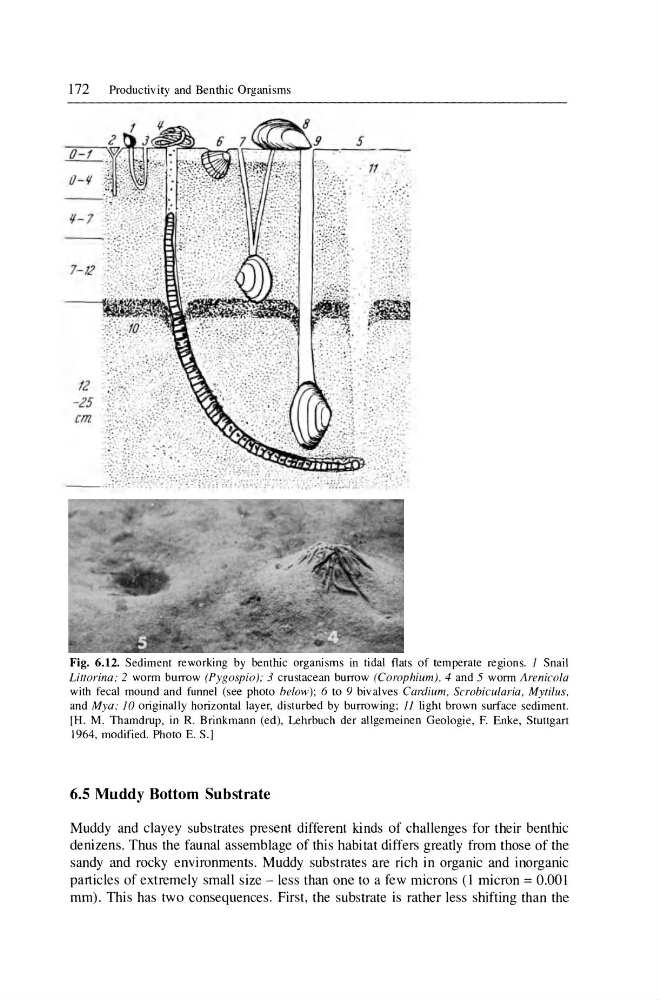
Fig. 6.12. Sediment reworking by benthic organisms in tidal flats of temperate regions. 1 Snail
Littorina: 2 worm burrow (Pygospio); 3 crustacean burrow (Corophium) , 4 and 5 worm Arenicola
with fecal mound and funnel (see photo below); 6 to 9 bivalves Cardium , Scrobicularia , Mylilus,
and Mya: 10 originally horizontal layer, disturbed by burrowing; II light brown surface sediment.
[H. M. Thamdrup, in R. Brinkmann (ed), Lehrbuch der allgemeinen Geologie, F. Enke. Stuttgart
1964, modified. Photo E. S.]
6.5 Muddy Bottom Substrate
Muddy and clayey substrates present different kinds of challenges for their benthic
denizens . Thus the faunal assemblage of this habitat differs greatly from those of the
sandy and rocky environments. Muddy substrates are rich in organic and inorganic
particles of extremely small size - less than one to a few microns (l micron = 0.001
mm). This has two consequences. First, the substrate is rather less shifting than the
5
. 11 .;."' . : .
"
',,'. ,', , ' ,
i ' ; s ' l ~
I
, ~/)!; ; ; t i i ) ;
Fig. 6.12. Sediment reworking by benthic organisms in tidal flats of temperate regions. 1 Snail
Littorina: 2 worm burrow (Pygospio); 3 crustacean burrow (Corophium) , 4 and 5 worm Arenicola
with fecal mound and funnel (see photo below); 6 to 9 bivalves Cardium , Scrobicularia , Mylilus,
and Mya: 10 originally horizontal layer, disturbed by burrowing; II light brown surface sediment.
[H. M. Thamdrup, in R. Brinkmann (ed), Lehrbuch der allgemeinen Geologie, F. Enke. Stuttgart
1964, modified. Photo E. S.]
6.5 Muddy Bottom Substrate
Muddy and clayey substrates present different kinds of challenges for their benthic
denizens . Thus the faunal assemblage of this habitat differs greatly from those of the
sandy and rocky environments. Muddy substrates are rich in organic and inorganic
particles of extremely small size - less than one to a few microns (l micron = 0.001
mm). This has two consequences. First, the substrate is rather less shifting than the