

The Ocean Habitat
165
A
1980
1979
1978
1977
1976
1975
1974
1973
1972
ISOTOP . TEMP . ('C)
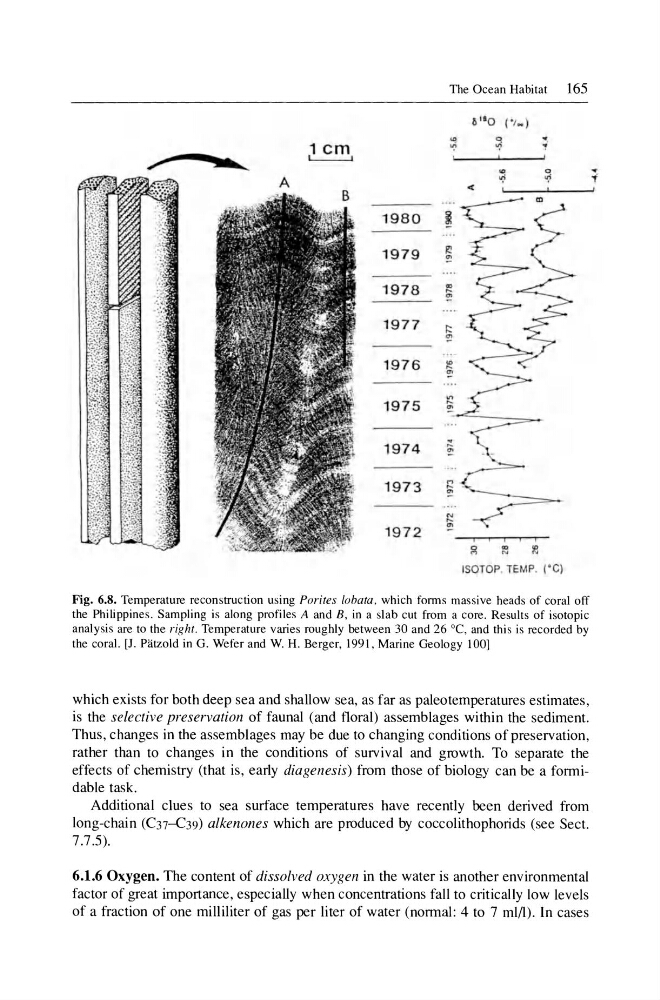
Fig. 6.8. Temperature reconstruction using Porites lobara. which forms massive heads of coral off
the Philippines. Sampling is along profiles A and B, in a slab cut from a core. Results of isotopic
analysis are to the right. Temperature varies roughly between 30 and 26 oc, and this is recorded by
the coral. [J. Ptitzold in G. Wefer and W. H. Berger, 1991, Marine Geology 100]
which exists for both deep sea and shallow sea, as far as paleotemperatures estimates,
is the selective preservation of faunal (and floral) assemblages within the sediment.
Thus, changes in the assemblages may be due to changing conditions of preservation,
rather than to changes in the conditions of survival and growth. To separate the
effects of chemistry (that is, early diagenesis) from those of biology can be a fonnidable task.
Additional clues to sea surface temperatures have recently been derived from
long-chain (C37-C39) alkenones which are produced by coccolithophorids (see Sect.
7.7.5).
6.1.6 Oxygen. The content of dissolved oxygen in the water is another environmental
factor of great importance, especially when concentrations fall to critically low levels
of a fraction of one milliliter of gas per liter of water (nonnal: 4 to 7 ml/l). In cases
165
A
1980
1979
1978
1977
1976
1975
1974
1973
1972
ISOTOP . TEMP . ('C)
Fig. 6.8. Temperature reconstruction using Porites lobara. which forms massive heads of coral off
the Philippines. Sampling is along profiles A and B, in a slab cut from a core. Results of isotopic
analysis are to the right. Temperature varies roughly between 30 and 26 oc, and this is recorded by
the coral. [J. Ptitzold in G. Wefer and W. H. Berger, 1991, Marine Geology 100]
which exists for both deep sea and shallow sea, as far as paleotemperatures estimates,
is the selective preservation of faunal (and floral) assemblages within the sediment.
Thus, changes in the assemblages may be due to changing conditions of preservation,
rather than to changes in the conditions of survival and growth. To separate the
effects of chemistry (that is, early diagenesis) from those of biology can be a fonnidable task.
Additional clues to sea surface temperatures have recently been derived from
long-chain (C37-C39) alkenones which are produced by coccolithophorids (see Sect.
7.7.5).
6.1.6 Oxygen. The content of dissolved oxygen in the water is another environmental
factor of great importance, especially when concentrations fall to critically low levels
of a fraction of one milliliter of gas per liter of water (nonnal: 4 to 7 ml/l). In cases