

a
b
164 Productivity and Benthic Organisms
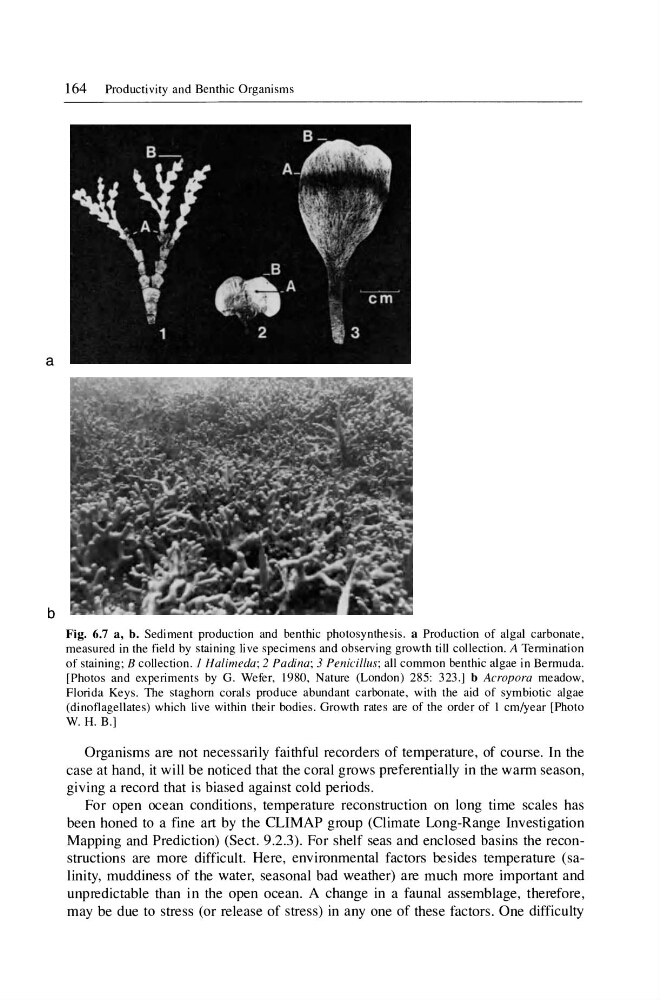
Fig. 6.7 a, b. Sediment production and benthic photosynthesis. a Production of algal carbonate ,
measured in the field by staining live specimens and observing growth till collection. A Termination
of staining; B collection. I Halimeda; 2 Padina; 3 Penicillus; all common benthic algae in Bermuda.
[Photos and experiments by G. Wefer, 1980, Nature (London) 285: 323.] b Acropora meadow,
Florida Keys. The staghorn corals produce abundant carbonate, with the aid of symbiotic algae
(dinoflagellates) which live within their bodies. Growth rates are of the order of I em/year [Photo
W. H. B. ]
Organisms are not necessarily faithful recorders of temperature, of course. In the
case at hand, it will be noticed that the coral grows preferentially in the warm season,
giving a record that is biased against cold periods.
For open ocean conditions, temperature reconstruction on long time scales has
been honed to a fine art by the CLIMAP group (Climate Long-Range Investigation
Mapping and Prediction) (Sect. 9.2.3). For shelf seas and enclosed basins the reconstructions are more difficult. Here, environmental factors besides temperature (salinity, muddiness of the water, seasonal bad weather) are much more important and
unpredictable than in the open ocean. A change in a faunal assemblage, therefore,
may be due to stress (or release of stress) in anyone of these factors. One difficulty
b
164 Productivity and Benthic Organisms
Fig. 6.7 a, b. Sediment production and benthic photosynthesis. a Production of algal carbonate ,
measured in the field by staining live specimens and observing growth till collection. A Termination
of staining; B collection. I Halimeda; 2 Padina; 3 Penicillus; all common benthic algae in Bermuda.
[Photos and experiments by G. Wefer, 1980, Nature (London) 285: 323.] b Acropora meadow,
Florida Keys. The staghorn corals produce abundant carbonate, with the aid of symbiotic algae
(dinoflagellates) which live within their bodies. Growth rates are of the order of I em/year [Photo
W. H. B. ]
Organisms are not necessarily faithful recorders of temperature, of course. In the
case at hand, it will be noticed that the coral grows preferentially in the warm season,
giving a record that is biased against cold periods.
For open ocean conditions, temperature reconstruction on long time scales has
been honed to a fine art by the CLIMAP group (Climate Long-Range Investigation
Mapping and Prediction) (Sect. 9.2.3). For shelf seas and enclosed basins the reconstructions are more difficult. Here, environmental factors besides temperature (salinity, muddiness of the water, seasonal bad weather) are much more important and
unpredictable than in the open ocean. A change in a faunal assemblage, therefore,
may be due to stress (or release of stress) in anyone of these factors. One difficulty