

The Ocean Habitat
159
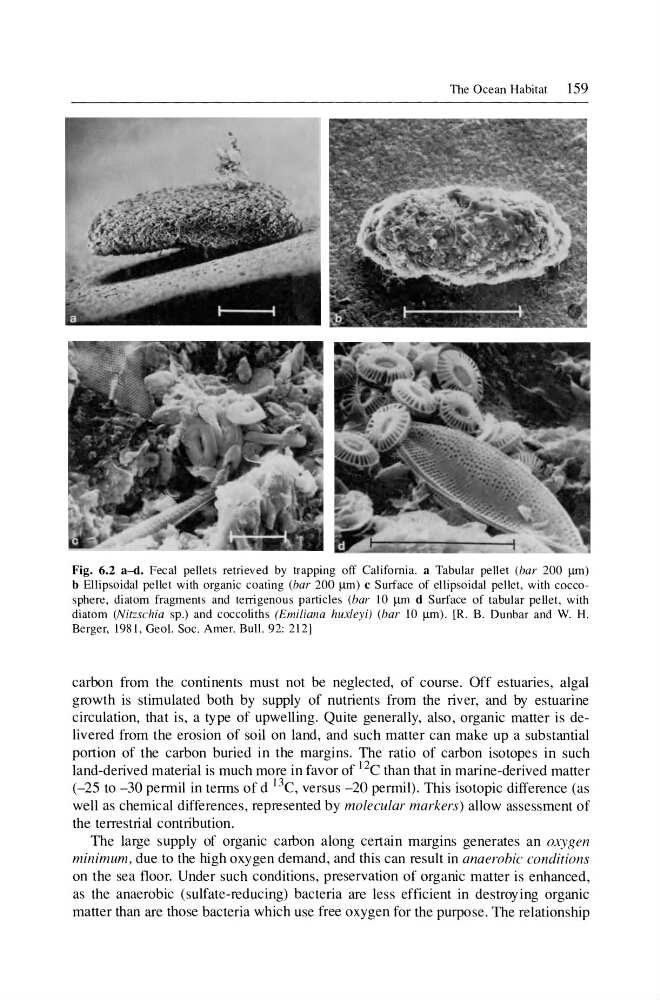
Fig. 6.2 a-d. Fecal pellets retrieved by trapping off California. a Tabular pellet (har 200 11m)
b Ellipsoidal pellet with organic coating (bar 200 Il-m) c Surface of ellipsoidal pellet, with coccosphere, diatom fragments and terrigenous particles (bar 10 Il-m d Surface of tabular pellet, with
diatom (Nitzschia sp.) and coccoliths (Emiliana huxleyi) (har 10 11m) . [R . B. Dunbar and W. H.
Berger, 1981 , Geol. Soc . Amer. Bull. 92: 212]
carbon from the continents must not be neglected, of course. Off estuaries, algal
growth is stimulated both by supply of nutrients from the river. and by estuarine
circulation, that is, a type of upwelling. Quite generally, also, organic matter is delivered from the erosion of soil on land, and such matter can make up a substantial
portion of the carbon buried in the margins. The ratio of carbon isotopes in such
land-derived material is much more in favor of 12C than that in marine-derived matter
(-25 to -30 permil in terms of d 13C , versus -20 permil). This isotopic difference (as
well as chemical differences , represented by molecular markers) allow assessment of
the terrestrial contribution.
The large supply of organic carbon along certain margins generates an oxygen
minimum, due to the high oxygen demand, and this can result in anaerohic conditions
on the sea floor. Under such conditions, preservation of organic matter is enhanced,
as the anaerobic (sulfate-reducing) bacteria are less efficient in destroying organic
matter than are those bacteria which use free oxygen for the purpose. The relationship
159
Fig. 6.2 a-d. Fecal pellets retrieved by trapping off California. a Tabular pellet (har 200 11m)
b Ellipsoidal pellet with organic coating (bar 200 Il-m) c Surface of ellipsoidal pellet, with coccosphere, diatom fragments and terrigenous particles (bar 10 Il-m d Surface of tabular pellet, with
diatom (Nitzschia sp.) and coccoliths (Emiliana huxleyi) (har 10 11m) . [R . B. Dunbar and W. H.
Berger, 1981 , Geol. Soc . Amer. Bull. 92: 212]
carbon from the continents must not be neglected, of course. Off estuaries, algal
growth is stimulated both by supply of nutrients from the river. and by estuarine
circulation, that is, a type of upwelling. Quite generally, also, organic matter is delivered from the erosion of soil on land, and such matter can make up a substantial
portion of the carbon buried in the margins. The ratio of carbon isotopes in such
land-derived material is much more in favor of 12C than that in marine-derived matter
(-25 to -30 permil in terms of d 13C , versus -20 permil). This isotopic difference (as
well as chemical differences , represented by molecular markers) allow assessment of
the terrestrial contribution.
The large supply of organic carbon along certain margins generates an oxygen
minimum, due to the high oxygen demand, and this can result in anaerohic conditions
on the sea floor. Under such conditions, preservation of organic matter is enhanced,
as the anaerobic (sulfate-reducing) bacteria are less efficient in destroying organic
matter than are those bacteria which use free oxygen for the purpose. The relationship