

158 Productivity and Benthic Organisms
I-----------------~
I
PP T
I
I
PHYTOZOO
I
:
PLANKTON
PLANKTON:
I PRIMARY PRODUCTION
SECONDARY PROD.
I
I
FERTILE ZONE
L.- - - - - - -
- - - - - 200 m - J
I
I
__ .-l
I EXTERNAL
INPUT
SEDIMENT
ACCUMULATION
DECAY
RESPIRATION
DECAY
RESPIRATION
OP~STAL
OCE~EAN
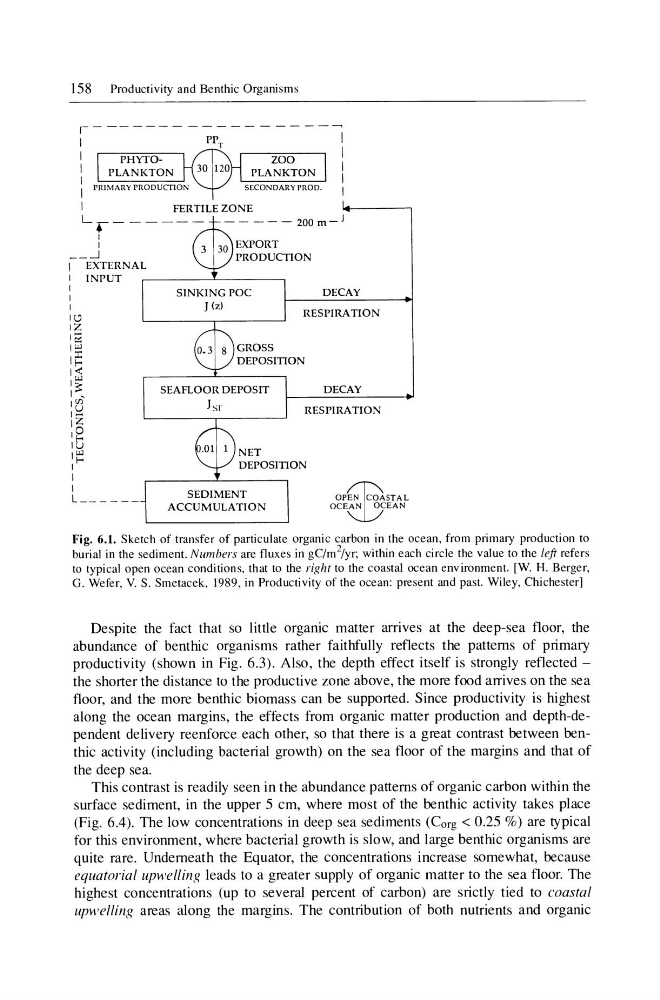
Fig. 6.1. Sketch of transfer Df particulate organic carbon in the ocean, from primary production to
burial in the sediment. Numbers are fluxes in gC/m 2 /yr; within each circle the value to the left refers
to typical open ocean conditions, that to the right to the coastal ocean environment. [W. H. Berger,
G. Wefer, V. S. Smetacek, 1989, in Productivity of the ocean: present and past. Wiley, Chichester]
Despite the fact that so little organic matter arrives at the deep-sea floor, the
abundance of benthic organisms rather faithfully reflects the patterns of primary
productivity (shown in Fig. 6.3). Also, the depth effect itself is strongly reflected -
the shorter the distance to the productive zone above, the more food arrives on the sea
floor, and the more benthic biomass can be supported. Since productivity is highest
along the ocean margins, the effects from organic matter production and depth-dependent delivery reenforce each other, so that there is a great contrast between benthic activity (including bacterial growth) on the sea floor of the margins and that of
the deep sea.
This contrast is readily seen in the abundance patterns of organic carbon within the
surface sediment, in the upper 5 cm, where most of the benthic activity takes place
(Fig. 6.4). The low concentrations in deep sea sediments (Corg < 0.25 %) are typical
for this environment, where bacterial growth is slow, and large benthic organisms are
quite rare. Underneath the Equator, the concentrations increase somewhat, because
equatorial upwelling leads to a greater supply of organic matter to the sea floor. The
highest concentrations (up to several percent of carbon) are srictly tied to coastal
upwelling areas along the margins. The contribution of both nutrients and organic
I-----------------~
I
PP T
I
I
PHYTOZOO
I
:
PLANKTON
PLANKTON:
I PRIMARY PRODUCTION
SECONDARY PROD.
I
I
FERTILE ZONE
L.- - - - - - -
- - - - - 200 m - J
I
I
__ .-l
I EXTERNAL
INPUT
SEDIMENT
ACCUMULATION
DECAY
RESPIRATION
DECAY
RESPIRATION
OP~STAL
OCE~EAN
Fig. 6.1. Sketch of transfer Df particulate organic carbon in the ocean, from primary production to
burial in the sediment. Numbers are fluxes in gC/m 2 /yr; within each circle the value to the left refers
to typical open ocean conditions, that to the right to the coastal ocean environment. [W. H. Berger,
G. Wefer, V. S. Smetacek, 1989, in Productivity of the ocean: present and past. Wiley, Chichester]
Despite the fact that so little organic matter arrives at the deep-sea floor, the
abundance of benthic organisms rather faithfully reflects the patterns of primary
productivity (shown in Fig. 6.3). Also, the depth effect itself is strongly reflected -
the shorter the distance to the productive zone above, the more food arrives on the sea
floor, and the more benthic biomass can be supported. Since productivity is highest
along the ocean margins, the effects from organic matter production and depth-dependent delivery reenforce each other, so that there is a great contrast between benthic activity (including bacterial growth) on the sea floor of the margins and that of
the deep sea.
This contrast is readily seen in the abundance patterns of organic carbon within the
surface sediment, in the upper 5 cm, where most of the benthic activity takes place
(Fig. 6.4). The low concentrations in deep sea sediments (Corg < 0.25 %) are typical
for this environment, where bacterial growth is slow, and large benthic organisms are
quite rare. Underneath the Equator, the concentrations increase somewhat, because
equatorial upwelling leads to a greater supply of organic matter to the sea floor. The
highest concentrations (up to several percent of carbon) are srictly tied to coastal
upwelling areas along the margins. The contribution of both nutrients and organic