

146 Sea Level Processes and Effects of Sea Level Change
REE'S DEAD AND PARTlY [liDDED e ... WAvE S
II." *"WLI
----------------- -------------------MI-/110. 1 -
3
5
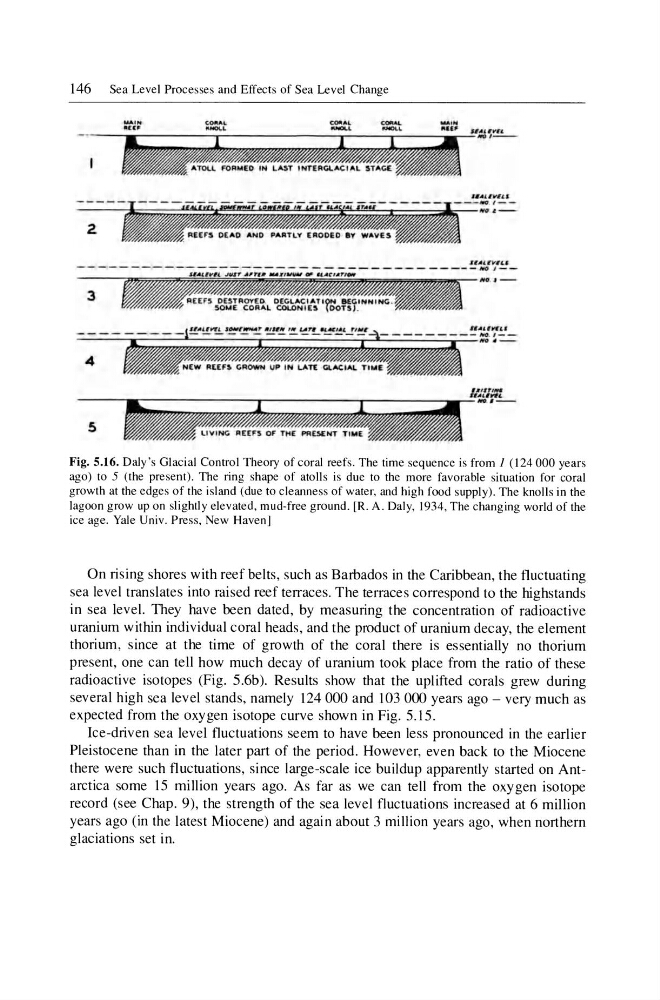
Fig. 5.16. Daly's Glacial Control Theory of coral reefs. The time sequence is from 1 (124000 years
ago) to 5 (the present). The ring shape of atolls is due to the more favorable situation for coral
growth at the edges of the island (due to cleanness of water, and high food supply). The knolls in the
lagoon grow up on slightly elevated, mud-free ground. [R . A. Daly, 1934, The changing world of the
ice age. Yale Univ. Press, New Haven]
On rising shores with reef belts, such as Barbados in the Caribbean, the fluctuating
sea level translates into raised reef terraces. The terraces correspond to the highstands
in sea level. They have been dated, by measuring the concentration of radioactive
uranium within individual coral heads, and the product of uranium decay, the element
thorium, since at the time of growth of the coral there is essentially no thorium
present, one can tell how much decay of uranium took place from the ratio of these
radioactive isotopes (Fig. S.6b). Results show that the uplifted corals grew during
several high sea level stands, namely 124000 and 103000 years ago - very much as
expected from the oxygen isotope curve shown in Fig. 5.15.
Ice-driven sea level fluctuations seem to have been less pronounced in the earlier
Pleistocene than in the later part of the period. However, even back to the Miocene
there were such fluctuations, since large-scale ice buildup apparently started on Antarctica some 15 million years ago. As far as we can tell from the oxygen isotope
record (see Chap. 9), the strength of the sea level fluctuations increased at 6 million
years ago (in the latest Miocene) and again about 3 million years ago, when northern
glaciations set in.
REE'S DEAD AND PARTlY [liDDED e ... WAvE S
II." *"WLI
----------------- -------------------MI-/110. 1 -
3
5
Fig. 5.16. Daly's Glacial Control Theory of coral reefs. The time sequence is from 1 (124000 years
ago) to 5 (the present). The ring shape of atolls is due to the more favorable situation for coral
growth at the edges of the island (due to cleanness of water, and high food supply). The knolls in the
lagoon grow up on slightly elevated, mud-free ground. [R . A. Daly, 1934, The changing world of the
ice age. Yale Univ. Press, New Haven]
On rising shores with reef belts, such as Barbados in the Caribbean, the fluctuating
sea level translates into raised reef terraces. The terraces correspond to the highstands
in sea level. They have been dated, by measuring the concentration of radioactive
uranium within individual coral heads, and the product of uranium decay, the element
thorium, since at the time of growth of the coral there is essentially no thorium
present, one can tell how much decay of uranium took place from the ratio of these
radioactive isotopes (Fig. S.6b). Results show that the uplifted corals grew during
several high sea level stands, namely 124000 and 103000 years ago - very much as
expected from the oxygen isotope curve shown in Fig. 5.15.
Ice-driven sea level fluctuations seem to have been less pronounced in the earlier
Pleistocene than in the later part of the period. However, even back to the Miocene
there were such fluctuations, since large-scale ice buildup apparently started on Antarctica some 15 million years ago. As far as we can tell from the oxygen isotope
record (see Chap. 9), the strength of the sea level fluctuations increased at 6 million
years ago (in the latest Miocene) and again about 3 million years ago, when northern
glaciations set in.